Locations:





Revitalized research program gets infusions of staff and dollars
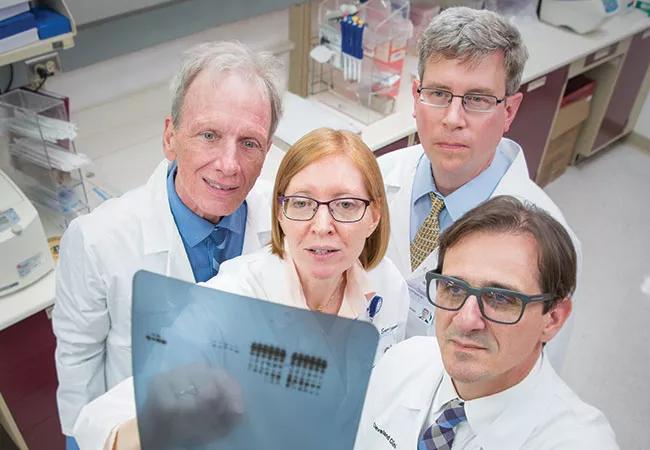
Image content: This image is available to view online.
View image online (https://assets.clevelandclinic.org/transform/016b437d-db4c-4c0d-9d98-996163647f77/650x450-Poggio-Bruggeman-Sedor-OToole-Kidney-Research-Disease_jpg)
650×450-Poggio-Bruggeman-Sedor-OToole-Kidney-Research-Disease
The addition of distinguished researchers John Sedor, MD; Leslie Bruggeman, PhD; and John O’Toole, MD, to the Glickman Urological & Kidney Institute research team has brought renewed vitality and $3.5 million in National Institutes of Health grants for projects aimed at improving the understanding of chronic renal disease.
Advertisement
Cleveland Clinic is a non-profit academic medical center. Advertising on our site helps support our mission. We do not endorse non-Cleveland Clinic products or services. Policy
“We are aiming to answer the big questions: Why kidney disease disproportionately affects minorities, and what drives it in patients with diabetes and hypertension,” says Dr. Sedor.
“Answers are needed to round out the big picture and help us develop more effective treatments for patients with kidney disease.”
More than 40 million U.S. adults suffer from chronic kidney disease (CKD). Not all progress to end-stage kidney disease (ERSD), but 35 percent of those who do are African-American.
“It’s a major cause of health inequality,” Dr. Sedor continues. “It’s also an enormous burden on our healthcare system, since the federal government pays for dialysis and kidney transplantation for more than 600,000 patients with ERSD every year. The cost eats up 7 percent of the Medicare budget, yet involves less than 1 percent of Medicare beneficiaries, and outcomes and quality of life remain poor.”
Several years ago, APOL1 was identified as the gene associated with increased frequency of chronic and progressive kidney disease in African-Americans. About 15 percent of this population carry the gene.
Drs. Sedor, Bruggeman and O’Toole are taking a multipronged approach to studying APOL1 using several genetic model systems and also investigating the gene’s role in HIV-associated kidney disease. With colleagues Emilio Poggio, MD; Ziad Zaky, MD; and Jesse Schold, PhD, they are examining the impact of genetic variants in the APOL1 gene on outcomes of kidney transplant patients.
“There is some information suggesting kidney recipients from donors with this gene may be at increased risk of developing kidney disease,” says Dr. Poggio, Director, Renal Function Lab, and this is another research area.
Advertisement
Drs. Sedor and O’Toole’s arrival and collaboration with Dr. Poggio puts Cleveland Clinic in the spotlight as one of a select number of U.S. institutions involved in the National Institute of Diabetes & Digestive & Kidney Diseases (NIDDK) Kidney Precision Medicine Project (KPMP).
KPMP aims to evaluate human kidney biopsies from participants with acute kidney injury or CKD, create a kidney tissue atlas, define disease subgroups and identify critical cells, pathways and targets for novel therapies.
“We are borrowing approaches that were successful in cancer and applying them to kidney disease,” he continues. “Significant advances in cancer care were made possible through the availability of tissue for study. Similarly, we will be conducting kidney biopsies to obtain tissues that can be studied with state-of-the-art methods to better understand the processes that drive kidney diseases in patients with diabetes and hypertension.”
“We don’t yet understand which patients with CKD are going to progress to ESRD and which ones are not. Our goal is to identify whose disease will worsen early on,” says Dr. Sedor. “Our ultimate goal is to offer the best treatment for an individual patient delivered at the right time with the right drugs.
“Cleveland Clinic offers a large patient volume, high-quality research facilities and outstanding scientists available for collaboration, making it an ideal location for this work,” says Dr. Sedor.
Advertisement
Advertisement
Clinicians should individualize dosing practices based on patient risk factors and preferences
Pioneering and refining the approach in pyeloplasty, nephrectomy and more
Fully-automated process uses preop CT, baseline GFR to estimate post-nephrectomy renal function
Could mean earlier treatment, but also could have negative effects

Unlike earlier pills, new drugs do not cause liver toxicity
Male factors play a role in about half of all infertility cases, yet men often are not evaluated
Surgeons choreograph nearly simultaneous procedures, sharing one robot between two patients

Identifying barriers in the renal genetic assessment of Black patients
 Search