Locations:





Surgical treatment should be considered in severe cases

Image content: This image is available to view online.
View image online (https://assets.clevelandclinic.org/transform/4f99333d-500b-4e69-a661-eb65061e06ca/15-URL-2250-Montague-Hero-Image-690x380pxl-V02-e1448732645480_jpg)
15-URL-2250-Montague-Hero-Image-690x380pxl-V02
Advertisement
Cleveland Clinic is a non-profit academic medical center. Advertising on our site helps support our mission. We do not endorse non-Cleveland Clinic products or services. Policy
Peyronie disease is the presence of a plaque or scar in the penis, resulting in erectile deformity. It occurs in as many as 9 percent of middle-aged men.
Peyronie disease occurs at a time in a man’s life when erectile rigidity, while suitable for vaginal intromission, is reduced — for example 7 on a scale of 10 rather than the normal 10/10 rigidity of a young man’s erection.
Even this decreased degree of rigidity is not always maintained throughout coitus. This subjects the penis to bending forces during thrusting, which can lead to delaminating injuries of the elastic tunica albuginea covering the erectile chambers. Healing of these injuries results in inelastic scar (plaque), which causes shortening of the erection as well as bending or hour-glass deformities.
The most common deformity is erectile curvature, which can be so severe that coitus is not possible. The goal of treatment is to straighten the penis and to enable an erection rigid enough that further injury is unlikely. In addition to assessing the degree of deformity, we evaluate the patient’s ability to attain and maintain an erection.
Patients may be prescribed a trial course of a PDE5 inhibitor (sildenafil, vardenafil, or tadalafil) to determine if it produces firmer, better maintained erections. If the patient responds, we often recommend a tunica albuginea plication (TAP) surgical procedure, which shortens the normal side of the penis opposite the point of maximum curvature. The advantage of this corrective procedure is that worsening of underlying erectile dysfunction (ED) is unlikely.
Advertisement
Many men would like to have a straight penis and regain lost penile length. Regaining some lost length is possible through surgical procedures that straighten the penis by incising or removing penile plaque and placing a tissue graft. Unfortunately, these grafting procedures can worsen erectile function in nearly 50 percent of patients.
In men with ED who do not respond to PDE5 inhibitors, we often advise implantation of an inflatable penile prosthesis. This operation, along with modeling or bending of the penis with the cylinders inflated while the patient is under anesthesia, results in a straight penis with a 10/10 prosthetic erection, which will prevent further injury.
In summary, if coitus is difficult or impossible due to Peyronie disease, surgical treatment should be considered. Goals in treatment should be to provide a straight penis with sufficient rigidity to prevent further injuries.
Dr. Montague is Director of the Center for Genitourinary Reconstruction and Associate Director of the Urology Residency Program in Cleveland Clinic’s Glickman Urological & Kidney Institute. He is also Professor of Surgery at Cleveland Clinic Lerner College of Medicine.
Advertisement
Advertisement
OMT may be right for some with Graves’ eye disease
Perserverance may depend on several specifics, including medication type, insurance coverage and medium-term weight loss

Integrate climate-related health information and counseling into your practice
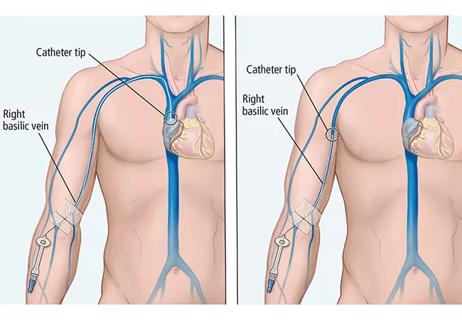
Physicians discuss a specific case example, and PICC pros, cons and alternatives

A snapshot of the 2020 GINA report

A review of available interventions
Abstinence from combustibles, dependence on vaping
An historical view of the disease
 Search