Locations:





Protocol promises to shape patient satisfaction, hospital resource utilization
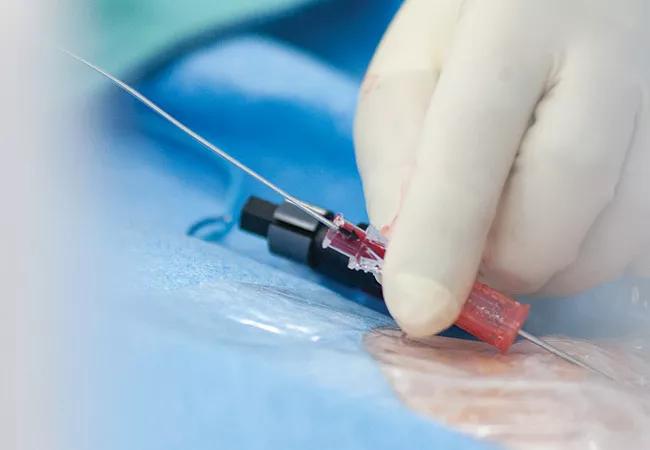
Image content: This image is available to view online.
View image online (https://assets.clevelandclinic.org/transform/a385956d-f5eb-4dbd-b36c-8f06ba98d979/22-HVI-2918751-TAVR_650x450_jpg)
22-HVI-2918751 TAVR_650x450
A retrospective analysis of patients undergoing transfemoral-approach transcatheter aortic valve replacement (TAVR) at Cleveland Clinic in 2019 and 2020 found that in-hospital and 30-day outcomes were similar with same-day discharge (SDD) and next-day discharge when SDD patients met predefined criteria.
Advertisement
Cleveland Clinic is a non-profit academic medical center. Advertising on our site helps support our mission. We do not endorse non-Cleveland Clinic products or services. Policy
“We demonstrated that patients can be candidates for same-day discharge if TAVR is performed without major complications and there is no evidence of post-procedural stroke, vascular site issues or conduction system abnormalities that would require further observation,” says Amar Krishnaswamy, MD, Section Head of Invasive and Interventional Cardiology at Cleveland Clinic. He is the first author of the study, which was published in JACC: Cardiovascular Interventions (2022;15[6]:575-589).
Same-day discharge is a standard protocol for outpatients undergoing percutaneous coronary intervention (PCI). About 50% of PCI patients at Cleveland Clinic are discharged on the day of their procedure. However, the applicability of SDD for patients undergoing outpatient TAVR (i.e., performed on the day of admission) has been explored only more recently — specifically in early 2020.
“We developed our same-day discharge protocol for appropriate patients undergoing transfemoral TAVR before the start of the COVID-19 pandemic, but the pandemic made it more relevant and necessary because hospitals needed to preserve beds for patients with COVID-19 and government was limiting which patients could be hospitalized,” says study co-author Samir Kapadia, MD, Chair of Cardiovascular Medicine at Cleveland Clinic.
“Even though our adoption of the protocol coincided fairly closely with the pandemic,” adds Dr. Krishnaswamy, “I believe same-day discharge was an inevitability. It just makes sense for patient convenience and comfort, for maximizing hospital-based resources for patients who need them most, and for minimizing inpatient risks — especially for elderly patients.”
Advertisement
Importantly, Cleveland Clinic had already become facile with the use of a next-day discharge pathway for TAVR and had the infrastructure for SDD in place. This served to simplify transfer of the protocol from one pathway to another.
“The assessments we needed for SDD patients were already being made,” Dr. Krishnaswamy explains. “The pathway was operating like a well-oiled machine thanks to established coordination among all its stakeholders, from the operators to the advanced practice providers to the bedside nurses.”
Cleveland Clinic implemented the post-TAVR SDD pathway in early 2020. That year, 22.1% of outpatient transfemoral TAVR cases were SDD cases (114 of 516). No significant differences were observed in in-hospital events or 30-day readmissions for cardiovascular or noncardiovascular reasons between SDD cases in 2020 and their next-day discharge counterparts in 2019 (N = 481). The outcomes were similar after propensity score matching. There were no deaths after SDD, and only one SDD patient required pacemaker implantation (on day 25 post-TAVR).
The frequency of SDD has increased to 29% of all transfemoral TAVR cases in 2021 and 42% of all transfemoral TAVR cases so far in 2022.
To be considered for SDD, TAVR patients must meet six criteria. In addition to procedural characteristics and outcomes, these criteria include patient comfort with the idea of going home the same day and the availability of social support after discharge.
After the procedure, SDD candidates are observed for six hours and monitored with continuous telemetry and a formal transthoracic echocardiogram. If the operator, bedside team and patient agree that SDD is safe and appropriate, discharge will occur before 7 p.m. The patient returns for an outpatient checkup and ECG on post-TAVR day 1 or 2.
Advertisement
Patients who do not meet all criteria for SDD but are in stable condition without need for further observation beyond an overnight stay are typically discharged the next day.
“Patient preference is a very important factor, assuming the care team believes same-day discharge is medically appropriate,” says Dr. Krishnaswamy. “If we don’t believe it’s appropriate, or if the patient is not comfortable going home, we keep them overnight.”
For centers considering establishment of a post-TAVR SDD protocol, Dr. Krishnaswamy recommends being clearheaded about their TAVR outcomes. “If a center has a higher-than-average rate of pacemaker implantation or stroke rate, particularly in the first 24 to 48 hours after TAVR, it may not be an appropriate center for SDD,” he says.
For centers with the experience and expertise needed to implement SDD, the fact that a separate multicenter study published in the same issue of JACC: Cardiovascular Interventions achieved similar results further supports the validity of the approach.
“If you take the two analyses together,” Dr. Krishnaswamy says, “they suggest that the applicability of a same-day discharge pathway to well-conducted TAVR procedures is significant and could make a difference in patient satisfaction and hospital resource utilization.” He speculates that SDD might even help reduce the frequency of post-TAVR delirium in elderly patients, although that hypothesis would require more rigorous investigation.
“The concept behind same-day discharge is to create a better patient experience and conserve resources without compromising safety,” Dr. Kapadia adds. “This requires a TAVR center to consider the specific needs of the patient, the procedure and systems.”
Advertisement
Success with post-TAVR SDD has prompted Cleveland Clinic to explore additional uses for the protocol. “The granular data insights we obtained in this trial have given us confidence to apply the same pathway to patients undergoing percutaneous mitral valve repair with MitraClip™ and transcatheter mitral valve-in-valve replacement. We are using similar criteria and achieving a similar safety profile in these areas,” Dr. Krishnaswamy says.
Advertisement
Advertisement
A sampling of outcome and volume data from our Heart & Vascular Institute
Concomitant AF ablation and LAA occlusion strongly endorsed during elective heart surgery
Large retrospective study supports its addition to BAV repair toolbox at expert centers
Young age, solid tumor, high uptake on PET and KRAS mutation signal risk, suggest need for lobectomy
Surprise findings argue for caution about testosterone use in men at risk for fracture
Residual AR related to severe preoperative AR increases risk of progression, need for reoperation
Findings support emphasis on markers of frailty related to, but not dependent on, age
Provides option for patients previously deemed anatomically unsuitable
 Search