Locations:





Patients get to choose incision site
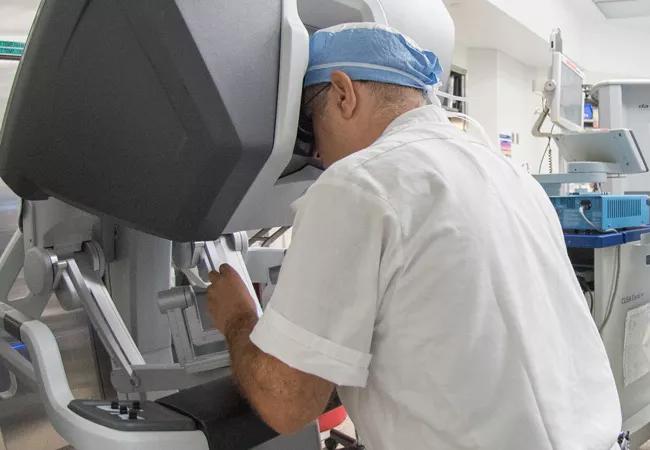
Image content: This image is available to view online.
View image online (https://assets.clevelandclinic.org/transform/b8e19964-0352-4cb9-9c2e-ea5756dd2cdf/Berber_650x450_jpg)
Berber_650x450
Few surgical scars announce themselves as prominently as that of thyroidectomy: The transverse incision across the anterior of the neck may be highly visible in some patients. This cosmetic outcome can affect patients’ quality of life, and for some patients, the scar itself can become a burden causing pruritus, pain, burning, tightening or adhesions. While conventional thyroidectomy (CT) is the standard of care, today’s engaged patients want to prevent that scar and its potential complications.
Advertisement
Cleveland Clinic is a non-profit academic medical center. Advertising on our site helps support our mission. We do not endorse non-Cleveland Clinic products or services. Policy
To meet this growing patient need, Cleveland Clinic’s Center for Endocrine Surgery offers several robotic thyroidectomy options. Using surgical robotic systems, surgeons can place the incision, and its resultant scar, in one of two less visible locations: transaxillary (armpit) or the newest, transoral (inside the mouth).
“There are definite benefits with the robot,” says Eren Berber, MD, Director of Robotic Endocrine Surgery at Cleveland Clinic. “For the patient, the cosmetic result is more satisfactory compared to a neck incision. For the surgeon, the robot provides a 3-dimensional view plus 360-degree rotation of the wristed instruments and the camera magnifies by 10. Plus, we don’t need to use gas. The safety and efficacy of this approach have been established and are the same as CT when performed on eligible patients by expert surgeons.” Eligible patients include those who have smaller glands; who are not obese; and who do not have Graves’ disease, extensive cancer or an inflamed gland with thyroiditis.
“We are one of the few academic centers in the United States doing this work,” says Dr. Berber, who authored an American Thyroid Association Statement on robotic thyroidectomy. “The traditional approach with that scar is not acceptable to some of our patients. They’re looking on the internet for options.” That’s how one woman, we’ll call her Jane, found Dr. Berber.
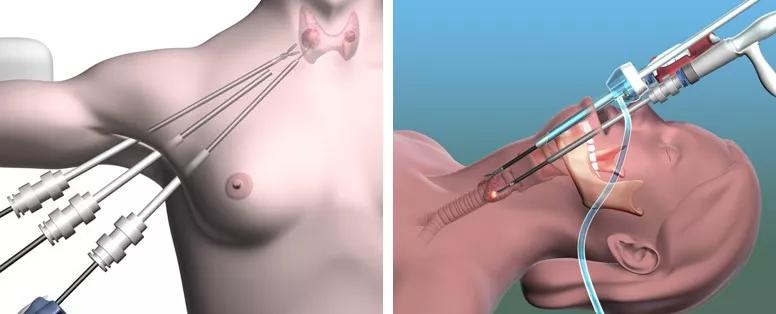
Image content: This image is available to view online.
View image online (https://assets.clevelandclinic.org/transform/cbc3ebd5-5c65-4135-b410-26d371f1bf6b/post-image_jpg)
Cleveland Clinic surgeons offer robotic thyroidectomy using two different approaches. Image one is transaxillary and image two is transoral.
Advertisement
Jane, a 21-year-old female, was diagnosed with a toxic thyroid nodule that was causing hyperthyroidism in August 2016; surgery was indicated. Because Jane had a history of bad scarring—she developed scars from even minor traumas, she was reluctant to have CT and began looking online for options. That’s where she found one of Dr. Berber’s associates who referred her for the robotic approach. After initial consultation, Dr. Berber explains what happened:
“We took her into the operating room in December 2016 to remove the toxic nodule. Using the transaxillary approach, we robotically removed the right lobe of the thyroid, which had a 2.5-centimeter toxic nodule, leaving the left lobe intact. Pathology found no cancer. The 5-centimeter incision hidden in her armpit is similar in size to what the incision in her neck would have been. There were no complications. She spent one night in the hospital. At follow-up two weeks later, she was doing well. She had no symptoms, the hyperthyroidism had resolved. She is back under the care of her endocrinologist. It has been more than six months now and she is very happy that the surgery was able to be performed without an incision on her neck”
For information about robotic thyroidectomy, Dr. Berber can be reached at 216.445.6568.
Advertisement
Advertisement
Radiofrequency ablation significantly reduces symptom severity, shrinks nodules

Maternal-fetal medicine specialists, endocrinologists and educators team up

Giving young patients a hand as they take charge of their own health

Case illustrates how easily condition can mimic preeclampsia
Analysis examines surgical resection of rare pituitary tumors
Screening and medication key to better outcomes
Spinal cord stimulation can help those who are optimized for success
Incidence, outcomes and management
 Search