Locations:





 Search
Study findings have treatment, policy implications
Image content: This image is available to view online.
View image online (https://assets.clevelandclinic.org/transform/433b9e30-67cf-4341-8f9e-c40c73a4120e/15-URL-073-Goldman-Hero-Image-690x380pxl_jpg)
15-URL-073 Goldman Hero Image 690x380pxl
By Howard Goldman, MD, and Javier Pizarro-Berdichevksy, MD
Advertisement
Cleveland Clinic is a non-profit academic medical center. Advertising on our site helps support our mission. We do not endorse non-Cleveland Clinic products or services. Policy
Knowledge of baseline risk factors for progression of pelvic organ prolapse (POP) can be used to help symptomatic women make treatment decisions. Unfortunately, data on progression of POP in symptomatic women are minimal.
Working with colleagues at the Sotero del Rio Hospital and the Pontificia Universidad Catolica of Santiago, Chile, and those in Cleveland Clinic Department of Urology’s Center for Female Pelvic Medicine and Reconstructive Surgery, we prospectively describe the natural evolution of POP in this group of patients, comparing the patients who developed progression with those who did not, and evaluating risk factors for progression.
We evaluated a prospective cohort of patients treated between 2008 and 2013. Women with symptomatic POP having two or more POP-Q examinations (a measure of degree of prolapse) during follow-up (still awaiting surgery or prior to surgery) were included. We defined changes of ≥ ± 2 cm in the POP-Q measurements of either points Ba, C or Bp (anterior, apical or posterior compartments) between initial and follow-up examinations as clinically significant. We analyzed risk factors for progression for both groups.
A total of 392 patients met the inclusion criteria. With a median follow-up of nine months, 47.5 percent of patients progressed (meaning prolapse worsened), 8.7 percent regressed and 43.8 percent did not change. Same-compartment progression was observed in 29.4 percent, 7.1 percent and 23 percent in the anterior, posterior and apical compartments, respectively. When the leading edge was the anterior compartment, 74 percent of the progressions involved the apical compartment.
Advertisement
We performed a baseline comparison between nonprogression (N = 206) and progression (N = 186). The groups were statistically significantly different at baseline in regard to the degree of anterior compartment descent and the presence of the leading edge of prolapse beyond the hymen (72.8 percent vs. 81.7 percent). There were no differences in terms of apical prolapse. More severe anterior POP and leading edge beyond the hymen were the only baseline factors that were associated with a statistically higher risk of progression.
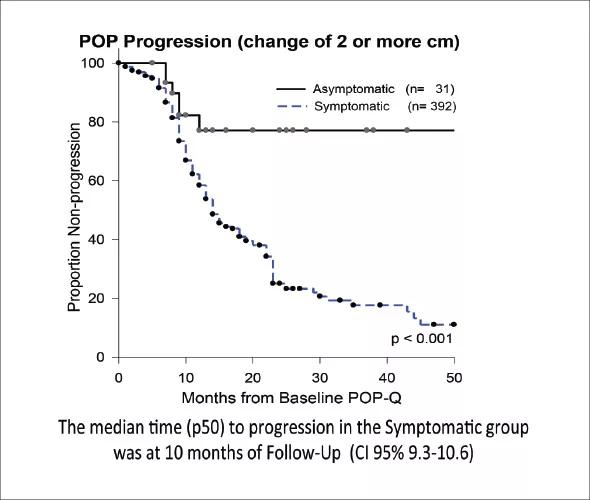
Image content: This image is available to view online.
View image online (https://assets.clevelandclinic.org/transform/dfe62d92-7495-4306-8666-9a7e54db8be0/15-URL-073-Goldman-Inset-Figure-01-590pxl-width_jpg)
Figure 1. Pelvic organ prolapse progression in symptomatic and asymptomatic patients.
We performed a multiple logistic regression analysis including the following variables for POP progression:
The only variable that was statistically significant was leading edge beyond the hymen at baseline, which demonstrated a twofold increase in risk of progression.
In summary, our research has demonstrated that almost 50 percent of women with symptomatic POP who are actively seeking treatment will have prolapse progression within a year. This information can be used to counsel symptomatic women regarding the chance that their POP will worsen. It also has public policy implications, given the increasing number of women at risk for POP as the baby boomer generation ages. In the coming decades, treatment of POP in this population will require increased resources and trained professionals.
Dr. Goldman is a staff member of Cleveland Clinic Glickman Urological & Kidney Institute’s Department of Urology. He is also the Urological & Kidney Institute’s Vice Chair for Quality and Patient Safety, and a Professor of Medicine at Cleveland Clinic Lerner College of Medicine.
Advertisement
At the time this article was written, Dr. Pizarro-Berdichevksy was a clinical fellow in the Department of Urology.
Advertisement
Advertisement

Clinicians should individualize dosing practices based on patient risk factors and preferences
Pioneering and refining the approach in pyeloplasty, nephrectomy and more
Fully-automated process uses preop CT, baseline GFR to estimate post-nephrectomy renal function

Could mean earlier treatment, but also could have negative effects

Unlike earlier pills, new drugs do not cause liver toxicity

Male factors play a role in about half of all infertility cases, yet men often are not evaluated

Surgeons choreograph nearly simultaneous procedures, sharing one robot between two patients

Identifying barriers in the renal genetic assessment of Black patients