Locations:





Large study carries implications for timing of surgical repair
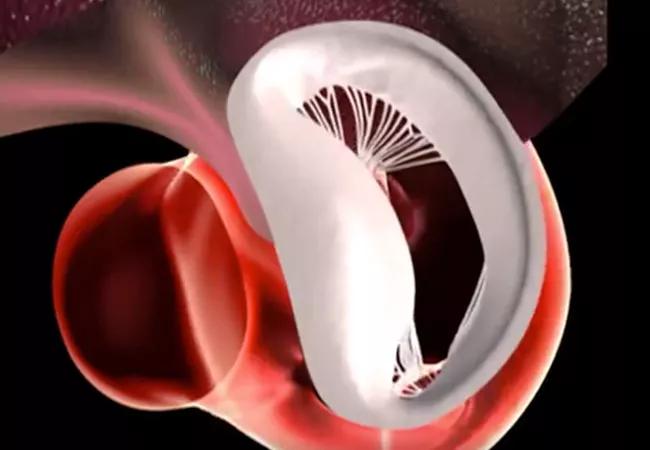
Image content: This image is available to view online.
View image online (https://assets.clevelandclinic.org/transform/e9cad748-33dd-4f90-b310-4825937fdad6/16-HRT-1149-DesaiJACC-CQD-650x450_jpg)
mitral valve regurgitation
Elevated right ventricular systolic pressure (RVSP) is independently associated with worse long-term survival in patients with primary mitral regurgitation (MR) and preserved left ventricular ejection fraction (LVEF), a large observational cohort study has shown. The study’s findings suggest that RVSP may play a role in guiding the timing of surgical intervention for patients with primary MR.
Advertisement
Cleveland Clinic is a non-profit academic medical center. Advertising on our site helps support our mission. We do not endorse non-Cleveland Clinic products or services. Policy
“In patients with severe mitral regurgitation who have minimal or no symptoms, it’s often a challenge to time surgery based on LVEF alone,” says corresponding author Milind Desai, MD, a cardiologist in Cleveland Clinic’s Section of Cardiovascular Imaging and Professor of Medicine at Cleveland Clinic Lerner College of Medicine. “We designed our study to determine whether baseline resting RVSP provides incremental prognostic usefulness in a large contemporary group of patients with significant primary mitral regurgitation and preserved LVEF.”
The study, published in the June 28, 2016, issue of Journal of the American College of Cardiology, retrospectively analyzed data on all patients with primary myxomatous MR evaluated at Cleveland Clinic between 2005 and 2008. Of these patients, 1,318 met the primary inclusion criteria of having an initial resting echocardiogram demonstrating ≥ 3+ primary MR and an LVEF ≥ 60 percent.
These patients’ mean Society of Thoracis Surgeons (STS) score was 3.98 ± 1 percent. Eighty-five percent were in New York Heart Association (NYHA) functional class I or II; 18 percent had atrial fibrillation. Overall, 86 percent of the cohort underwent mitral valve surgery during the study’s follow-up period, typically soon after the baseline echocardiogram (median of five days).
At mean follow-up of 7.1 ± 2.0 years, the study’s primary outcome of death from any cause occurred in 130 patients (10 percent). Multivariable survival analysis for the primary outcome revealed the following key findings:
Advertisement
“This study shows that, in addition to established risk factors, a higher baseline resting RVSP is significantly and independently associated with shorter long-term survival in patients with significant primary regurgitation and preserved LVEF,” says Dr. Desai. He identifies previously established risk factors as age, coronary artery disease, atrial fibrillation, NYHA class and LV dimensions.
“In addition to showing that mitral valve surgery is associated with long-term freedom from death, we found that adding baseline RVSP and mitral valve surgery provides incremental prognostic value to standard clinical predictors,” he adds.
Dr. Desai observes that this new analysis is much larger than previous studies of this issue, with much longer follow-up. He says it’s also notable because its patients, 85 percent of whom where in NYHA classes I or II, reflect “a much less sick population, in whom indirect predictors like RVSP might offer greater usefulness. We confirmed that the impact of RVSP is progressive and not limited to patients with the highest baseline values.”
Although Dr. Desai is quick to note that these observational findings require prospective replication, he says they should prompt closer scrutiny of optimal timing of mitral valve repair surgery in this population. “It appears that even mild RVSP elevation — 35 mm Hg or above — might be a marker of early decompensation,” he notes. “As a result, waiting for RVSP to progress to 50 mm Hg or more before offering mitral valve repair could have negative prognostic implications. This demands further study.”
Advertisement
Advertisement

A sampling of outcome and volume data from our Heart & Vascular Institute

Concomitant AF ablation and LAA occlusion strongly endorsed during elective heart surgery

Large retrospective study supports its addition to BAV repair toolbox at expert centers

Young age, solid tumor, high uptake on PET and KRAS mutation signal risk, suggest need for lobectomy

Surprise findings argue for caution about testosterone use in men at risk for fracture

Residual AR related to severe preoperative AR increases risk of progression, need for reoperation

Findings support emphasis on markers of frailty related to, but not dependent on, age

Provides option for patients previously deemed anatomically unsuitable
 Search