Locations:





Many patients report improved symptoms after surgery

Image content: This image is available to view online.
View image online (https://assets.clevelandclinic.org/transform/8e6b6293-e6cc-4b5b-a3a0-6d966d245da0/Mayer-690x380_jpg)
Mayer-690×380
Advertisement
Cleveland Clinic is a non-profit academic medical center. Advertising on our site helps support our mission. We do not endorse non-Cleveland Clinic products or services. Policy
Both conventional wisdom and the current literature support the notion that mental health distress is a negative prognostic indicator for patients undergoing surgery or interventional procedures for spinal disorders. Yet several years of outcomes tracking in Cleveland Clinic’s Center for Spine Health are turning that conventional wisdom on its head.
We are finding consistently that treatments for spinal disease have meaningful effects on depression and other forms of mental health distress. Specifically, our outcomes monitoring shows that the presence of reactive mental changes with impaired function and pain in patients who are otherwise good candidates for spine surgery does not prevent these patients from achieving clinically meaningful improvement in mental health distress scores ‒ improvement that mirrors their functional improvement.
For instance, among patients with at least moderate depressive symptoms prior to treatment for their spine disease:
66% noted improvement in depressive symptoms following lumbar diskectomy for disk herniation (N = 67)
71% noted improvement in depressive symptoms following lumbar decompression with fusion for spinal stenosis (N = 42)
65% noted improvement in depressive symptoms following lumbar decompression without fusion for spinal stenosis (N = 46)
64% noted improvement in depressive symptoms following lumbar spinal injections for disk herniation (N = 22)
In all cases above, moderate depressive symptoms were defined as a score greater than 9 on the Patient Health Questionnaire-9 (PHQ-9), and improvement was defined as clinically meaningful improvement ‒ i.e., a change of 5 points or more on the PHQ-9. Outcomes are for patients managed over 12- to 16-month periods from late 2012 through early 2014; mean follow-up ranged from 125 to 203 days, depending on the condition and intervention.
Advertisement
These rates of improvement in depressive symptoms actually slightly exceeded rates of self-reported functional improvement and generally mirrored rates of improvement in health-related quality of life.
These findings about mental health outcomes in patients with spinal disease are in keeping with our findings from previous years, which have prompted an ongoing prospective research study in the Center for Spine Health. We look forward to continued reporting of our results in this area ‒ and the potential to perhaps change conventional wisdom on this aspect of spine medicine.
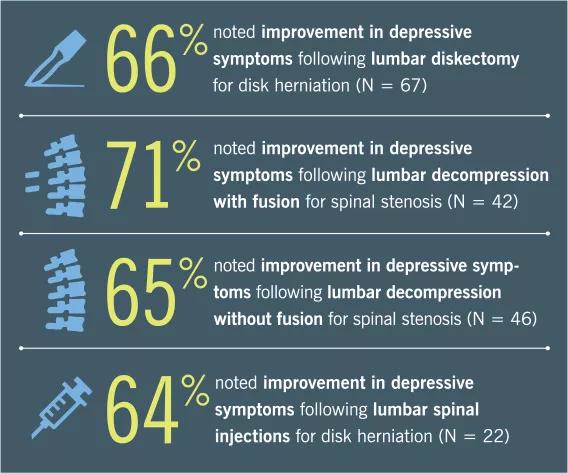
Image content: This image is available to view online.
View image online (https://assets.clevelandclinic.org/transform/1e6ad210-0d2c-4379-b21e-4feb174b2f51/Mayer-figure_jpg)
The outcomes tracking efforts profiled here are part of Cleveland Clinic’s broad Outcomes book initiative, under which the health system has published annual Outcomes books for more than a dozen of its institutes since 2007. The aim is to promote transparency and continuous quality improvement.
For more outcomes from the Center for Spine Health and Cleveland Clinic’s Neurological Institute at large, see the 2013 Neurological Institute Outcomes book at clevelandclinic.org/outcomes.
E. Kano Mayer, MD, is a medical and interventional spine specialist in the Center for Spine Health.
Advertisement
Advertisement

New study advances understanding of patient-defined goals

Testing options and therapies are expanding for this poorly understood sleep disorder
Real-world claims data and tissue culture studies set the stage for randomized clinical testing
Digital subtraction angiography remains central to assessment of ‘benign’ PMSAH

Cleveland Clinic neuromuscular specialist shares insights on AI in his field and beyond

Findings challenge dogma that microglia are exclusively destructive regardless of location in brain

Neurology is especially well positioned for opportunities to enhance clinical care and medical training
New review distills insights from studies over the past decade
 Search