Locations:





Video case study highlights reverse PAO technique
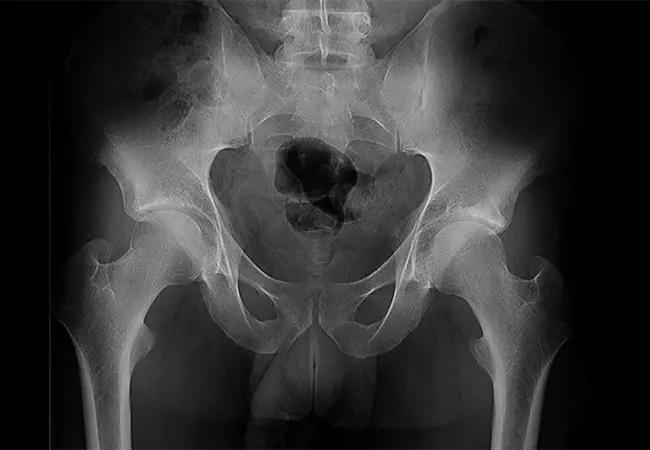
Image content: This image is available to view online.
View image online (https://assets.clevelandclinic.org/transform/e6c11692-f07a-46d4-9d60-34cda42d1e48/21-ORI-2204459-CQD-650x450-1_jpg)
21-ORI-2204459 CQD 650×450
A 21-year-old male presented to Cleveland Clinic’s Center for Hip Preservation for treatment of symptomatic left hip pain, which developed over time in his occupation as a heavy manual laborer.
Advertisement
Cleveland Clinic is a non-profit academic medical center. Advertising on our site helps support our mission. We do not endorse non-Cleveland Clinic products or services. Policy
The patient’s physician, Atul Kamath, MD, who is also director of the center and staff surgeon in the Orthopaedic and Rheumatologic Institute, notes that anteroposterior imaging showed that the patient was skeletally mature. And while the cartilage on his left hip was preserved, Dr. Kamath also noticed a crossover sign, indicating acetabular retroversion, a posterior malorientation of the acetabulum. Acetabular retroversion can predispose patients to femoroacetabular impingement and is a risk factor for early-onset osteoarthritis of the hip.
Given the global acetabular retroversion, the procedure could not be accomplished by a simple rim trimming of the cranial aspect of the socket through an arthroscope. As Dr. Kamath explains, “This would cause insufficiency or a lower volume socket that might cause secondary or iatrogenic instability of the hip.”
Dr. Kamath chose to address the complex deformity with introverting, or reverse PAO (anteverting periacetabular osteotomy), where the shape of the socket is manipulated to create more effective anteversion and dramatically increase range of motion. “This offers a powerful method for treating the impingement within the hip, and then also affording more normal biomechanics given the anteverted socket,” he says.
Dr. Kamath notes that postoperative imaging demonstrates elimination of crossover sign and fixation through the PAO. The patient is doing well and was able to return to his work with great functional improvements and decreased pain.
Advertisement
To learn more about the case and see preoperative images, watch the video below or visit Cleveland Clinic’s YouTube channel.
Video content: This video is available to watch online.
View video online (https://www.youtube.com/embed/TZqcf09XNVc?feature=oembed)
Global Acetabular Retroversion
Advertisement
Advertisement
Biologic approaches, growing implants and more
Study reports zero infections in nearly 300 patients
How to diagnose and treat crystalline arthropathy after knee replacement
Study finds that fracture and infection are rare
Center will coordinate, interpret and archive imaging data for all multicenter trials conducted by the foundation’s Osteoarthritis Clinical Trial Network

Reduced narcotic use is the latest on the list of robotic surgery advantages
Cleveland Clinic specialists offer annual refresher on upper extremity fundamentals
Cleveland Clinic orthopaedic surgeons share their best tips, most challenging cases and biggest misperceptions
 Search