Locations:





Proximal humeral torsion is focus of recent study

Image content: This image is available to view online.
View image online (https://assets.clevelandclinic.org/transform/ea6206cd-8e23-4e54-a858-b029951a7b49/14-ORT-1688-Schickendanz-Hero-Image-690x380pxl_jpg)
14-ORT-1688-Schickendanz-Hero-Image-690x380pxl
By Mark Schickendantz, MD, and Joshua Polster, MD
Advertisement
Cleveland Clinic is a non-profit academic medical center. Advertising on our site helps support our mission. We do not endorse non-Cleveland Clinic products or services. Policy
Kinetic chain theory tells us that the proximal and distal segments of a moving limb are dynamically related; what goes on in the shoulder affects the elbow and other points further down the limb.
Baseball pitchers are a prototype of kinetic chain theory in action. Several studies have shown a correlation between physical examination findings in the shoulder and the development of distal arm injuries, such as a sprain of the medial ulnar collateral ligament. Dominant-side arm injuries in throwing athletes are often multifactorial and therefore challenging to treat.
The better we understand throwing athletes’ anatomy and function, the more success we will have in returning them to high-level play.
Pitching a baseball at high speeds requires that the pitcher develop a high degree of angular velocity of internal rotation of the humerus during the throwing motion. Maximum internal rotation velocity is directly related to the length of the throwing arc. A longer arc of rotation allows more time for arm acceleration, resulting in higher peak velocity (arm speed) and thus higher velocity of the released ball. Pitchers achieve this longer arc by increasing the degree of external rotation of the shoulder during the late cocking phase of the throwing motion.
Normal anatomical constraints, particularly contact between the greater tuberosity and rotator cuff and the posterior superior glenoid margin (i.e., internal impingement), limit the extent of external rotation the throwing athlete can achieve. Thus, to achieve “hyperexternal” rotation, both the soft tissues and osseous structures of the shoulder must undergo adaptive changes in response to the supraphysiologic demands of high-level throwing. Sometimes, rather than adapting to the stresses, soft tissues fail under these conditions, resulting in injury.
Advertisement
Humeral torsion describes the rotational relationship between the axes of the proximal and distal articular surfaces of the humerus. Humeral torsion is generally symmetrical from side to side. It has been well established that baseball pitchers have a higher degree of humeral torsion (also known as retroversion) in their dominant arm compared with their nondominant arm.
During normal development, the proximal humerus de-rotates from a position of high retroversion to a more anteverted position. Pitching prior to skeletal maturity exposes the proximal humeral physis and shaft to high degrees of torque, resulting in a diminution of this normal de-rotation. The result is a proximal humerus that is more retroverted (exhibiting higher degrees of torsion) than normal (Figure).
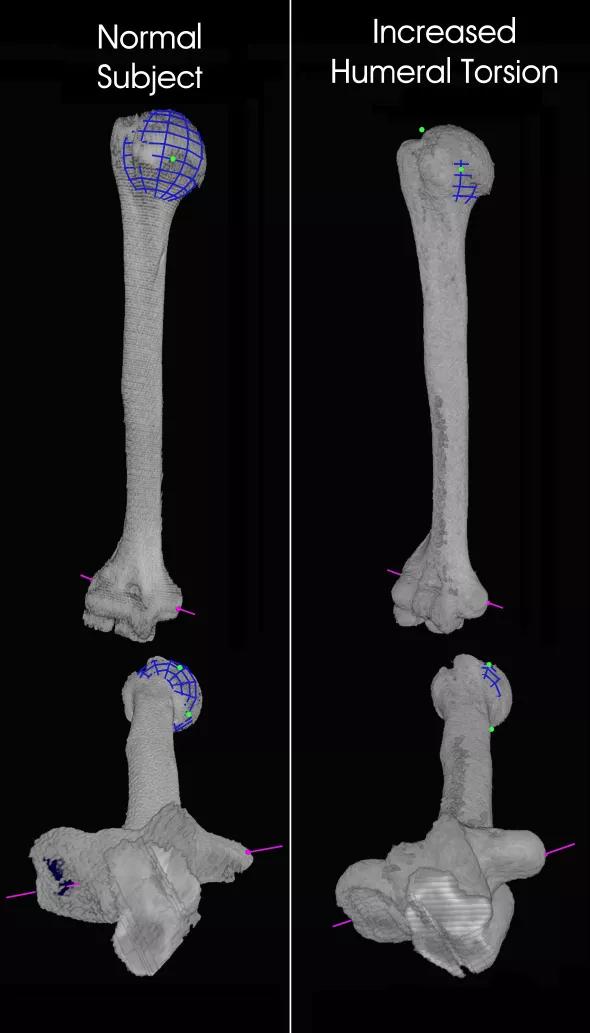
Image content: This image is available to view online.
View image online (https://assets.clevelandclinic.org/transform/149190c4-3ac8-47da-9134-ca9a6800a457/14-ORT-1688-Schickendanz-Inset-Image-02-590pxl-width_jpg)
Figure. Volume-rendered CTs of humeri in two pitchers. The images on the right show increased humeral torsion, as indicated by the epicondylar axis lines (pink).
An athlete with greater humeral torsion can achieve an arm position in the late cocking phase of the throwing motion with less external rotation of the humeral head and tuberosities relative to the glenoid compared with a player with less torsion. This led us to hypothesize that baseball pitchers who exhibit higher degrees of humeral torsion would have lower levels of shear and torque on the soft tissues of the shoulder and therefore fewer and less severe throwing-related shoulder and other upper extremity injuries.
To test our hypothesis, we conducted a study1 that prospectively recruited 25 professional baseball pitchers from a single Major League Baseball organization. CT scans were performed on the pitchers’ dominant and nondominant humeri to measure proximal humeral torsion. The resulting imaging data were processed with a proprietary three-dimensional volume-rendering post-processing program developed at Cleveland Clinic and validated for accuracy and interobserver reliability in measurements of humeral torsion.2
Advertisement
Players were followed for two years after imaging. All injuries were recorded. The number of days missed from pitching was used to determine injury severity, with 30 days considered significant/severe.
Consistent with previously published reports, we found that dominant humeral torsion was significantly higher than nondominant torsion in this cohort of pitchers. Among the 11 pitchers injured during follow-up, five had shoulder injuries, seven had elbow injuries and two had finger injuries.
Dominant humeral torsion was found to be a statistically significant predictor of severe injuries. Among injured players, higher numbers of days missed because of injury were strongly correlated with lower degrees of humeral torsion. Thus, we concluded that there is a strong relationship between lower degrees of dominant humeral torsion and more severe upper extremity injuries.
It is apparent that adaptive changes in the proximal humerus, resulting from the gradual application of stress during skeletal growth, occur in throwing athletes. Furthermore, these changes seem to confer a level of protection to the soft tissues of the upper extremity in these athletes.
We continue to evaluate these athletes using ultrasound to measure humeral torsion and follow them as part of their clinical care. If future research confirms our findings, measurement of proximal humeral torsion could play a role in risk assessment in baseball pitchers.
Advertisement
About the Authors
Dr. Schickendantz is Director of the Cleveland Clinic Center for Sports Health, Department of Orthopaedic Surgery.
Dr. Polsteris a musculoskeletal radiologist in the Department of Diagnostic Radiology.
Advertisement
Advertisement
Biologic approaches, growing implants and more
Study reports zero infections in nearly 300 patients
How to diagnose and treat crystalline arthropathy after knee replacement
Study finds that fracture and infection are rare
Center will coordinate, interpret and archive imaging data for all multicenter trials conducted by the foundation’s Osteoarthritis Clinical Trial Network

Reduced narcotic use is the latest on the list of robotic surgery advantages
Cleveland Clinic specialists offer annual refresher on upper extremity fundamentals
Cleveland Clinic orthopaedic surgeons share their best tips, most challenging cases and biggest misperceptions
 Search