Locations:





Later distal aorta repair facilitated in two-thirds of cases
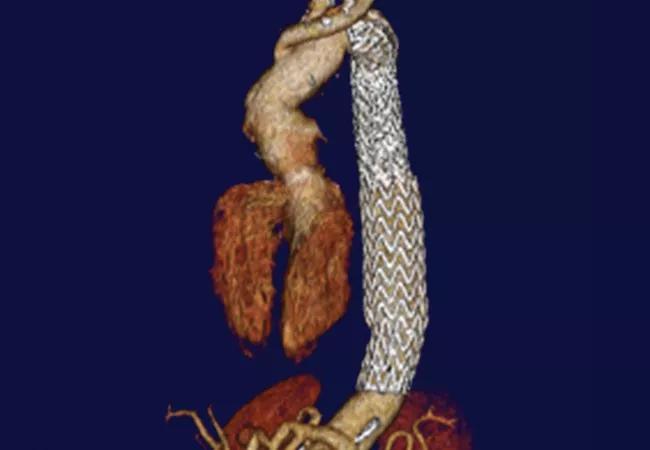
Image content: This image is available to view online.
View image online (https://assets.clevelandclinic.org/transform/3ecfaa3c-51c3-4752-bba1-f73e7dd5e6bc/17-HRT-071-STS-CQD-600p_jpg)
17-HRT-071-STS-CQD-600p
Both conventional and frozen elephant trunk (ET) procedures are good options for aortic arch reconstruction during reoperations in patients with residual dissection after emergency acute type A repair — and they facilitate later distal aortic repair. So concludes a large single-center retrospective analysis presented in late January at the Society of Thoracic Surgeons’ 53rd annual meeting in Houston by the Cleveland Clinic Aorta Center team.
Advertisement
Cleveland Clinic is a non-profit academic medical center. Advertising on our site helps support our mission. We do not endorse non-Cleveland Clinic products or services. Policy
“Patients with residual dissection following type A repair often undergo multiple reoperations for disease progression and complications,” says co-investigator Eric Roselli, MD, Surgical Director of Cleveland Clinic’s Aorta Center. “We wanted to characterize these patients and assess outcomes of complex aortic reconstruction with conventional ET and frozen ET procedures.” The options for managing this population of patients are either a repair of the aorta through the left chest, which risks damaging the dissected aortic arch and causing complications, or doing a two-stage operation. The study is the largest report of outcomes in this population to date.
The Aorta Center researchers reviewed records of 790 consecutive patients who underwent ET or frozen ET procedures at Cleveland Clinic from 2000 to 2016. In 214 (27 percent) of these patients, the procedures were done as first-stage reoperations for degenerative chronic dissection following acute type A repair. Of the 214 patients, 168 underwent ET and 46 underwent frozen ET.
Among these 214 patients undergoing reoperation, the mean interval from the initial repair for acute aortic dissection was 6.8 years (± 6 years SD). The mean maximum dissection diameter was 6 cm ± 0.9 cm. The aortic root was replaced during the initial type A repair in 55 patients (26 percent) and during first-stage ET/frozen ET in 41 patients (19 percent).
Operative mortality was 1.8 percent (4/214), with all four deaths occurring among patients undergoing conventional ET repair. All deaths resulted from coagulopathy complications and heart failure.
Advertisement
Over mean follow-up of 3 years (± 2 years SD), second-stage completion was performed in 134 patients (63 percent) at a median interval of 3.7 months. Slightly more than half of completions were done via open surgery, with the rest done endovascularly.
The remaining 80 patients (37 percent) who did not have second-stage completion broke down as follows:
Estimated survival at five years was 72 percent.
“These results confirm that frozen and conventional ET procedures are good alternatives for arch reconstruction during reoperations,” concludes Dr. Roselli. “At the same time, they underscore that patients with chronic residual type A dissection require lifelong surveillance for late complications at a center specializing in aortic disease.”
Advertisement
Advertisement

A sampling of outcome and volume data from our Heart & Vascular Institute
Concomitant AF ablation and LAA occlusion strongly endorsed during elective heart surgery
Large retrospective study supports its addition to BAV repair toolbox at expert centers
Young age, solid tumor, high uptake on PET and KRAS mutation signal risk, suggest need for lobectomy
Surprise findings argue for caution about testosterone use in men at risk for fracture
Residual AR related to severe preoperative AR increases risk of progression, need for reoperation

Findings support emphasis on markers of frailty related to, but not dependent on, age
Provides option for patients previously deemed anatomically unsuitable
 Search