Locations:





Individual and population factors play a role
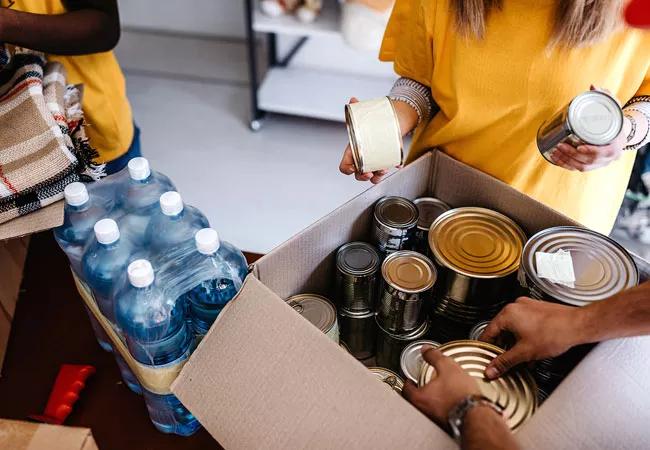
Image content: This image is available to view online.
View image online (https://assets.clevelandclinic.org/transform/5d17a188-76a6-4898-9c54-c9a0a69a73f8/22-NUR-3143276-FoodInsecurity-NghbrhdDisadvntge-CQD_650x450_jpg)
22-NUR-3143276-FoodInsecurity-NghbrhdDisadvntge-CQD_650x450
As a clinical nurse specialist at Cleveland Clinic South Pointe Hospital, Karen Distelhorst, PhD, APRN, GCNS-BC, participated in a project focused on screening emergency department patients for social determinants of health. To her surprise, food insecurity – defined as having limited or uncertain access to adequate food – was found to have the most profound effect on the overall health of the individuals evaluated.
Advertisement
Cleveland Clinic is a non-profit academic medical center. Advertising on our site helps support our mission. We do not endorse non-Cleveland Clinic products or services. Policy
That information piqued Dr. Distelhorst’s interest, prompting her to pursue a research study examining the relationship between food insecurity, neighborhood disadvantage and healthcare utilization.
“Although there had been some work specifically focused on food insecurity and neighborhood disadvantage in children and families with children, there was little research on adults,” she explains. “Additionally, there was some evidence linking food insecurity and healthcare utilization and other data linking neighborhood disadvantage and healthcare utilization, but I wanted to pull it all together and see how the factors interacted.”
Dr. Distelhorst, now a nurse scientist in the Office of Nursing Research & Innovation, collaborated with Cleveland Clinic’s Center for Populations Health Research (CPHR) to conduct a retrospective study. Using data from health system administrative billing databases, publicly available population databases and patient electronic medical records, researchers analyzed adults who received primary care from Cleveland Clinic providers and were hospitalized in an Ohio Cleveland Clinic hospital. The study aimed to examine:
The CPHR biostatistician performed geocoding (providing geographical coordinates) that identified patients’ neighborhoods and allowed the research team to access public data on neighborhood disadvantage, food deserts and mean income.
Advertisement
“We wanted to ascertain what individual and population factors were associated with increased healthcare utilization – not only hospitalization, but also emergency department visits and observation stays,” she says.
In analysis, Dr. Distelhorst learned that food insecurity was a stronger predictor for healthcare utilization and hospital readmission than neighborhood disadvantage.
“The biggest takeaway for me was how important it is for nurses to be aware of patients who may be experiencing food insecurity, which can wax and wane, and how it might affect their care moving forward,” she says.
Dr. Distelhorst recommends that case managers and nurses who perform intake screening use a simple food insecurity screening tool similar to what was used in her team’s research. Essentially, Cleveland Clinic caregivers asked two questions adapted from the Vital Hunger Sign™ screening:
“It’s an easy questionnaire that can be completed in an acute care or ambulatory setting,” says Dr. Distelhorst. “A ‘yes’ answer to either question should prompt nurses to connect the patient with appropriate community resources, such as food banks and meal sites. As healthcare professionals, we also want to know that people are getting access to healthy, nutritious meals, not just cheap food.”
Advertisement
Advertisement
Nurses play key role in comprehensive lifetime treatment program
Customized bots improve speed, efficiency by streamlining daily clinical, clerical tasks
Nurses play pivotal role in patients’ ability to recover in the comfort of their own homes
New protocol reduces costs, increases patient and caregiver satisfaction

Advocating for patient safety is imperative in fast-paced surgical settings

M-Power program improves the perinatal experience for people who have survived abuse

Advice for those pursuing a WOC nursing career

Veteran nurse shares his experience as a caregiver and community volunteer
 Search