Locations:





Characterizing the retina’s injury response
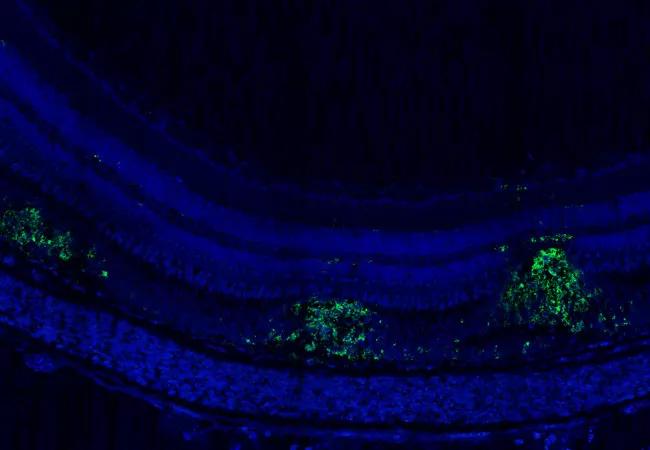
Image content: This image is available to view online.
View image online (https://assets.clevelandclinic.org/transform/647aaf2e-187f-4752-ad65-bf0e29165ba5/16-EYE-2651-Regeneration-CQD-650x450_jpg)
16-eye-2651-regeneration-cqd-650×450
Advertisement
Cleveland Clinic is a non-profit academic medical center. Advertising on our site helps support our mission. We do not endorse non-Cleveland Clinic products or services. Policy
Regenerative therapies hold the promise of restoring vision by replacing diseased retina with normal retina. In recent years, considerable efforts to reprogram stem cells into retinal cells such as photoreceptors have demonstrated the ability to produce photoreceptors and other retinal cell types from embryonic stem cells and induced pluripotent stem cells. However, complete retinal regeneration and integration of these stem cells into injured or diseased retina has not been possible. At Cole Eye Institute, we are using zebrafish to better characterize the injury response of the retina.
Current strategies in both human clinical trials and animal preclinical studies involve subretinal delivery of mature cells derived from stem cells grown in the laboratory, or immature retinal cells from fetal retina. Successful transplantation of true stem cells, which differentiate into mature retinal cell types capable of integrating into the retinal circuitry, has not yet been demonstrated.
To address this knowledge gap, our laboratory studies retinal regeneration in zebrafish. Unlike humans, primitive vertebrates such as teleost fish are capable of retinal regeneration in response to injury. The zebrafish retina is capable of rapid and complete regeneration in response to a variety of injuries induced by thermal, chemical or mechanical insults. By understanding the differences between the zebrafish regenerative response and the typical scarring response to injury seen in mice and humans, we hope to unlock the secrets to retinal regeneration.
Advertisement
Using a novel thermal laser injury model, we observed the earliest response to injury in the zebrafish retina. Unlike other methods, damage from thermal lasers is rapid and localized. We identified retinal microglia as one of the earliest responders to retinal injury. These cells rapidly migrate to the site of injury prior to the activation of retinal stem cells.
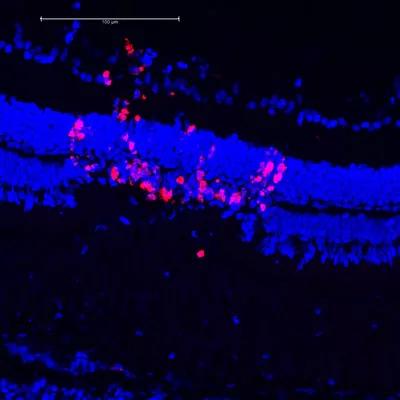
Image content: This image is available to view online.
View image online (https://assets.clevelandclinic.org/transform/00d3bab6-a2ca-47d9-a5aa-c03a5112c531/16-EYE-2651-Regeneration-CQD-Inset-1_jpg)
Proliferating stem cells (red) shown with nuclei (blue) from the different layers of the retina
Following this microglial cell migration, Müller glia, which normally serve as retinal support cells, begin to proliferate and assume a retinal stem cell phenotype. These Müller glia-derived stem cells then migrate away from the inner nuclear layer in a radial pattern. We believe they migrate along scaffolds formed by Müller cells. The cells that migrate to the destroyed photoreceptor layer continue to proliferate and eventually differentiate into new photoreceptors. The regeneration and formation of a new layer of photoreceptors takes about three weeks.
Future investigations in our lab are focused on developing novel surgical tools to place stem cells intraretinally. Our research suggests intraretinal placement could enhance the integration of newly differentiated cells into the remaining retinal architecture. Unlike subretinal injections, intraretinal injections would place these cells adjacent to the Müller cell scaffold, possibly enhancing their ability to migrate to the site of injury.
We hope that our ongoing studies using zebrafish will one day make regenerative therapy in humans a reality.
Advertisement
Dr. Yuan is Principal Investigator of the Regeneration/Cell Therapy Lab at Cole Eye Institute.
Advertisement
Advertisement
Early data shows risk is 73% higher in patients with lupus, 40% higher in patients with rheumatoid arthritis

Identifies weak spots in the cornea before shape change occurs
Study highlights the value of quantitative ultra-widefield angiography
Switching medications may decrease treatment burden and macular fluid
Interventions abound for active and stable phases of TED
Corneal imaging and interpretation play a major role
Cole Eye Institute imaging specialists are equal parts technician, artist and diagnostician

Effect of low-dose atropine and dual-focus contact lenses is unknown in patients with comorbid eye conditions
 Search