Locations:





Program helps eliminate distractions
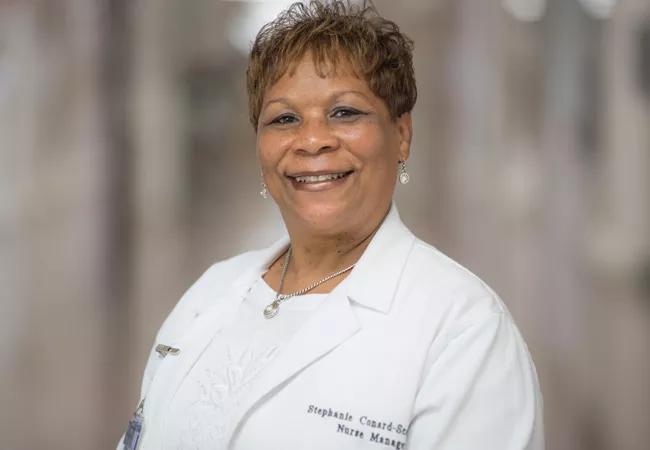
Image content: This image is available to view online.
View image online (https://assets.clevelandclinic.org/transform/c0990dff-fe7b-4f40-8233-69c2c2342031/Concard-Scott_S_650x450_jpg)
Concard-Scott_S_650x450
All too often nurses get interrupted during medication administration by other healthcare staff, patients and visitors. A 2012 article published by the Institute for Safe Medication Practices noted that nurses are distracted and interrupted as often as once every two minutes. To help prevent interruptions, Cleveland Clinic Marymount Hospital adopted a medication pass program that was originally implemented at the health system’s main campus.
Advertisement
Cleveland Clinic is a non-profit academic medical center. Advertising on our site helps support our mission. We do not endorse non-Cleveland Clinic products or services. Policy
The program was piloted in early 2015 on two medical/surgical units at Marymount Hospital. “Our nurses have a certain amount of time to pass medications,” says Stephanie Conard-Scott, BSN, RN, nurse manager of the med/surg units. “Nurses were getting interrupted by transport, pharmacy and others. They had to stop in the middle of med pass and answer questions. It was a safety issue.”
Marymount Hospital instituted the medication administration program to eliminate unnecessary interruptions. Two hours each day – from 8:30 a.m. to 9:30 a.m. and from 8:30 p.m. to 9:30 p.m. – are dedicated med pass times. During those times, the health unit coordinator (HUC) places a sign on the nurses’ station indicating that it is med pass time and turns on a light at the station. “When the light is on, everyone is aware that nurses are passing medications,” says Conard-Scott.
The program includes a few other components to dissuade interruptions:
In addition, during the two-hour medication administration times, nurses transfer all phone calls to the HUC, who triages the calls and takes messages. Only if it is urgent, will the HUC call the nurse.
Advertisement
The pilot program was so successful that Marymount Hospital has since rolled out the program to several other units. “The nurses love it because they can concentrate on administering meds,” says Conard-Scott. “And it benefits patients, too. We have to make sure our patients’ medications are being administered in a timely, efficient and safe manner.”
Advertisement
Advertisement

Nurses play key role in comprehensive lifetime treatment program
Customized bots improve speed, efficiency by streamlining daily clinical, clerical tasks
Nurses play pivotal role in patients’ ability to recover in the comfort of their own homes
New protocol reduces costs, increases patient and caregiver satisfaction

Advocating for patient safety is imperative in fast-paced surgical settings

M-Power program improves the perinatal experience for people who have survived abuse

Advice for those pursuing a WOC nursing career

Veteran nurse shares his experience as a caregiver and community volunteer
 Search