Locations:





Research leads to alarm changes in ICU
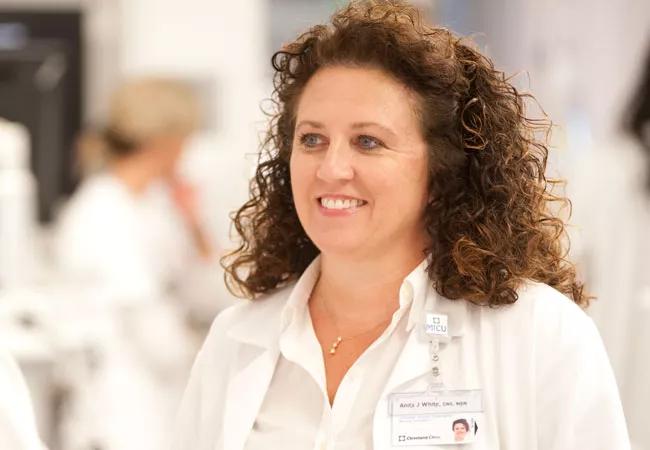
Image content: This image is available to view online.
View image online (https://assets.clevelandclinic.org/transform/a388278d-e84c-446c-b0e9-06472d15dd95/White_650x450_jpg)
White_650x450
A concerted effort by Cleveland Clinic to reduce the number of alarms in intensive care units (ICUs) was associated with a 70 percent overall reduction.
Advertisement
Cleveland Clinic is a non-profit academic medical center. Advertising on our site helps support our mission. We do not endorse non-Cleveland Clinic products or services. Policy
“Nurses have asked for help with making alarms go away without causing harm to their patients, and we believe we have done that,” says Anita White, MSN, RN, ACNS-BC, CCRN, a clinical nurse specialist at Cleveland Clinic who led the ICU alarm management task force.
Before this effort began, there were 8 million alarms per month in the 264 ICU* beds on Cleveland Clinic’s main campus. After employing a number of changes in alarm criteria, they now number just over 2 million per month, says White, who works in the Medical ICU and is a member of the Department of Nursing Education and Professional Practice.
“On any given day, one nurse would hear up to 80 alarms per patient per shift,” she says. “That was not even considering alarms produced by other patients on the unit. Alarm noise was intrusive.”
The result is nurses being able to hear the alarms that they need to act on, which improves both patient safety and job satisfaction, she adds.
White explains that changes came about in stages. First, she searched the literature for evidence-based solutions on how to reduce alarms. The taskforce learned that standardizing the alarms of physiologic monitors was a good starting point.
“Another group had determined that standardizing heart rate and SpO2 monitor alarm settings would result in a substantial gain, so we started by looking at alarm default settings,” she says.
Patient data from the previous year showed patient norms to be consistent across all Cleveland Clinic main campus adult ICUs. However, the team found that alarm default settings varied from unit to unit, and even, in some cases, from bed space to bed space within units.
Advertisement
Establishing consistent standard alarm default settings for oxygen saturation and heart rate settings on monitors led to a 7 percent alarm reduction, White says.
The next step was to target common ICU “nuisance alarms.” We agreed that some alarms that did not require action by nurses or communication about a change in patient condition should be simply turned off. “If we are not going to treat a patient when an alarm sounds off, why would we want to have that alarm?” she says.
Examples included a too-high oxygen saturation alarm on patients who are otherwise doing well, and most alarms associated with patient temperatures, as ICU nurses take temperatures regularly.
The team also sought to reduce duplicate alarms, such as those that can occur when patients have heart rate alarms on multiple hemodynamic monitoring devices – for example, on an electrocardiogram (ECG) monitor, an arterial line and an SpO2 monitor. “We only need one alert about a problem,” White says.
The task force also added an end-of-life profile to allow for a peaceful, respectful time for patients and families at the end of life. This profile would turn off all alarms. After some tweaking of this change, it was determined to allow these alarms to be turned off as appropriate.
*Cleveland Clinic’s main campus ICUs include: cardiothoracic, coronary, heart failure, medical, neurological, surgical and vascular
Advertisement
Advertisement

Nurses play key role in comprehensive lifetime treatment program
Customized bots improve speed, efficiency by streamlining daily clinical, clerical tasks
Nurses play pivotal role in patients’ ability to recover in the comfort of their own homes
New protocol reduces costs, increases patient and caregiver satisfaction

Advocating for patient safety is imperative in fast-paced surgical settings

M-Power program improves the perinatal experience for people who have survived abuse

Advice for those pursuing a WOC nursing career

Veteran nurse shares his experience as a caregiver and community volunteer
 Search