Locations:





Cleveland Clinic’s roadmap to recovering critical digital assets stems from strategic planning and preparedness

Image content: This image is available to view online.
View image online (https://assets.clevelandclinic.org/transform/150292d7-83e3-4f2f-845b-6c1f44ef9cc2/24-CCC-4575808-HIT-967x544-1_jpg)
Cloud technology
Time and health are precious commodities; often overlooked, until there is a crisis.
Advertisement
Cleveland Clinic is a non-profit academic medical center. Advertising on our site helps support our mission. We do not endorse non-Cleveland Clinic products or services. Policy
For healthcare organizations, overlooking timely patient care isn’t an option. Planning for these unexpected disruptions makes recovery readiness a top priority.
At Cleveland Clinic, restoring critical applications within eight hours of a declared event was a two-year journey defined by strategic planning and preparedness.
“Returning critical business operations within eight hours of an unplanned disruption was unheard of in the healthcare industry,” says Ian Willis, an enterprise architect within Cleveland Clinic’s Information Technology Division.
Willis continues, “To do this, we created an infrastructure of caregivers, processes and technologies to identify and restore 200 critical patient care and business applications in a matter of hours instead of days. Narrowing this timeframe was imperative to maintain continuity of care, and ultimately, to save lives.”
“It’s tempting to buy more hardware and store it offsite to avoid extended network and server outages. But that leads to owning a bunch of idle hardware that consumes power, operating expenses and capital, which eventually becomes obsolete,” says Willis.
To that end, Willis prefers the ‘pilot light’ concept that leverages maintenance and restoration with a cloud hybrid and a remote data center to reduce the amount of needed hardware without duplicating the entire system.
Willis explains, “Isolating and separating the recovery environment into a ‘clean room’ allows for restoration and full testing of individual applications without disruptions. This practice ensures dedicated time for recovery testing of the actual applications.”
Advertisement
Following three military tours, Willis maintains a heightened appreciation for mastering tasks through ongoing practice.
“In the military, the only way to be consistent and efficient is to practice, practice, practice. This mindset aligns with our continuous efforts to prepare and limit disruptions caused by unforeseen circumstances,” says Willis.
Achieving this relies on 50 caregivers coming together four times a year to practice restoring the data; followed by a full system test of each application involving 500 caregivers once a year. This approach keeps caregivers engaged and connected to delivering the safest, highest-quality patient care.
He also likens recovery readiness to a fitness program – the more practice, the better the results. With ongoing planning and frequent technical tests, architecture and process issues are discovered in a safe setting.
“Continuous preparation builds resiliency by having individual teams work together to coordinate their steps and practice the processes.” He explains, “By further refining sequencing and lock-step motions, teams gain cross-training for rarely used and highly specialized technical practices.”
Cleveland Clinic’s recovery readiness strategy addresses the necessary safeguards to protect its mission-critical digital assets and network. This requires:
Advertisement
“Adhering to this strategy requires an ‘all in’ mentality to be successful,” say Willis. “While this isn’t an easy task, we’re very proud to have 100% participation during the practice drills and testing. This is a team sport that’s improved through trial-and-error and by having difficult conversations.”
Since adopting this strategy, Willis estimates that restoration via the separate environment is 300% faster than the previous process.
But for Willis, it’s more than a cost savings — it’s about helping people. Willis summarizes, “In my role, I’m fortunate to help a lot of people without being a clinical caregiver. Our quicker recovery process limits potential disruptions for our care teams so they can continuously provide the exceptional service our patients deserve. That’s an accomplishment we can all be proud of.”
Advertisement
Advertisement

The Friends of Cybersecurity program bridges innovative technology solutions with mitigating security risks

Cleveland Clinic’s Information Technology Apprenticeship Program expands skill set while leading to meaningful employment
Protecting patient data and privacy while preventing unnecessary risks
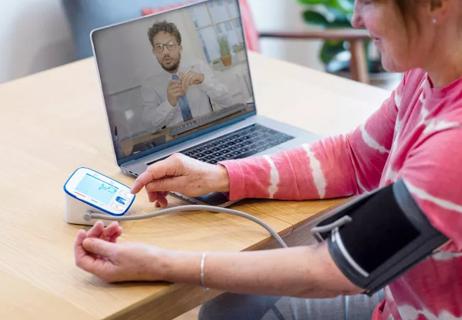
While logistical questions remain about RPM, its benefits for both patients and caregivers are abundantly clear

Telehealth aids in treatment of fibromyalgia and median arcuate ligament syndrome
Rates of CR eligibility high and internet access low among older patients in rural areas

The infant fever care path is an interactive, step-by-step tool within the electronic health record that reduces high variability among standard practices to ensure safe, quality care at all Cleveland Clinic locations
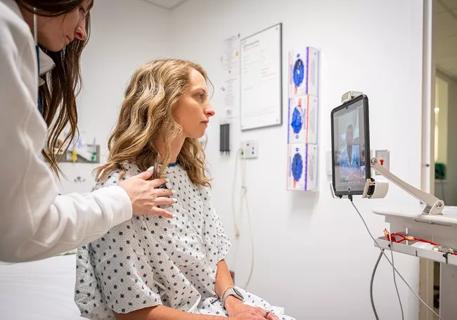
Remotely based physicians use telehealth technology to evaluate lower-acuity patients in the ED, express clinic or during an EMS response
 Search