Locations:





Variants uncovered include ADAMTS6
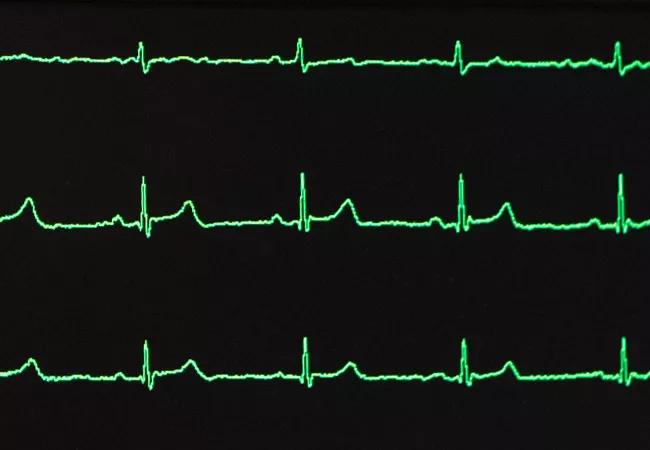
Image content: This image is available to view online.
View image online (https://assets.clevelandclinic.org/transform/44263449-659d-4324-a71e-3e900a08cf83/EKG_650-x450_jpg)
EKG_650-x450
An international team of researchers, including scientists from Lerner Research Institute, has uncovered new loci (chromosomal regions) associated with heart function and development.
Advertisement
Cleveland Clinic is a non-profit academic medical center. Advertising on our site helps support our mission. We do not endorse non-Cleveland Clinic products or services. Policy
Electrocardiograms (EKGs) are commonly used to evaluate and diagnose cardiac health, including the heart’s rhythm and blood flow. Shown as the main spike on an EKG, the time it takes for the heart ventricles to contract and expel blood (depolarization) is called the QRS interval. Prolonged QRS intervals are associated with poor cardiac events and a predictor of mortality. Previous genome-wide association studies have identified more than 20 loci associated with QRS duration.
In this study, the team of researchers — led by Yalda Jamshidi, PhD, St. George’s University of London — validated these loci and, notably, uncovered rare genetic variants never before connected with QRS duration and heart function. Up to this point, the influence of rare variants has not been widely studied.
The researchers used specialized assays to detect variants with particularly low frequencies (minor allele frequency of less than 1 percent) in coding regions of the DNA. They identified five new genes with variants associated with lengthened QRS duration, including ADAMTS6 (A Disintegrin-Like And Metalloproteinase with Thrombospondin Type 1 Motif 6).
Timothy Mead, PhD, who is co-first author on the paper published in Genome Biology, and Suneel Apte, MBBS, DPhil, both of Lerner’s Department of Biomedical Engineering, offered their cell culture expertise and preclinical models, as well as their familiarity with the related ADAMTS9 gene, to validate this data and characterize the biological mechanism responsible for ADAMTS6’s causative effect on elongated QRS intervals.
Advertisement
Together, the team found in cellular experiments that the genetic anomaly caused reduced secretion of the ADAMTS6 protein. Additionally, they showed in a preclinical model that having only one functional copy of the ADAMTS6 gene causes a decrease in concentration of the molecule connexin 43 (Cx43). Cx43 is a gap junction protein that helps connect neighboring heart cells, serving as the conduit that transmits electrical signals across the heart. This reduction in Cx43 likely explains the abnormal EKG patterns observed — with fewer Cx43 proteins to lubricate and propagate electrical signals, it takes longer for the ventricles to depolarize.
The other genes with damaging variants found include CSRP3, FHOD3, ISM1 and TBX5.
While additional research will be important to validate the gene associations identified in this study and to elucidate the mechanisms through which they affect cardiac development and dysfunction, this is a meaningful step forward in the quest for improved diagnosis of genetic heart conditions.
Advertisement
Advertisement


International collaboration is most genetically diverse study of the disease to date

Preclinical work promises large-scale data with minimal bias to inform development of clinical tests

Matching SNOMED Term with Curated Post. Please do not touch this post or any of its categories/snomed terms, thank you!

Matching Primary -> Secondary SNOMED Term with Curated Post. Please do not touch this post or any of its categories/snomed terms, thank you!

Cleveland Clinic researchers pursue answers on basic science and clinical fronts

Study suggests sex-specific pathways show potential for sex-specific therapeutic approaches

Cleveland Clinic launches Quantum Innovation Catalyzer Program to help start-up companies access advanced research technology
 Search