Locations:





Affiliated providers turn to Cleveland Clinic for advice on toughest cases

Image content: This image is available to view online.
View image online (https://assets.clevelandclinic.org/transform/38957b50-7287-42ad-aad2-892497d73172/16-HRT-2451-Affiliate-Case-Study-CQD_jpg)
16-HRT-2451-Affiliate-Case-Study-CQD
Advertisement
Cleveland Clinic is a non-profit academic medical center. Advertising on our site helps support our mission. We do not endorse non-Cleveland Clinic products or services. Policy
In July 2016, a 56-year-old woman presented to her community hospital in central Pennsylvania complaining of indigestion. Workup suggested a potential heart problem, and she was sent to an interventional cardiologist. Cardiac catheterization demonstrated normal coronaries, but a large tumor was found in the right ventricle immediately below the tricuspid valve. This was confirmed with an echocardiogram, which also revealed a moderately sized pericardial effusion. The patient was referred to UPMC Susquehanna in Williamsport, Pennsylvania, for management.
We saw the patient in clinic. Because primary cardiac tumors are rare, one in this location is often secondary to a systemic process such as lymphoma. We ordered a whole-body PET scan and excluded this possibility.
Although our team has removed many cardiac tumors, the location of this one was unsettling, as it was encroaching on the junction between the atria and the ventricle. It was likely that a major reconstruction would be necessary following resection of the mass.
In view of UPMC Susquehanna’s affiliate relationship with Cleveland Clinic’s Miller Family Heart & Vascular Institute, I immediately called Cleveland Clinic cardiothoracic surgeon Edward Soltesz, MD, MPH, for his opinion on whether the tumor could be safely resected.
Dr. Soltesz and I reviewed the patient’s PET scan and echo together via secure image-sharing technology. Because her angiogram was available only on a disc, it was sent by overnight mail. The following day, Dr. Soltesz and his colleagues reviewed the films and confirmed that the patient was an appropriate candidate for surgery. They also agreed that her tumor was rare enough to merit referral to Cleveland Clinic for surgery. The patient agreed to travel to Cleveland and underwent a successful surgery by Dr. Soltesz shortly thereafter. She has recovered well and returns to UPMC Susquehanna for follow-up care.
Advertisement
As an affiliate of Cleveland Clinic’s Heart & Vascular Institute, UPMC Susquehanna is able to provide all its cardiovascular physicians a direct pipeline to their counterparts at Cleveland Clinic for free second-opinion consultations on complex cases like this one.
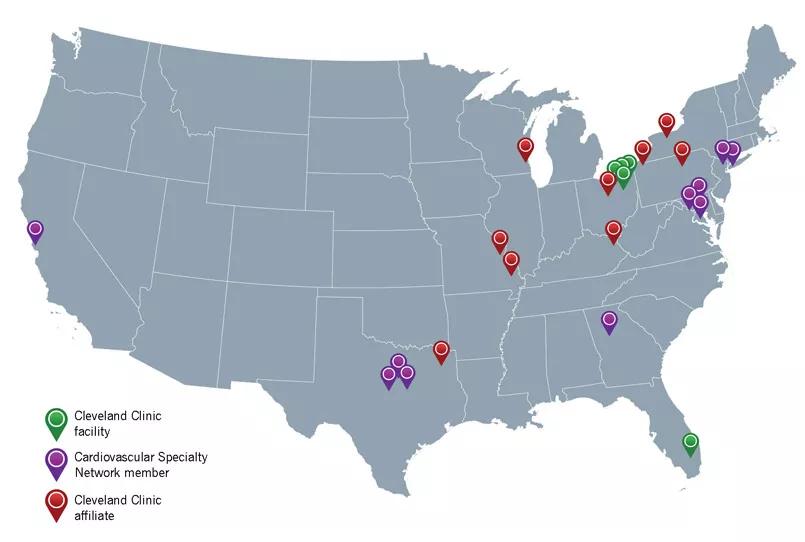
Image content: This image is available to view online.
View image online (https://assets.clevelandclinic.org/transform/79f52f65-f725-4dc8-9a49-351ddabb0857/16-HRT-2451-Affiliate-Case-Study-Inset1b_jpg)
Cleveland Clinic has partnered with hospitals and health systems across the U.S. to promote improved clinical and operational aspects of cardiovascular care, including the provision of second-opinion case reviews. This map shows locations of current affiliated provider organizations (such as UPMC Susquehanna) as well as members of Cleveland Clinic’s Cardiovascular Specialty Network, a coalition of provider organizations that have entered into deeper collaborative relationships with Cleveland Clinic.
Since our affiliation began in February 2014, we have called Cleveland Clinic for a second opinion on 30 to 40 patients. The service is overwhelmingly a consultation service, as only three or four of these patients ended up traveling to Cleveland Clinic for surgery as this patient did.
Our referring physicians tell patients that if they come to UPMC Susquehanna for a second opinion, we can actually offer them a third opinion from Cleveland Clinic, if necessary. If a patient does not need surgery, this additional level of expert consultation further reassures the patient that everything is being done that should be done.
As a referral hospital for complicated patients that smaller hospitals cannot handle, UPMC Susquehanna draws comfort from knowing our Cleveland Clinic colleagues are there for us when needed. The first patient for whom I sought a second opinion under this affiliation was a 73-year-old with a congenital cardiac abnormality. Cleveland Clinic cardiothoracic surgeon Lars Svensson, MD, PhD, was taking consults that day and proved to be a wealth of expertise and experience. He agreed that, among the possible options, ligation of the anomaly would be a suitable approach. Surgery went well, the patient stayed local and the family was impressed by the result and the speed of service.
Advertisement
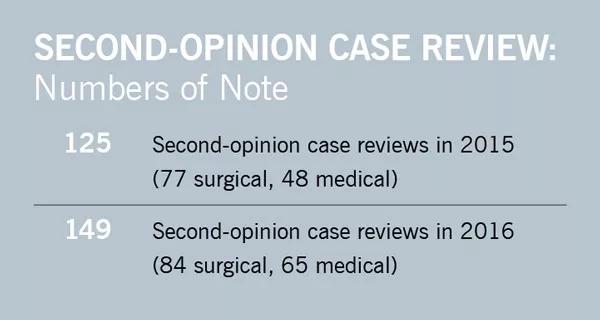
Image content: This image is available to view online.
View image online (https://assets.clevelandclinic.org/transform/744cd6aa-797d-48b4-a509-21222c1467a8/16-HRT-2451-Affiliate-Case-Study-Inset2_jpg)
Most cases for which we seek consultation with Cleveland Clinic involve surgical questions — e.g., whether the patient is a surgical candidate or the best surgical approach to use. Often these questions involve cutting-edge technologies present only at quaternary centers like Cleveland Clinic.
For the case patient above, I called Dr. Soltesz directly. The usual practice, however, is for my nurse to gather the patient information, call the number provided for affiliate physicians, and submit documents and images via secure electronic transfer as needed. Cleveland Clinic forwards the information for review by the appropriate subspecialist physician, who then provides direct feedback to the requesting physician at the affiliated provider organization. This service helps us determine whether surgery is warranted, the timing of the procedure, the recommended approach and whether escalation of care is required.
Our cardiologist colleagues follow a similar process, often asking their Cleveland Clinic counterparts to read echocardiograms or assist with catheter lab metrics.
At Cleveland Clinic’s end, case reviews are categorized as emergency, urgent or nonurgent for appropriate triage. Emergency review allows for the physician at the affiliated provider to contact Cleveland Clinic physicians on a 24/7 basis via an internal paging system or direct phone call to the appropriate specialist. In some instances, multiple Cleveland Clinic physicians take part in a second-opinion case review, as dictated by case complexity and the requirement for subspecialty collaboration.
Advertisement
Our discharge data across the board confirm that our affiliate relationship with Cleveland Clinic — including these second-opinion case reviews — enhances the quality of care we are able to provide our patients. We look forward to continued collaboration.
Dr. Lazar is a cardiothoracic surgeon and medical director of the Heart & Vascular Institute at UPMC Susquehanna, an affiliate of Cleveland Clinic’s Miller Family Heart & Vascular Institute. For more on cardiovascular affiliation opportunities with Cleveland Clinic, visit affiliatenetwork.clevelandclinic.org.
Advertisement
Advertisement
A sampling of outcome and volume data from our Heart & Vascular Institute
Concomitant AF ablation and LAA occlusion strongly endorsed during elective heart surgery
Large retrospective study supports its addition to BAV repair toolbox at expert centers
Young age, solid tumor, high uptake on PET and KRAS mutation signal risk, suggest need for lobectomy
Surprise findings argue for caution about testosterone use in men at risk for fracture
Residual AR related to severe preoperative AR increases risk of progression, need for reoperation
Findings support emphasis on markers of frailty related to, but not dependent on, age
Provides option for patients previously deemed anatomically unsuitable
 Search