Locations:





Cleveland Clinic investigators report preliminary results
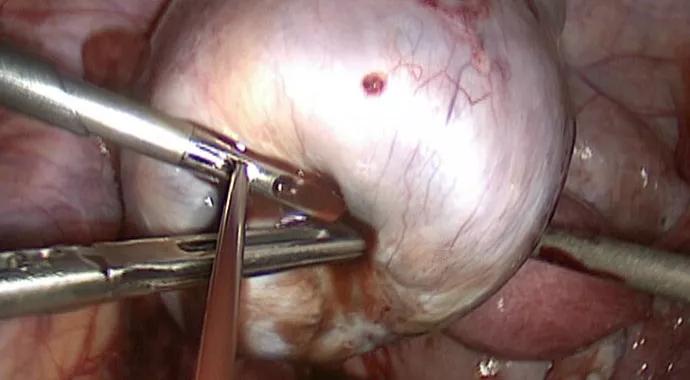
Image content: This image is available to view online.
View image online (https://assets.clevelandclinic.org/transform/22cf5c7b-1ec2-43bf-b392-a9dda1afc541/Endometrioma-690x380_jpg)
Endometrioma-690×380
By Linnea R. Goodman, MD, and Tommaso Falcone, MD
Advertisement
Cleveland Clinic is a non-profit academic medical center. Advertising on our site helps support our mission. We do not endorse non-Cleveland Clinic products or services. Policy
Preliminary results of a prospective evaluation suggest that surgical resection of ovarian endometriomas may precipitate a substantial, persistent decline in ovarian reserve.
Endometriosis, affecting up to 2 percent of women of reproductive age 1,2, can be asymptomatic but often causes pain and/or infertility. Researchers hypothesize that the mere presence of endometriomas — cysts that form when the ovaries are involved — may have a detrimental effect on ovarian reserve3.
While surgery offers definitive treatment, removal of endometrioma(s) for fertility purposes remains controversial due to concerns that cyst removal may damage healthy ovarian tissue, further decreasing ovarian reserve4,5.
Anti-Mullerian hormone (AMH) has proven to be a reliable surrogate marker of ovarian reserve 6, 7. Despite extensive scientific exploration, however, the relationship between pelvic endometriosis and AMH levels remains uncertain8,9.
Studies on the impact of endometrioma excision on ovarian reserve over time have also had mixed results. However, most studies of AMH levels after endometrioma removal report a decrease in ovarian reserve, particularly with bilaterality.
No studies to date have looked at ovarian reserve, before and after surgery, in women with ovarian endometriomas versus a similar subfertile population whose complaints are consistent with suspected pelvic endometriosis.
The goals of our prospective cohort trial were to determine whether baseline ovarian reserve was lower in women with ovarian endometriomas than in women with only pelvic endometriotic lesions, as compared to those with negative laparoscopies; and to assess the impact of laparoscopic surgical excision of endometriomas on long-term ovarian reserve.
Advertisement
We recruited 116 patients from our reproductive endocrinology and infertility clinic. Half the women had radiological evidence of endometrioma(s). The other half had complaints (pain and/or infertility) consistent with pelvic endometriosis but no evidence of ovarian involvement on imaging.
We further segregated the control group into subjects with pathological confirmation of pelvic endometriosis on surgical exploration and subjects with no evidence of endometriosis. There were no significant differences in age, body mass index or presenting complaints between the groups.
Patients underwent AMH testing preoperatively for a baseline value; at four to six weeks after surgery; and then six months postoperatively. AMH values were compared longitudinally and between groups.
Overall, based on preliminary results, baseline AMH values were lower in subjects with endometriomas than in those without endometriomas. AMH levels remained stable after surgery in subjects with only pelvic endometriosis or with negative laparoscopies. However, evidence suggested a substantial, persistent decline in ovarian reserve over the six-month follow-up period for those undergoing endometrioma resection.
These preliminary results support the need for conservative surgical management in the subfertile population as ovarian endometrioma surgery may have persistent, deleterious effects on ovarian reserve.
Dr. Falcone is Professor and Chair of Cleveland Clinic’s Ob/Gyn & Women’s Health Institute and may be reached at 216.444.1758 or falcont@ccf.org.
Advertisement
Dr. Goodman is a fellow in the Department of Reproductive Endocrinology and Infertility, and may be reached at 216.839.3150 or goodmal3@ccf.org.
Advertisement
Advertisement
Counseling and careful surgical considerations are key

Deprivation is linked to impaired glucose intolerance and racial disparities

Perioperative prophylaxis and class III obesity

Artesunate ointment is safe well and tolerated patients with vulvar intraepithelial neoplasia
Endoscopic balloon dilation during pregnancy helps optimize outcomes
Researchers examine waste and implore colleagues to take action

Mode of delivery does not affect patient satisfaction
 Search