Locations:





 Search
Stem cell homing may be basis of future treatment option
Image content: This image is available to view online.
View image online (https://assets.clevelandclinic.org/transform/2d11db32-d70b-4de9-85a0-921ec6558007/15-URL-083-Goldman-Hero-Image-690x380pxl_jpg)
15-URL-083-Goldman-Hero-Image-690x380pxl
By Howard Goldman, MD, and Javier Pizarro-Berdichevksy, MD
Advertisement
Cleveland Clinic is a non-profit academic medical center. Advertising on our site helps support our mission. We do not endorse non-Cleveland Clinic products or services. Policy
Delivery of stem cells may someday represent a treatment option for childbirth injury and related disorders, such as pelvic organ prolapse (POP). First, it must be determined whether stem cells home preferentially to pelvic organs after injection.
POP is the downward descent of the pelvic organs that results in a protrusion of the uterus, vagina or both. It is a problem that affects adult women worldwide across different cultures and races.
About 12.6 percent of women will undergo surgery for POP by the age of 80 in the United States. Although not life-threatening, POP can be devastating to one’s quality of life.
There is increasing agreement that the strongest risk factor for lifetime development of POP is vaginal childbirth, which can injure the nerves, muscles and supportive tissues responsible for maintaining pelvic support. Obesity, diabetes mellitus and advanced age are other major risk factors for development of POP. With obesity on the rise, the incidence of POP is expected to substantially increase.
Stem cells participate in normal repair processes and therefore have the potential to be harnessed to facilitate repair of childbirth-related injuries. Cytokine gradients produced by the injured tissues attract or home circulating stem cells to sites of injury, where they facilitate the repair process, sometimes via the same receptor-mediated mechanisms involved in homing.
Cleveland Clinic research fellows Javier Pizarro-Berdichevksy, MD, and Bruna Couri, MD, from the Section of Female Pelvic Medicine, together with Howard B. Goldman, MD, and a research group led by Margot S. Damaser, PhD, of Cleveland Clinic Lerner Research Institute’s Department of Biomedical Engineering and the Glickman Urological & Kidney Institute, have shown that a lysyl oxidase like-1 (LOXL1) knockout (KO) mouse develops POP that increases with parity and age, as in humans.
Advertisement
Our research also demonstrates that stem cell homing cytokines, particularly those that attract adult mesenchymal stem cells (MSCs), are upregulated after delivery in the pelvic floor tissues of LOXL1 KO female mice.
These mice serve as a valuable animal model to study pelvic floor disorders. Homing of stem cells has been described in other animal injury models but not in LOXL1 KO mice after delivery. We are conducting a study to verify stem cell homing in this POP model using an in vivo and ex vivo cell tracking system (the IVIS® Lumina system; PerkinElmer, Waltham, MA) that measures radiance emitted by cells that express luciferase.
In vivo cell tracking demonstrated a three- and 6.5-fold higher radiance one and four days after vaginal delivery and injection, respectively, indicating preferential stem cell homing to the pelvic region after pup delivery in these mice.
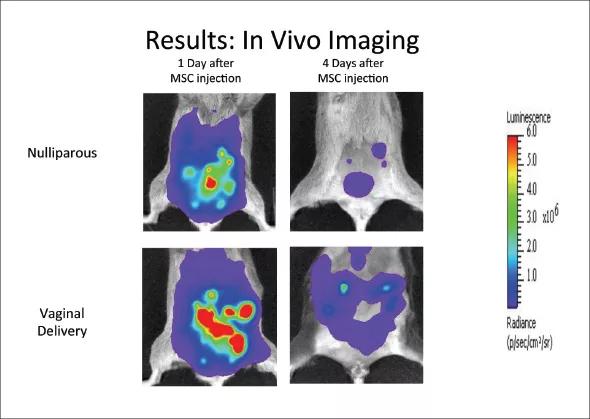
Image content: This image is available to view online.
View image online (https://assets.clevelandclinic.org/transform/59949542-728a-436c-83cf-34a6299e1e5f/15-URL-083-Goldman-Inset-Image-Fig-1-590pxl-width_jpg)
Figure 1. In vivo imaging comparing preferential homing of bone marrow-derived mesenchymal stem cells one and four days after injection in nulliparous and vaginaldelivery mice.
Ex vivo imaging demonstrated 5.8 and 3.3 times higher homing of cells in the vagina and urethra, respectively, four days after the stem cell injection. There were no differences in cell homing in other organs four days after injection compared with nulliparous animals. No differences were noted one day after injection.
After vaginal delivery, bone marrow-derived MSCs that were delivered intraperitoneally home preferentially to the vagina and urethra. This preferential homing suggests that the vagina and urethra are injured by parturition and secrete injury-related cytokines, as we have previously confirmed.
Advertisement
A semi-local cell delivery route such as intraperitoneal injection may enable a regenerative therapy to reach areas of injury not accessible by a local delivery mechanism. Assuming a diffuse injury provoked by the parturition process, our results could be relevant for future stem cell-based therapies for delivery-related disorders, such as POP.
Dr. Goldman is a staff member of Cleveland Clinic Glickman Urological & Kidney Institute’s Department of Urology. He is also the Urological & Kidney Institute’s Vice Chair for Quality and Patient Safety, and a Professor of Medicine at Cleveland Clinic Lerner College of Medicine.
Dr. Pizarro-Berdichevksy is a clinical fellow in the Department of Urology.
Advertisement
Advertisement
Clinicians should individualize dosing practices based on patient risk factors and preferences
Pioneering and refining the approach in pyeloplasty, nephrectomy and more
Fully-automated process uses preop CT, baseline GFR to estimate post-nephrectomy renal function
Could mean earlier treatment, but also could have negative effects

Unlike earlier pills, new drugs do not cause liver toxicity
Male factors play a role in about half of all infertility cases, yet men often are not evaluated
Surgeons choreograph nearly simultaneous procedures, sharing one robot between two patients

Identifying barriers in the renal genetic assessment of Black patients