Locations:





Project PASS aims to reduce attempts, assess services for efficacy

Image content: This image is available to view online.
View image online (https://assets.clevelandclinic.org/transform/f3dcc43a-eb99-4b10-876c-9e427f59ef24/650x450-GettyImages-172155747_jpg)
650×450-GettyImages-172155747
By Tatiana Falcone, MD; Migle Staniskyte, BA; and Jane Timmons-Mitchell, PhD
Advertisement
Cleveland Clinic is a non-profit academic medical center. Advertising on our site helps support our mission. We do not endorse non-Cleveland Clinic products or services. Policy
Every year, approximately 157,000 youths receive medical care for suicide-related injuries at emergency departments (EDs) throughout the U.S. What differentiates those who return to the healthcare system for another suicide-related complaint from those who do not?
That’s a key focus of a research collaboration around youth suicide prevention among Cleveland Clinic, Case Western Reserve University and the Ohio Suicide Prevention Foundation. We are part of the team carrying out this collaboration, and our ongoing research aims to identify risk factors for suicide in adolescents. This article (1) reviews results from a recent retrospective review of risk factors in high-risk adolescents and (2) previews a new clinical study designed to determine which services are most likely to prevent repeat suicide attempts and rehospitalization among youths with prior suicide attempts.
Our recent retrospective review, presented at the 2015 annual meeting of the American Academy of Child & Adolescent Psychiatry, was based on an analysis of 1,200 adolescent patients who came to any of 13 EDs in the Cleveland Clinic health system with a suicide-related complaint in 2013.
Of these 1,200 patients, 320 returned in the next three months for suicidal ideation or related behavior. We reviewed the electronic health records of 176 of those patients, who ultimately constituted our sample.
Of these 176 youths, 97 did not return for a suicide complaint during the year and were classified as “nonrepeaters,” while 79 did return for a suicide complaint and were classified as “repeaters.” Patients were also separately evaluated according to whether they had had a suicide attempt (SA) versus suicidal ideation (SI).
Advertisement
Patients in the sample were predominantly male (69 percent) and Caucasian (57 percent). Ages ranged from 6 to 17 years, with an overall mean of 14.21 years (SD = 1.99).
The repeater and nonrepeater groups were equivalent in terms of gender, race/ethnicity and age, as were the SA and SI groups.
ED encounters and inpatient admissions were significantly higher among repeaters compared with nonrepeaters, whereas the SA and SI groups did not differ on these variables.
Patients in the SA group were significantly more likely to be repeaters than were those in the SI group, based on one-sided Fisher’s exact test analysis (P = .042). Similarly, repeaters were significantly more likely to present with SA, while nonrepeaters were more likely to present with SI (Table 1).
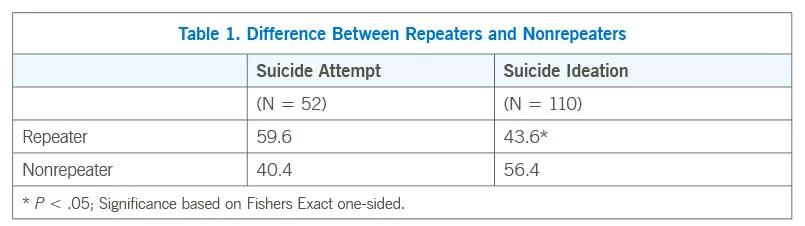
Image content: This image is available to view online.
View image online (https://assets.clevelandclinic.org/transform/f9d0e265-4d23-4e6f-970c-33ea5536d6ab/Table-1_jpg)
Among repeaters, patients in the SA group were significantly more likely to report both sexual and emotional abuse than were those in the SI group (Table 2).
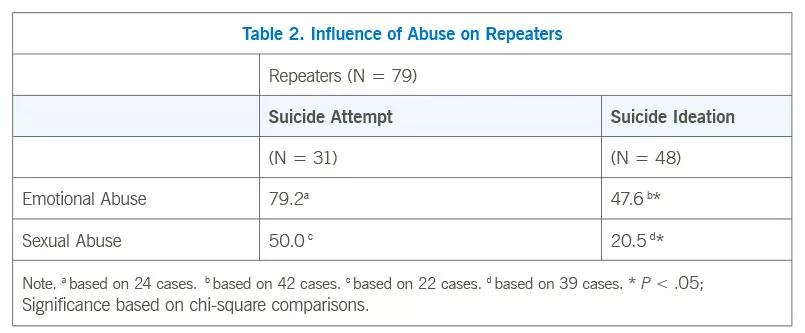
Image content: This image is available to view online.
View image online (https://assets.clevelandclinic.org/transform/e89133b1-69a5-40bb-bf30-711d658a1be2/Table-2_jpg)
Our research team is looking to build on these retrospective findings, particularly in view of the important gap in mental health services for suicide attempt survivors after discharge and the belief that enhancing access to services in the first week after discharge may reduce the risk of a second attempt.
Mental health services are often not securely in place for these individuals, and a first appointment can take several weeks to arrange. Caregivers frequently express frustration about the inability to access mental health services sooner, and many suicidal youths do not receive outpatient mental healthcare because of limited access.
Advertisement
With the aim of improving care for this high-risk youth population, our team has designed Project PASS (Promoting Access to Stop Suicide). Goals of this project include:
Participants will be randomly assigned to one of three treatment arms:

Image content: This image is available to view online.
View image online (https://assets.clevelandclinic.org/transform/b80251a3-4ab0-4ff5-999e-1b830f82c57a/Figure-1_jpg)
Figure. Sample postcards to be sent to participants throughout the study.
Project PASS will be providing services to high-risk youths in Ohio. The project also includes a study to measure improvement in young people at high risk for suicide. The randomized controlled trial, for youths discharged from an inpatient psychiatric hospital, is designed to determine which combination of services (as outlined above) is most likely to prevent subsequent suicide attempts and rehospitalization. We expect to recruit at least 135 participants during the study’s four-year duration.
We look forward to sharing results and insights from this project in the years ahead.
Advancing Strategies for Youth Suicide Prevention is a collaborative research study between Case Western Reserve University, Ohio Suicide Prevention Foundation and Cleveland Clinic. The Substance Abuse and Mental Health Services Administration is funding this collaboration (SM62894-01).
Advertisement
Suggested reading
Torio CM, Encinosa W, Berdahl T, et al. Annual report on health care for children and youth in the United States: National estimates of cost, utilization and expenditures for children with mental health conditions. Acad Pediatr. 2015;15(1):19-35.
Falcone T, Mishra L, Carlton E, et al. Suicidal behavior in adolescents with first-episode psychosis. Clin Schizophr Relat Psychoses. 2010;4(1):34-40.
Dr. Falcone is a child and adolescent psychiatrist in Cleveland Clinic’s Center for Behavioral Health who is leading multiple projects on suicide prevention. She is also an assistant professor of medicine at Cleveland Clinic Lerner College of Medicine.
Ms. Staniskyte is a research coordinator for Project PASS in Cleveland Clinic’s Neurological Institute.
Dr. Timmons-Mitchell is a senior research associate with the Begun Center for Violence Prevention Research and Education at the Jack, Joseph and Morton Mandel School of Applied Sciences within Case Western Reserve University (CWRU), Cleveland. She is also an associate clinical professor of psychology at CWRU School of Medicine.
Advertisement
Advertisement

New study advances understanding of patient-defined goals

Testing options and therapies are expanding for this poorly understood sleep disorder

Real-world claims data and tissue culture studies set the stage for randomized clinical testing
Digital subtraction angiography remains central to assessment of ‘benign’ PMSAH

Cleveland Clinic neuromuscular specialist shares insights on AI in his field and beyond

Findings challenge dogma that microglia are exclusively destructive regardless of location in brain

Neurology is especially well positioned for opportunities to enhance clinical care and medical training

New review distills insights from studies over the past decade
 Search