Locations:





Drug blocks chemo’s effects on primordial follicles
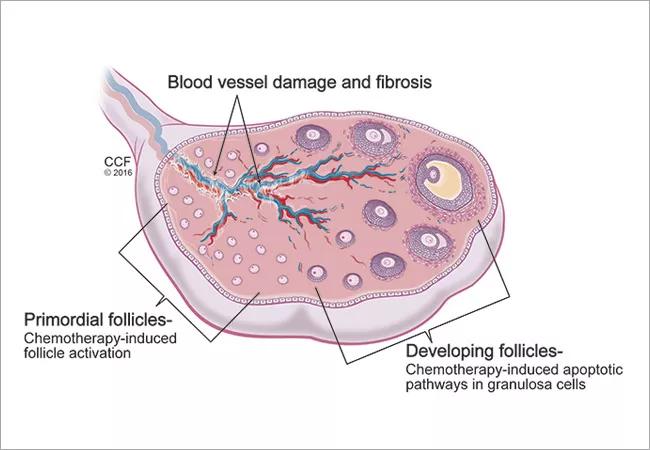
Image content: This image is available to view online.
View image online (https://assets.clevelandclinic.org/transform/bc6078d5-bf09-44d9-8c2e-0ccd3fb8254d/17-OBG-390-Falcone-650x450-1_jpg)
17-OBG-390-Falcone-650×450
Advertisement
Cleveland Clinic is a non-profit academic medical center. Advertising on our site helps support our mission. We do not endorse non-Cleveland Clinic products or services. Policy
A diagnosis of cancer is a life-changing event. There are so many aspects of this disease that must be considered, one of which is quality of life associated with preservation of ovarian function.
Preserving ovarian function is important not only to safeguard fertility, but also to maintaining quality of life and preventing medical consequences. For example, the hormonal changes that often accompany loss of ovarian function can affect sexual function and lead to psychological stress and relationship strain. Alterations in hormonal function may also lead to early menopause symptoms, osteoporosis and cardiovascular disease.
In our review, we highlighted the options women have for preserving ovarian function while undergoing chemotherapy. For preservation of fertility, we offer in vitro fertilization with egg or embryo freezing, if the patient has a partner. These forms of treatment are not considered experimental.
New ovarian stimulation protocols can be initiated immediately to avoid delaying chemotherapy. Furthermore, aromatase inhibitors can be used to decrease estradiol levels in women with estrogen-sensitive tumors such as breast cancer.
Experimentally, we can offer ovarian tissue cryopreservation and subsequent autotransplantation when the medical oncologists deem that the disease is in remission. The advantage of this procedure is that it can be done immediately with no delay in treatment, an option that is appealing for patients whose tumors that require instantaneous treatment.
Advertisement
None of these treatments, however, protect gonadal function long term. Even with autotransplantation, the longevity of the graft is generally only a few years, although it may be longer.
The ideal scenario is one in which the patient receives a drug that blocks the effects of chemotherapy on the most sensitive ovarian cells — the primordial follicles. For the moment, the only drug available is a gonadotropin releasing-hormone agonist such as leuprolide acetate.
The use of this drug is controversial because it traditionally is used to suppress the hypothalamic-pituitary-ovarian axis rather than to protect the ovaries from the effects of chemotherapy. We reviewed the evidence that supports this latter use, especially in breast cancer patients. Although leuprolide acetate is considered experimental for this indication, it is the only one available that can potentially protect gonadal function in women undergoing chemotherapy.
Advertisement
Advertisement
Counseling and careful surgical considerations are key

Deprivation is linked to impaired glucose intolerance and racial disparities

Perioperative prophylaxis and class III obesity

Artesunate ointment is safe well and tolerated patients with vulvar intraepithelial neoplasia
Endoscopic balloon dilation during pregnancy helps optimize outcomes
Researchers examine waste and implore colleagues to take action

Mode of delivery does not affect patient satisfaction
 Search