Locations:





Early learnings include how to make the most of multidisciplinary resources
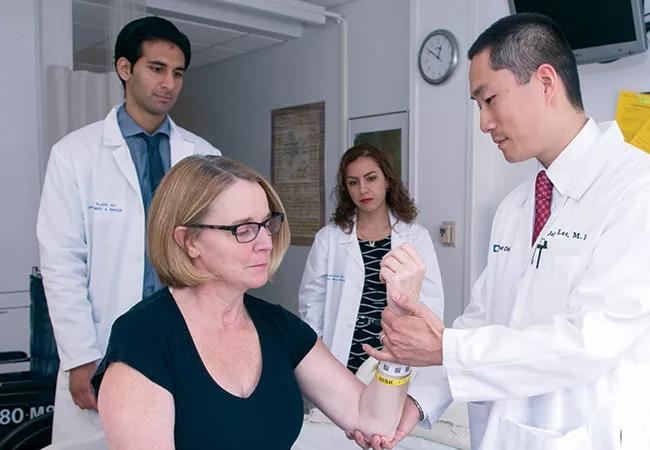
Image content: This image is available to view online.
View image online (https://assets.clevelandclinic.org/transform/e39821e1-59c6-4b72-aa87-0a8887e19225/16-NEU-1705-Lee-650x450_jpg)
16-NEU-1705-Lee-650×450
At a time when other U.S. institutions are closing or scaling back residency programs in physical medicine and rehabilitation (PM&R), Cleveland Clinic has done just the opposite: In July 2016, it welcomed the first two residents (see box below) in its new three-year PM&R residency program.
Advertisement
Cleveland Clinic is a non-profit academic medical center. Advertising on our site helps support our mission. We do not endorse non-Cleveland Clinic products or services. Policy
“The launch of this residency program, along with Cleveland Clinic’s new and expanding joint venture with Select Medical to operate inpatient rehabilitation hospitals, signals the commitment our health system has made to PM&R,” says Frederick S. Frost, MD, Chairman of the Department of Physical Medicine and Rehabilitation. “As more and more baby boomers enter and approach their 70s, physiatry’s importance as a specialty is only increasing. Cleveland Clinic gets that and is responding to train the expert clinicians needed to meet the demand.”
The new ACGME-accredited residency program, first profiled here in late 2015 while still in development, derives some distinctive benefits from being offered at Cleveland Clinic, according to PM&R Residency Program Director John Lee, MD:
Exposure to a diverse mix of highly complex cases. As a tertiary and quaternary referral center, Cleveland Clinic draws patients from around the world for highly specialized care for the most challenging conditions. “Our residents encounter an incredible array of patients and rehabilitative needs,” says Dr. Lee. He notes that they’ll care for patients with neurological conditions ranging from stroke to Parkinson’s disease to spinal cord injuries as well as patients recovering from complex surgeries like multiorgan transplants or requiring rehab for heart failure or the effects of cancer therapy.
Extensive interactions with specialists outside PM&R. While certainly not unique to Cleveland Clinic, opportunities for such interactions are more abundant at large institutions like this one. “Take our program’s geriatrics rotation,” says Dr. Lee. “It involves patients that physiatrists often care for, but residents are rotating directly with geriatricians, not physiatrists, so they see the care of these patients from a different — and potentially invaluable — perspective.”
Advertisement
The rotation in Cleveland Clinic’s renowned Chronic Pain Rehabilitation Program is another case in point. “Because this program is run by psychiatrists, our PM&R residents are exposed to how psychiatry deals with chronic pain issues from a multidisciplinary perspective,” Dr. Lee notes.
Other outpatient rotations offer further opportunities for multidisciplinary exposure, and additional rotations are being planned for direct training with more specialties, including neurosurgery, orthopaedics, family practice and others. “These will grow over time,” says Dr. Lee.
Abundant practice settings. Residents, who are in PGYs 2-4, train across a diversity of clinical settings, including three Cleveland Clinic inpatient rehabilitation hospitals for adults, Cleveland Clinic Children’s Hospital for Rehabilitation, multiple family health centers, the Cleveland VA Medical Center (for amputee care) and the MetroHealth Rehabilitation Institute of Ohio (for spinal cord injury and traumatic brain injury care).
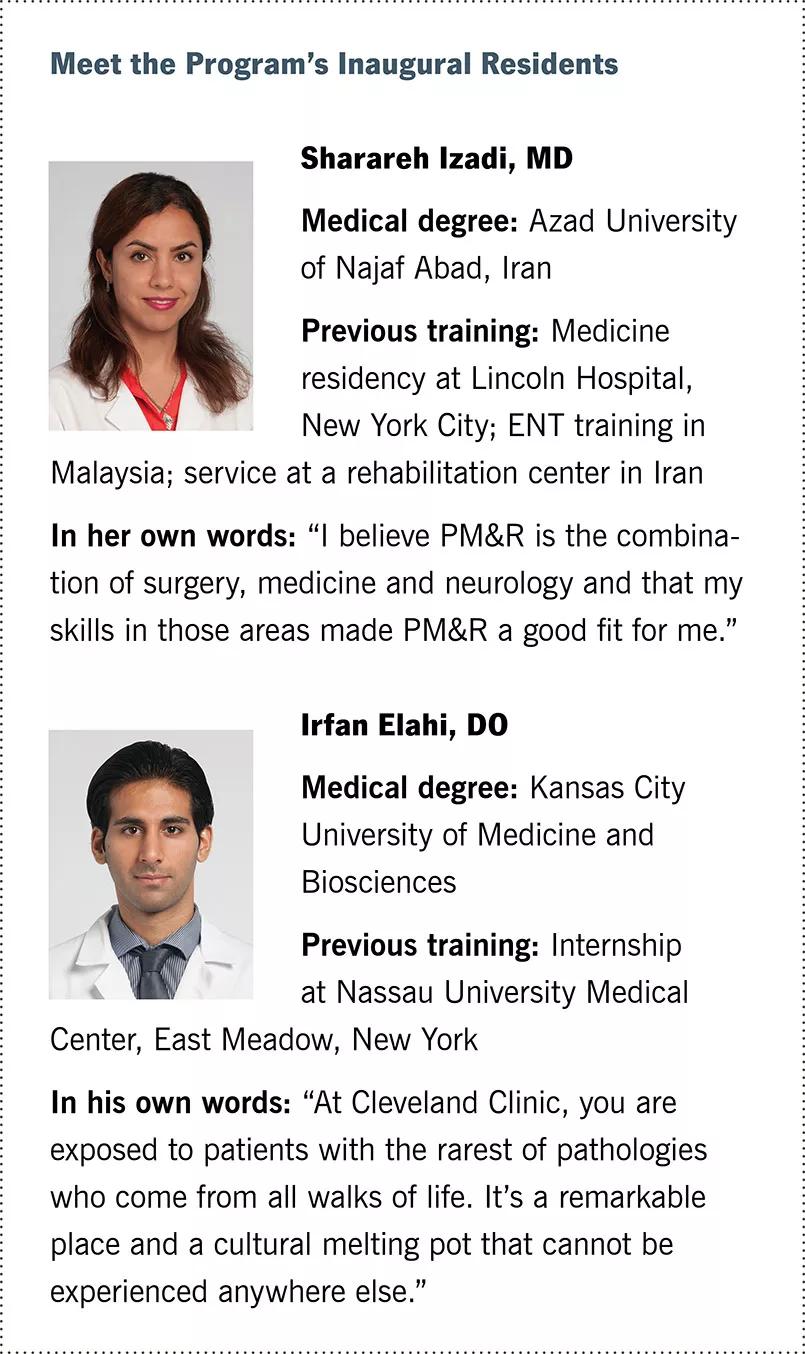
Image content: This image is available to view online.
View image online (https://assets.clevelandclinic.org/transform/07fcf025-6646-4fe9-babc-48e2287b894d/16-NEU-1705-Lee-Inset_jpg)
Dr. Lee sees additional strengths stemming directly from the program’s newness. “Because we just started, we’re able to build the program as it grows and be fairly flexible and innovative,” he says. He cites the fact that residents can consider a broad range of topics and mentors — including many multidisciplinary opportunities — for their research project as they discover areas of interest while proceeding through the program.
“Also, because we currently have only two residents, we can tailor the rotations according to residents’ interests,” he points out. “So within the confines of ACGME requirements, we have the flexibility to create rotations that appeal to an individual’s interest in a given clinical area.”
Advertisement
He adds that the number of residents will grow over time to better match Cleveland Clinic’s large patient volumes and clinical breadth.
Dr. Lee notes that the new residency program was developed over three years and with input from 44 Cleveland Clinic PM&R clinicians and researchers.
Reflecting on that experience, he offers this advice to other institutions looking to start or refresh a PM&R residency: “Knowing your institution’s resources very well is important, from the standpoint of clinical volumes and the other specialties you can tap into. Because PM&R works so closely with so many other specialties, take full advantage of all the learning opportunities your nonphysiatrist colleagues can offer your residents.”
Advertisement
Advertisement

New study advances understanding of patient-defined goals
Testing options and therapies are expanding for this poorly understood sleep disorder

Real-world claims data and tissue culture studies set the stage for randomized clinical testing
Digital subtraction angiography remains central to assessment of ‘benign’ PMSAH

Cleveland Clinic neuromuscular specialist shares insights on AI in his field and beyond
Findings challenge dogma that microglia are exclusively destructive regardless of location in brain

Neurology is especially well positioned for opportunities to enhance clinical care and medical training

New review distills insights from studies over the past decade
 Search