Locations:





A new study quantifies just how much

Image content: This image is available to view online.
View image online (https://assets.clevelandclinic.org/transform/7324c613-c82b-4eab-b847-0aa566ae157d/18-RHE-1032-Husni-Hero-Image-650x450pxl_jpg)
18-RHE-1032-Husni-Hero-Image-650x450pxl
Current treatments for rheumatoid arthritis (RA) bring trade-offs for patients: am I okay with a higher risk of cancer if I can live with much less pain? Does a significant increase in function outweigh an increased risk of serious infection? A new study led by M. Elaine Husni, MD, MPH, sought to quantify these questions to help physicians both understand how patients analyze the costs and benefits of RA treatments and engage in shared decision-making.
Advertisement
Cleveland Clinic is a non-profit academic medical center. Advertising on our site helps support our mission. We do not endorse non-Cleveland Clinic products or services. Policy
In this discrete choice experiment published in Rheumatology International, researchers asked 510 participants to choose between two hypothetical RA treatments. The treatments had varied levels of efficacy, adverse events and process-related attributes. Using multivariable logistic regression, Dr. Husni, Director of Cleveland Clinic’s Arthritis and Musculoskeletal Treatment Center, and her team assessed the association between these attributes and patients’ decisions and calculated a risk-increase. The results showed that patients with moderate to severe RA will accept increased risk for better physical function and disease control. Just how much?
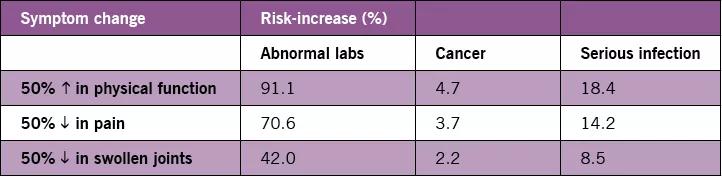
Image content: This image is available to view online.
View image online (https://assets.clevelandclinic.org/transform/41ade30f-3ce7-4e84-a4d4-947b76cb18aa/18-RHE-1032-Husni-Table-01-650pxl-width_jpg)
Adverse effects may discourage some physicians from prescribing the biologic treatments recommended for RA patients with moderate to high disease activity after failure of conventional disease-modifying antirheumatic drugs (DMARDs). “The results of this study show that patients are willing to accept the risk if the benefits are significant, and the increases they’re willing to accept are higher than the actual risk in most cases,” says Dr. Husni. “As physicians, if we understand how patients value treatments, we can improve their acceptance of what we recommend.”
This study is the first in the U.S. to quantify the benefit-risk thresholds in the treatment of RA.
Advertisement
Advertisement

Treatment strategies require understanding of pathomechanisms
Education, prevention strategies and monitoring serves this at-risk group

Treatment for scleroderma can sometimes cause esophageal symptoms

Lupus Clinic providers collaborate to advance treatment and understanding

Older Psoriasis Patients May Experience Quicker Transition

Cleveland Clinic’s Rheumatic Lung Disease program treats patients with complex conditions

Symptoms complement one another

E-coaching program is tailored for those with the disease
 Search