Locations:





Rising expectations of today’s patients spur innovation
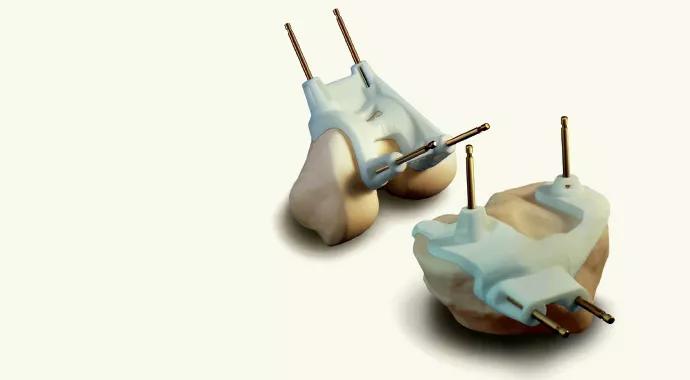
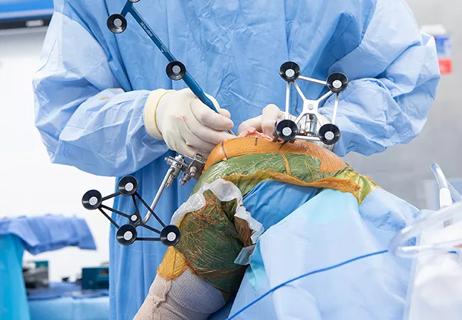
Image content: This image is available to view online.
View image online (https://assets.clevelandclinic.org/transform/0438224a-2aad-4bac-b974-a5d95606c03c/14-ORT-976-Murray-Hero-Image-690x380pxl_jpg)
14-ORT-976-Murray-Hero-Image-690x380pxl
By Trevor G. Murray, MD, and Alison Klika, MS
Advertisement
Cleveland Clinic is a non-profit academic medical center. Advertising on our site helps support our mission. We do not endorse non-Cleveland Clinic products or services. Policy
The number of total knee replacements (TKRs) performed annually in the United States doubled from 1999 to 2008 and is projected to rise by an additional 600 percent by 2030. Consistent with this trend, the volume of TKR procedures performed at Cleveland Clinic has risen 30 percent over the past five years. These increases are attributable to an expansion of indications to younger and more active patients as well as to the burgeoning population of aging baby boomers. These patients are demanding more from their joint replacements than ever before.
The rising expectations of today’s TKR patients have spurred the pursuit of improvements in the design, delivery and execution of TKR. A recent technological focus is patient-specific positioning guides, which are custom guides made to match an individual patient’s anatomy, potentially allowing the surgeon to perform TKR more efficiently and accurately.
Most of the major orthopaedic implant manufacturers offer versions of this technology, all of which are based on the mechanical axis. CT or MRI scanning with or without a long leg radiograph is used to build the custom cutting blocks. Many facilities within the Cleveland Clinic health system are equipped with the imaging protocols required by the device manufacturers to facilitate production of these guides, enabling patients to be accommodated with minimal inconvenience.
The goals for arthroplasty are to reduce pain and restore function by way of a well-placed, durable TKR. Many laboratory investigations, finite element studies and clinical outcome trials have demonstrated that appropriate alignment is critical to achieving these objectives. Traditional cutting guides aid in the placement of components, but studies have shown that there is room for improvement. Navigation systems were developed with the hope of improving accuracy and reproducibility of TKR, although literature reports have been conflicting and emphasize concerns about increased cost, time in the operating room (OR) and complications.
Advertisement
Patient-specific cutting guides (see Figure for example) offer several potential benefits, including reduced OR time, increased efficiency in case preparation, decreased blood loss and improved outcomes secondary to improved component alignment.
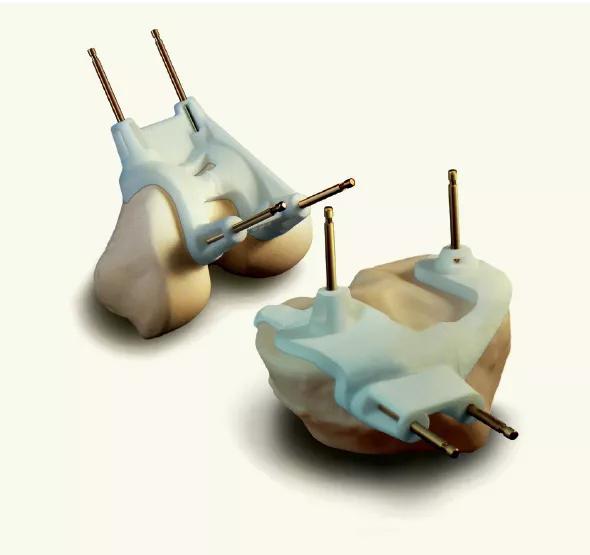
Image content: This image is available to view online.
View image online (https://assets.clevelandclinic.org/transform/ca384a89-9e2e-45f0-9926-e29109349335/15-ORT-976-Murray-Inset-Image-590pxl-width_jpg)
Figure. Patient-specific cutting guides pinned to models of the femur and tibia. Reprinted with permission from Zimmer.
This technology takes the “navigation” portion of the procedure, and all the time that it requires, out of the OR. The plan is established preoperatively and can be implemented at the time of surgery quickly. The custom guides pin onto the distal femur and proximal tibia without violating either canal. The theoretical advantages of this approach include reduced blood loss, which in turn should reduce transfusion requirements and ultimately decrease infection rates.
Customization allows the operation to be performed with fewer tools and trays, resulting in decreased turnover time and improved OR efficiency. Although the use of patient-specific guides does increase up-front costs to the hospital, it has been suggested that these costs may be offset by the reductions in OR time and by lower revision rates as a result of improvements in alignment. Early data in the literature provide some support for these claims.
Today’s healthcare climate dictates pursuit of technologies aimed at improving clinical outcomes while enhancing efficiency. Patient-specific instrumentation has the potential to be a technology that achieves both of these objectives. At Cleveland Clinic, we are committed to research to evaluate outcomes as we continue our use of patient-specific instrumentation.
Advertisement
Dr. Murray is an orthopaedic surgeon in the Department of Orthopaedic Surgery’s Center for Adult Reconstruction. He specializes in primary and revision total hip and knee arthroplasty.
Ms. Klika is a research program manager for the Department of Orthopaedic Surgery and Surgical Operations.
Ng VY, DeClaire JH, Berend KR, Gulick BC, Lombardi AV Jr. Improved accuracy of alignment with patient-specific positioning guides compared with manual instrumentation in TKA. Clin Orthop Relat Res. 2012;470:99-107.
Advertisement
Advertisement
Biologic approaches, growing implants and more
Study reports zero infections in nearly 300 patients
How to diagnose and treat crystalline arthropathy after knee replacement
Study finds that fracture and infection are rare
Center will coordinate, interpret and archive imaging data for all multicenter trials conducted by the foundation’s Osteoarthritis Clinical Trial Network

Reduced narcotic use is the latest on the list of robotic surgery advantages
Cleveland Clinic specialists offer annual refresher on upper extremity fundamentals
Cleveland Clinic orthopaedic surgeons share their best tips, most challenging cases and biggest misperceptions
 Search