Locations:





Examining 18 years of surgical outcomes
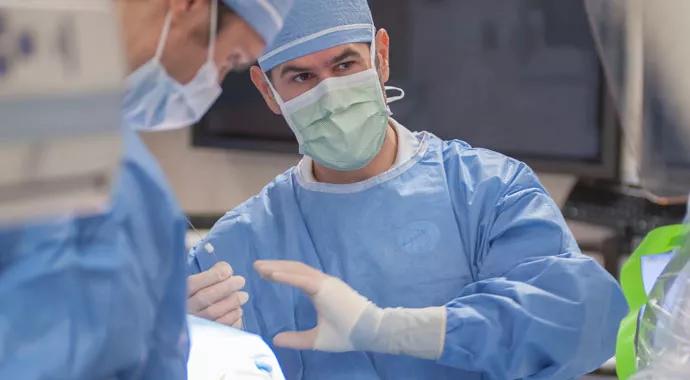
Image content: This image is available to view online.
View image online (https://assets.clevelandclinic.org/transform/c6736be6-146f-4fdd-9cfe-8359b401258c/EpilepsySurg-690x380_jpg)
EpilepsySurg-690×380
Cleveland Clinic Epilepsy Center staff recently examined 18 years of epilepsy surgery outcomes data from more than 2,000 patients to evaluate patients’ long-term chances of achieving and maintaining seizure freedom. Seizure outcomes were classified using the widely accepted Engel classification1 of seizure freedom (seizure-free = Engel class 1).
Advertisement
Cleveland Clinic is a non-profit academic medical center. Advertising on our site helps support our mission. We do not endorse non-Cleveland Clinic products or services. Policy
As detailed in the graph and table below, approximately 60 percent of patients with previously medically intractable epilepsy remained seizure-free 10 years after surgical treatment at Cleveland Clinic’s Epilepsy Center. Individual curves for adult patients and pediatric patients who underwent epilepsy surgery at the center from 1996 to 2014 show similar long-term chances of seizure freedom between these two populations.
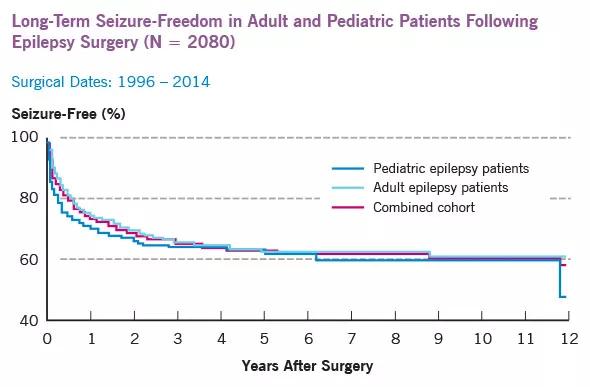
Image content: This image is available to view online.
View image online (https://assets.clevelandclinic.org/transform/21321509-3d41-4334-8f22-0e9c2197db2b/EpilepsySurg-inset1_jpg)
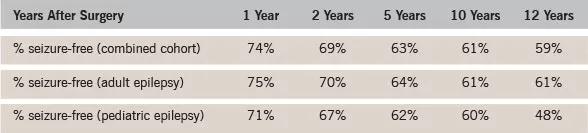
Image content: This image is available to view online.
View image online (https://assets.clevelandclinic.org/transform/b4e2f588-15aa-4ade-91f6-2430aa5073f5/EpilepsySurg-inset2_jpg)
These data are a sampling of what’s included in the newly released 2014 Outcomes book from Cleveland Clinic’s Neurological Institute. The book is one in a series of Outcomes books issued each year by more than a dozen of Cleveland Clinic’s institutes for the purpose of enabling evaluation of care delivery in common areas of medical and surgical treatment. The books, which are intended for a physician audience, benefit outside clinicians by helping inform potential referral or consultation decisions. The process of outcomes collection and analysis behind the books benefits Cleveland Clinic by guiding continuous improvement efforts and yielding data to generate research questions.
For free access to the online version of the 2014 Neurological Institute Outcomes book, which also includes profiles of new technologies and innovations from the Neurological Institute, click here.
Advertisement
Advertisement

New study advances understanding of patient-defined goals
Testing options and therapies are expanding for this poorly understood sleep disorder
Real-world claims data and tissue culture studies set the stage for randomized clinical testing
Digital subtraction angiography remains central to assessment of ‘benign’ PMSAH

Cleveland Clinic neuromuscular specialist shares insights on AI in his field and beyond
Findings challenge dogma that microglia are exclusively destructive regardless of location in brain
Neurology is especially well positioned for opportunities to enhance clinical care and medical training
New review distills insights from studies over the past decade
 Search