Locations:





Cleveland Clinic Florida offers several alternatives
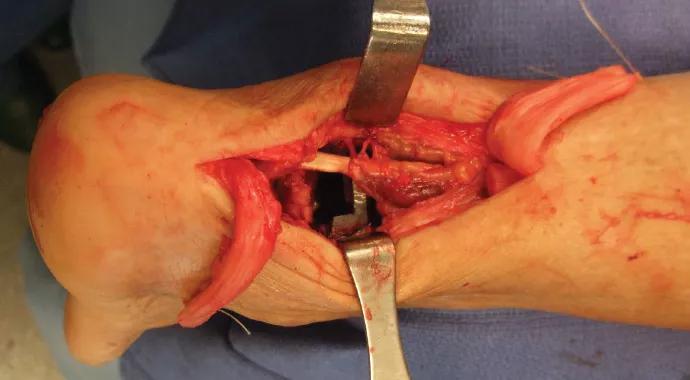
Image content: This image is available to view online.
View image online (https://assets.clevelandclinic.org/transform/0c3b0fca-40de-42c8-83fb-b6ebda45a953/Srinath-Hero-Image-690x380pxl_jpg)
Srinath-Hero-Image-690x380pxl
Advertisement
Cleveland Clinic is a non-profit academic medical center. Advertising on our site helps support our mission. We do not endorse non-Cleveland Clinic products or services. Policy
While ankle replacement is becoming more common in patients with ankle arthritis, ankle fusion is still a necessary and reliable procedure for many patients who are not candidates for replacement or in whom replacement has failed.
The patient with a history of ankle trauma, surgery or infection can be a challenge, and at Cleveland Clinic Florida, we offer alternative approaches to handle these difficult situations. Arthroscopic and “mini-open” approaches are ways to minimize soft tissue dissection and preserve blood supply. The posterior approach can be used when there is anterior skin compromise (Figure 1).
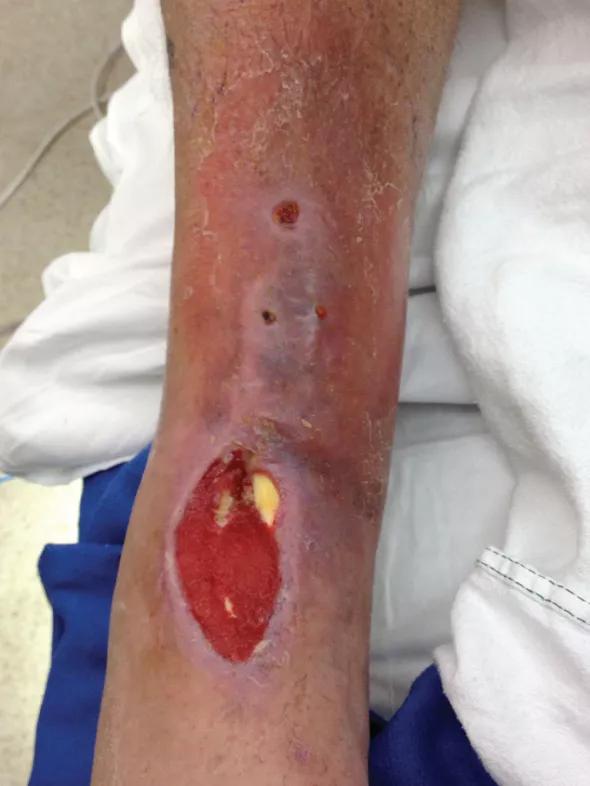
Image content: This image is available to view online.
View image online (https://assets.clevelandclinic.org/transform/ba6d3088-2a65-4281-8c31-38e99d2cd0b0/Srinath-Inset-Image-Figure-1-590pxl-width_jpg)
Figure 1. An example of anterior skin compromise that may prompt consideration of a posterior approach to ankle fusion.
Arthroscopic and mini-open techniques. The arthroscopic technique is ideal in patients with minimal deformity. Standard anteromedial and anterolateral arthroscopic portals are created. A combination of curettes, burrs and shavers is used to denude the cartilage. Screws are then placed percutaneously for compression. Fusion rates with this technique have been as high as 97 percent, with healing occurring as early as nine weeks postoperatively.
If a larger degree of deformity correction is needed, an alternative to arthroscopy is the mini-open technique. Originally described by Myerson and colleagues (see Suggested Reading below), this procedure is performed through small incisions and limits periosteal stripping. Because this technique avoids resecting the fibula, vascularity to the ankle joint is maintained.
Advertisement
In the mini-open approach, two incisions are made, each 2.5 cm in length. The first is created between the medial malleolus and anterior tibialis tendon. The second is over the anterolateral joint line lateral to the superficial peroneal nerve. A laminar spreader is alternated from medial to lateral to distract the joint and denude the cartilage with osteotomes. As with the arthroscopic technique, screws are placed percutaneously.
Posterior approach. When an arthroscopic or mini-open technique is not an option, the posterior approach is a versatile procedure that can be performed through a single incision and offers a healthy and deep soft tissue bed for reconstruction.
The patient is placed in the prone position and a longitudinal incision is made through the skin and down to the paratenon. The Achilles tendon can be split longitudinally and left in place, although my preference is to perform a Z cut, which allows the tendon ends to be sutured down and out of the working area (Figure 2). This also limits tension on the skin resulting from prolonged retraction. The deep posterior compartment fascia is incised, and then the flexor hallucis longus tendon is identified and retracted medially to protect the neurovascular bundle. Full exposure of the posterior tibia, ankle joint, subtalar joint and distal fibula is possible.
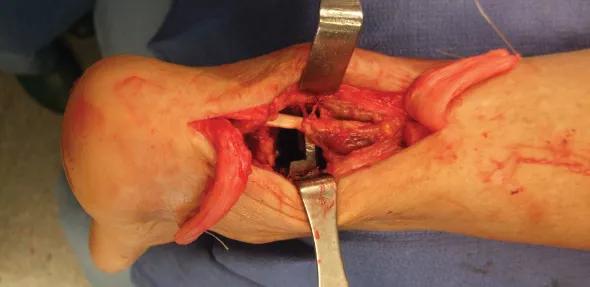
Image content: This image is available to view online.
View image online (https://assets.clevelandclinic.org/transform/0f4486f5-a813-48f0-9335-d0b605f8d55c/Srinath-Inset-Image-Figure-2-590pxl-width_jpg)
Figure 2. Posterior approach to ankle fusion using a Z cut. The Achilles tendon ends are sutured down to clear the surgical area and reduce tension on the skin from prolonged retraction.
Advertisement
This technique can be used not only for ankle fusions but also for more complex reconstructions such as conversion of total ankle replacement to tibiotalocalcaneal fusion.
The capability to perform ankle and hindfoot fusion through multiple approaches is needed for challenging patients with compromised soft tissues. The arthroscopic and mini-open procedures offer preservation of blood supply and avoidance of the complications associated with larger incisions. The posterior approach avoids compromised anterior soft tissues and allows for deformity correction and salvage of previous surgical cases.
-Nickisch F, Avilucea FR, Beals T, Saltzman C. Open posterior approach for tibiotalar arthrodesis. Foot Ankle Clin. 2011;16(1):103-114.
-Ferkel RD, Hewitt M. Long-term results of arthroscopic ankle arthrodesis. Foot Ankle Int. 2005;26(4):275-280.
-Paremain GD, Miller SD, Myerson MS. Ankle arthrodesis: results after the miniarthrotomy technique. Foot Ankle Int. 1996;17(5):247-252.
Dr. Srinath is a member of the Department of Orthopaedic Surgery at Cleveland Clinic Florida specializing in injuries and deformities of the ankle and foot.
Advertisement
Advertisement
Biologic approaches, growing implants and more
Study reports zero infections in nearly 300 patients
How to diagnose and treat crystalline arthropathy after knee replacement
Study finds that fracture and infection are rare
Center will coordinate, interpret and archive imaging data for all multicenter trials conducted by the foundation’s Osteoarthritis Clinical Trial Network

Reduced narcotic use is the latest on the list of robotic surgery advantages
Cleveland Clinic specialists offer annual refresher on upper extremity fundamentals
Cleveland Clinic orthopaedic surgeons share their best tips, most challenging cases and biggest misperceptions
 Search