Locations:





Retrospective chart review demonstrates the strategy’s feasibility
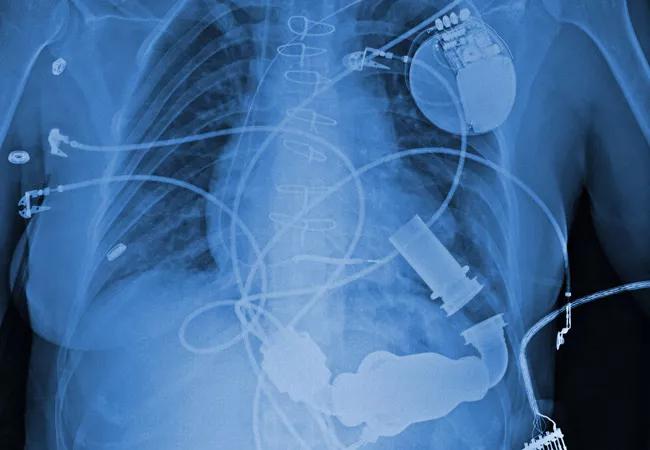
Image content: This image is available to view online.
View image online (https://assets.clevelandclinic.org/transform/609e4a4b-24be-45ff-a930-d1a4a5720bf5/18-HRT-430-LVAD-650x450-1_jpg)
In LVAD Patients with Atrial Arrhythmias, Rhythm Control Offers Little Benefit
Use of an opioid-sparing regimen for postoperative pain management after left ventricular assist device (LVAD) implantation resulted in pain control comparable to that achieved with an opioid-based regimen while significantly reducing subsequent chronic opioid use.
Advertisement
Cleveland Clinic is a non-profit academic medical center. Advertising on our site helps support our mission. We do not endorse non-Cleveland Clinic products or services. Policy
So reported Cleveland Clinic researchers presenting results of a retrospective chart review at the Heart Failure Society of America’s 2019 annual meeting.
The opioid-sparing regimen was associated with a significant decrease in need for opioid prescriptions at hospital discharge and with sustained freedom from chronic opioid use 18 months after surgery, reported Dmitry Yaranov, MD, a recent Cleveland Clinic advanced heart failure and transplant cardiology fellow who presented the results.
“Opioid therapy has historically been the dominant means of postoperative analgesia in cardiac surgery, but multimodal pain approaches using opioid-sparing techniques have grown in prevalence,” says Dr. Yaranov. “Nevertheless, we were aware of no reported data on the use of opioid-sparing regimens in patients receiving LVADs, so we undertook this analysis.”
The study reviewed the charts of all 196 adult LVAD recipients at Cleveland Clinic from 2014 through 2017, comparing pain control and opioid use between those who received their LVADs before versus after Cleveland Clinic’s June 2016 adoption of an opioid-sparing regimen for LVAD patients.
The opioid-sparing regimen was developed by Cleveland Clinic’s multidisciplinary heart failure team in consultation with the 2016 Centers for Disease Control and Prevention Guideline for Prescribing Opioids for Chronic Pain and several other guideline documents. The approach was developed in collaboration with Cleveland Clinic’s Department of Pain Management.
Advertisement
The protocol begins with tapering of opioids the day an LVAD recipient is transferred from the surgical ICU to a regular nursing floor. Opioid therapy is supplemented with non-opioid alternatives, including around-the-clock acetaminophen, lidocaine patches and, in some patients, gabapentin.
“The taper has to be individualized, yet we will not increase the opioid dose back to a previous level but instead move forward by escalating non-opioid alternatives,” notes heart failure critical care nurse and study co-investigator Kimberly Miracle, NP.
Adoption of the opioid-sparing regimen included new pain management training for midlevel providers on the mechanical circulatory support team, with an emphasis on preoperative education of patients.
“A big part of pain is the fear associated with it,” explains Richard Rosenquist, MD, Chair of the Department of Pain Management and another co-investigator. “Teaching patients before surgery that some pain is to be expected helps patients cope by making them less afraid of what is happening to them.”
A total of 196 patients received LVADs over the three-year study period. The sample was evenly divided between those receiving LVADs before (n = 98) and after (n = 98) adoption of the opioid-sparing regimen (OSR), and the before and after groups were statistically similar in all major patient characteristics, including age, sex, LVAD etiology, prior opioid use, baseline pain score, length of stay and others.
Postoperative pain intensity was reported by patients using the Numeric Rating Scale (NRS-11), and chronic opioid use (defined as 90 days of continuous use or 120 days of non-continuous use within a year) was assessed via review of the Ohio Automated Rx Reporting System.
Advertisement
Results on the primary endpoints were as follows:
“These findings demonstrate the feasibility of an opioid-sparing approach for delivering postoperative pain control that’s comparable to that with a traditional opioid-based strategy in patients receiving LVADs, with the added benefit of markedly reduced opioid prescriptions at hospital discharge and high rates of long-term freedom from opioids,” says co-investigator Wilson Tang, MD, Research Director of the Section of Heart Failure and Cardiac Transplantation Medicine.
“The success of our opioid-sparing regimen stems from a unified team approach to postoperative pain management that includes consistent and measurable opiate standards, use of a written opioid education tool, and consistent messaging to patients about pain expectations and their daily plan of care for pain management,” adds co-investigator Edward Soltesz, MD, MPH, Surgical Director of the Kaufman Center for Heart Failure and Recovery. “This retrospective study suggests that approaches like this can consistently yield significant reductions in patients’ opioid use following LVAD surgery.”
Advertisement
LVAD teams looking to implement a similar protocol should consult with those who have already done so and should plan to be persistent, advises co-investigator and senior social worker Kay Kendall, LISW. “It is difficult to change the management of pain in this setting, but this is a professional responsibility for all caregivers,” she says.
Advertisement
Advertisement

A sampling of outcome and volume data from our Heart & Vascular Institute
Concomitant AF ablation and LAA occlusion strongly endorsed during elective heart surgery
Large retrospective study supports its addition to BAV repair toolbox at expert centers
Young age, solid tumor, high uptake on PET and KRAS mutation signal risk, suggest need for lobectomy
Surprise findings argue for caution about testosterone use in men at risk for fracture
Residual AR related to severe preoperative AR increases risk of progression, need for reoperation

Findings support emphasis on markers of frailty related to, but not dependent on, age
Provides option for patients previously deemed anatomically unsuitable
 Search