Locations:





Cleveland Clinic announces readiness to enroll first patient in trial
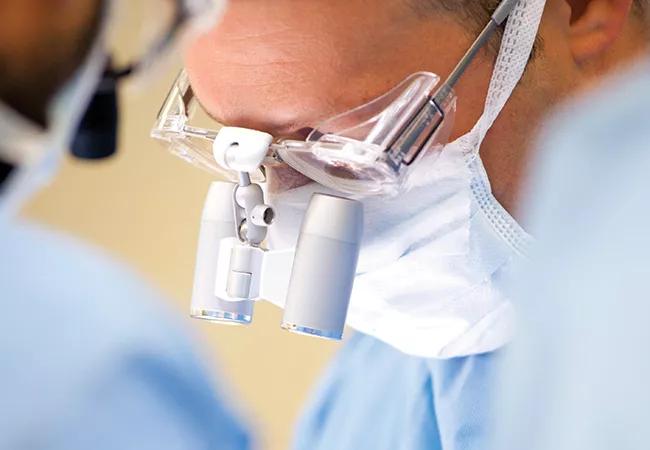
Image content: This image is available to view online.
View image online (https://assets.clevelandclinic.org/transform/93cf8dd2-372d-4399-a96b-f579cb26a78e/650x450-Machado-Surgery_jpg)
650×450-Machado-Surgery
Cleveland Clinic is ready to begin the first human trial of deep brain stimulation (DBS) for post-stroke physical rehabilitation. So announced the trial’s leader, Andre Machado, MD, PhD, Chairman of Cleveland Clinic’s Neurological Institute, this week. The news follows Cleveland Clinic’s recent approval from the FDA to conduct the pioneering trial, as reported earlier this year on Consult QD.
Advertisement
Cleveland Clinic is a non-profit academic medical center. Advertising on our site helps support our mission. We do not endorse non-Cleveland Clinic products or services. Policy
The go-ahead from the FDA came after 10 years of research by Dr. Machado and his team using a rodent model of stroke. That work showed that stimulation of a novel brain pathway promoted motor recovery along with neurogenesis and angiogenesis in the thalamus and perilesional cortex, as reported last year.
“Our findings suggested that DBS of the cerebello-thalamo-cortical pathway may enhance the brain’s plasticity and ability to form new neural connections during recovery from stroke,” says Dr. Machado, a neurosurgeon (shown in surgery in the photo above) who will perform the DBS procedures in the newly launched trial. “The expectation is that stimulation may augment the effects of physical rehabilitation for stroke.”
He notes that the cerebellum, which controls voluntary muscle movements, was part of the region targeted for stimulation in the hope of reestablishing flow of neurological input to the brain hemisphere affected by stroke.
Candidates for the new trial will be ischemic stroke patients who suffered a stroke 12 to 24 months previously and have residual severe weakness affecting one arm despite treatment with physical therapy. Key questions the trial will seek to address include:
Dr. Machado notes that the goal of DBS in this setting is to augment, not replace, the effects of physical rehabilitation. “The proposition here is to make that recovery greater,” he told Time magazine in a new exclusive interview.
Advertisement
In the same interview he noted what most distinguishes this latest application of DBS from prior uses of the technology, such as for movement disorders: “The big difference is that when we are treating the motor symptoms of Parkinson’s disease, we’re trying to make the symptom, like a tremor, go away. When we are treating stroke, we are really trying to make movement come back. There is something inherently different about that.”
Advertisement
Advertisement

New study advances understanding of patient-defined goals
Testing options and therapies are expanding for this poorly understood sleep disorder
Real-world claims data and tissue culture studies set the stage for randomized clinical testing
Digital subtraction angiography remains central to assessment of ‘benign’ PMSAH

Cleveland Clinic neuromuscular specialist shares insights on AI in his field and beyond
Findings challenge dogma that microglia are exclusively destructive regardless of location in brain
Neurology is especially well positioned for opportunities to enhance clinical care and medical training
New review distills insights from studies over the past decade
 Search