Locations:





Combining remote and direct techniques to avoid bypass
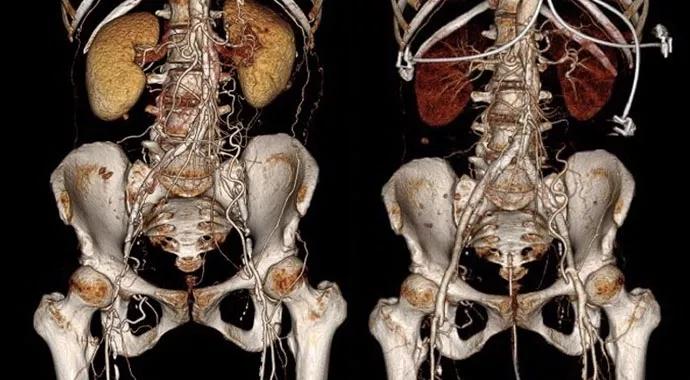
Image content: This image is available to view online.
View image online (https://assets.clevelandclinic.org/transform/7a178c68-19da-433b-85a0-41fc15ad1b03/HybridRevasc-690x380_jpg)
Hybrid Approach to Restorative Vascular Surgery
Aortobifemoral bypass (ABF) grafting is the traditional treatment for extensive aortoiliac occlusive disease. But the endarterectomy and its modern incarnation — the remote endarterectomy (EndoRE) — offer an important option in revascularization.
Advertisement
Cleveland Clinic is a non-profit academic medical center. Advertising on our site helps support our mission. We do not endorse non-Cleveland Clinic products or services. Policy
The advantages, according to W. Michael Park, MD, a vascular surgeon in Cleveland Clinic’s Department of Vascular Surgery, include the following:
Dr. Park is one of only a few surgeons in the United States performing this procedure that restores the superficial femoral artery to its original state without incisions, and he is the only one with extensive experience in removing occluded stents. The hybrid technique is based on an established technique of open remote endarterectomy dating back to the 1960s.
“It’s a revival of an old way of doing things,” Dr. Park says. “It’s a lost art because everyone is doing stents. The problem is that they block up. After that, bypass with autologous vein typically is performed, but when that fails, the options are limited.”
That’s when having this third option, after stenting and bypass, is really useful. “This offers another avenue of revascularization,” he says.
In his blog, Dr. Park details two cases that highlight this restorative therapy option, which is used extensively in Europe.
The first case involves diffuse bilateral iliac atherosclerotic plaque with occlusion of the right common femoral artery and left common and external iliac artery. The 70-year-old female patient was unable to walk due to severe leg pain.
Advertisement
Dr. Park was able to restore function by performing a hybrid common femoral and profunda femoris endarterectomy, external iliac artery EndoRE and common iliac artery stenting.
EndoABF is an established hybrid procedure involving an open endarterectomy of the common femoral and profunda femoris/superficial femoral arteries with iliac balloon angioplasty and stenting; often the stents are taken distally into the common femoral artery and the patch to deal with complex distal external iliac artery plaque.
Taking it a step further, Dr. Park removes plaque from the common femoral artery, along with doing an iliac endarterectomy. He uses a slight variation with the EndoRE-ABF, which removes a great deal of external plaque surgically, reopening the previously occluded artery. By combining the remote and direct techniques, he is able to avoid using bypass, which can involve nominal and substantial blood loss, as well as remove occlusive stents.
Dr. Park says this hybrid procedure is an excellent option for patients who have undergone multiple prior procedures and patients with infections who need revascularization.
The procedure is also highlighted in a second case, in which Dr. Park was able to remove all the patient’s stents without bypass. In this case, the patient had undergone multiple procedures for leg pain that only worsened with intervention. The patient also had a groin infection from a previous surgery, making bypass challenging.
“By using this hybrid approach, I was able to avoid going back into the groin and avoid long incisions to remove the vein,” Dr. Park observes.
Advertisement
Advertisement

A sampling of outcome and volume data from our Heart & Vascular Institute
Concomitant AF ablation and LAA occlusion strongly endorsed during elective heart surgery
Large retrospective study supports its addition to BAV repair toolbox at expert centers
Young age, solid tumor, high uptake on PET and KRAS mutation signal risk, suggest need for lobectomy
Surprise findings argue for caution about testosterone use in men at risk for fracture
Residual AR related to severe preoperative AR increases risk of progression, need for reoperation

Findings support emphasis on markers of frailty related to, but not dependent on, age
Provides option for patients previously deemed anatomically unsuitable
 Search