Locations:





Poses matter less than taking a few minutes now and then to move mindfully
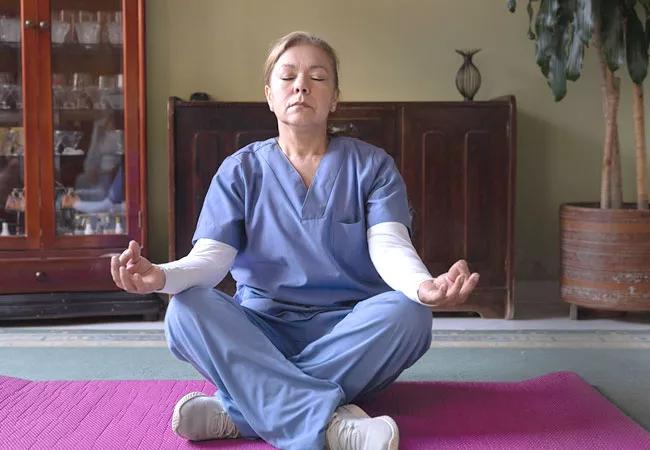
Image content: This image is available to view online.
View image online (https://assets.clevelandclinic.org/transform/06ad3232-6ef2-4ca4-a05a-bc700abe233a/21-NUR-2414669-Energizing-Yoga-Poses-StartYourDayRight-CQD_650x450_jpg)
yoga for nurses
Research studies have substantiated yoga’s health benefits – including how practicing the ancient discipline can help reduce stress. For healthcare workers in particular, yoga has been shown to reduce stress levels and feelings of burnout.
Advertisement
Cleveland Clinic is a non-profit academic medical center. Advertising on our site helps support our mission. We do not endorse non-Cleveland Clinic products or services. Policy
As the ongoing pandemic continues to tax healthcare workers and add to stress, anxiety and chronic pain, now might be the perfect time to give yoga a try.
Whether you’re a seasoned yogi or you’ve never done a downward dog, it is possible to work some yoga postures into your workday without rolling out a mat or drawing any attention to yourself.
The following list highlights a few moves you can do to relieve stress and pain from head to toe while on the job. All of the moves can be done in 30 seconds. Certified Yoga Therapist Judi Bar, C-IAYT, E-RYT500, lead yoga therapist for the Wellness and Preventive Medicine Department at Cleveland Clinic, suggests trying to integrate at least three of them into your shift.
“Taking a quick pause to incorporate one of these yoga moves during times of stress can help stop the body’s physical response to stress in that moment,” Bar says.
It can also help bring your awareness to the present moment – a state known as mindfulness.
“If you can really be present, focus on what is going on in that moment and not thinking of the next thing you have to do instead, that helps to decrease stress levels,” Bar says.
Good posture is important and practicing it is something you can do all day, Bar says. Practice standing straight – shoulders back, head tall – while walking and try “mountain pose” when you have a chance to stand or sit still.
“Standing straight can help you breathe better, improve your circulation and give you more energy,” Bar says.
· Mountain pose: Stand with your feet apart 2 to 3 inches. Your knees, hips and toes should be facing forward, muscles in the legs and buttocks should be active, and your abdomen should be pulled in slightly. Stand with a tall spine and shrug your shoulders up and then back and down.
Advertisement
Your chin should be parallel to the ground with the top of your head reaching to ceiling; arms relaxed down at your sides. Stand for a breath, breathing in and out of the nose as deeply and slowly as possible.
· Shoulder roll (to loosen tension in the shoulders): Roll your shoulders up, back and down three or four times while seated or standing.
Then, roll the shoulders up, forward and down, going slower when moving forward to feel the shoulder blades pull away from spine.
Take deep, cleansing breaths, breathing in and out of the nose as deep and slow as possible.
· Side bend (to stretch the neck and sides): While standing in mountain pose, inhale, lengthen your torso, drop your ear to your right shoulder and take a breath or two. Let your arms hang at your side when bending to the side. Move your head back up, inhale and then switch sides.
· Neck stretches (to loosen tension in the neck):
From mountain pose, keep your body facing forward and turn your neck and look to the right, with your chin parallel to the ground; breathe in and out of the nose slowly and deeply. Turn your head back to neutral. Repeat on the left.
· Back-body stretch: From mountain pose, face a wall or table and place your hands on it.
Step back and hinge forward at the hips, folding halfway down, to make an “L” shape. Keep your feet under your hips and bend or straighten your knees. Breathe easy and pause to feel the stretch in your lower back, hamstrings and shoulders.
· Feet and lower legs: Stand straight, with your fingertips on a chair or table, bend your knees, move your weight into your toes to feel the stretch in the heels and calves; hold for three easy and slow breaths.
Advertisement
· Breathwork (for when you need to pause and take a breath; can also be done while walking or standing in mountain pose): Inhale though your nose; pause at the top of the inhale, and then exhale through your mouth slowly. Make the exhale a little longer than the inhale. To stimulate the relaxation response, repeat this two to three times.
If you can find the time outside of work, an at-home yoga practice of even just 15 minutes a few times a week can do wonders for your overall stress level and well-being. It can help you learn to quiet your mind and relax while easing physical pain. There are lots of apps and videos available online that offering varying lengths of practice and levels of intensity.
“The idea is self-care,” Bar says. “What poses you do don’t matter. Do what feels best for you and makes you feel most relaxed.”
Advertisement
Advertisement

Nurses play key role in comprehensive lifetime treatment program

Customized bots improve speed, efficiency by streamlining daily clinical, clerical tasks

Nurses play pivotal role in patients’ ability to recover in the comfort of their own homes
New protocol reduces costs, increases patient and caregiver satisfaction
Advocating for patient safety is imperative in fast-paced surgical settings

M-Power program improves the perinatal experience for people who have survived abuse

Advice for those pursuing a WOC nursing career
Veteran nurse shares his experience as a caregiver and community volunteer
 Search