Locations:





Nurse scientists bridge divide between bench and bedside
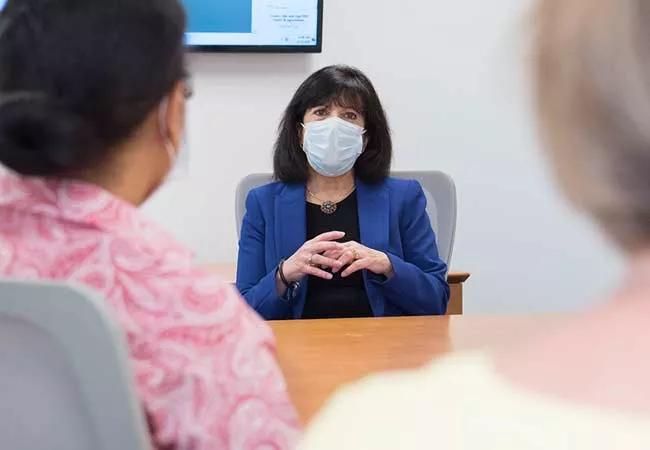
Image content: This image is available to view online.
View image online (https://assets.clevelandclinic.org/transform/3f5f2b6b-5e11-4568-9241-5b5a58468ec7/22-NUR-3320411-MeansToBeNurse-Scientist-CQD_650x450_jpg)
22-NUR-3320411-MeansToBeNurse-Scientist-CQD_650x450
As Associate Chief Nursing Officer of Cleveland Clinic’s Office of Nursing Research and Innovation, Nancy M. Albert, PhD, CCNS, CHFN, CCRN, NE-BC, FAHA, FCCM, FHFSA, FAAN, has one of the key characteristics necessary for a nurse scientist: curiosity.
Advertisement
Cleveland Clinic is a non-profit academic medical center. Advertising on our site helps support our mission. We do not endorse non-Cleveland Clinic products or services. Policy
“I tend to ask a lot of questions. I like to know why, what and how,” says Albert, who is one of seven nurse scientists in her office. “When I was a clinical nurse in the ICU, I wasn’t happy with the status quo unless I really understood the behind-the-scenes reasoning for decisions.”
That curiosity is one of the reasons Dr. Albert pursued her PhD from Kent State University in 2000 and became a full-time nurse scientist in 2004. The role encompasses many types of work.
“First and foremost, nurse scientists are trained as research scientists and are able to conduct, disseminate and translate nursing research,” says Dr. Albert. “In a hospital setting, they guide nurses in research to ensure the work is rigorous and the results have value.” This includes mentoring nurses in developing proposals for evidence-based practice and implementation science projects, conducting research in a way that is feasible for busy clinical nurses, evaluating outcomes, interpreting results and disseminating findings.
In addition to a team of dedicated nurse scientists, Cleveland Clinic has doctoral and other terminal degree-trained nurses who work in a clinical setting and pursue research projects in their areas of expertise.
The most common path to becoming a nurse scientist is to earn a doctorate in philosophy (PhD) or other research-based doctoral degree in nursing, education or science. In addition, a master’s degree in public health can benefit those with a focus in epidemiology and population health research. After obtaining a PhD degree, nurse scientists may also complete a research fellowship to advance their skills and knowledge. Cleveland Clinic offers a three-year, postdoctoral distance-mediated clinical research fellowship.
Advertisement
“When nurse scientists finish their PhD program, the outcome is completion of one dissertation, so they have practical knowledge in one type of research, such as a descriptive correlational design or a randomized control study,” says Dr. Albert. “For nurse scientists in the academic field, or those who want to mentor other nurses, a research fellowship steeps them in other types of research designs and the multiple methodologies used to answer research questions.”
Nurse scientists also need to be skilled as first authors for peer-reviewed publications and should volunteer on national committees to stay abreast of trends in healthcare or their clinical fields.
One of the advantages of having nurse scientists employed at a healthcare system is that they can help the organization rigorously evaluate innovative programs and practice decisions.
“Nurse scientists know how to review and synthesize the literature; they can interpret research findings accurately,” says Dr. Albert. “Having and understanding information in the literature can help a hospital define and design a new program, as well as determine if locally-led research or published evidence is ready to be translated into clinical practice.”
The goal of translating research into practice is to improve the lives of patients, improve clinical and quality outcomes or create nursing efficiencies, all of which benefit healthcare organizations, says Dr. Albert. Her first experience with research – and its subsequent translation into practice – influenced her decision to become a nurse scientist.
Advertisement
As a nurse manager in an intensive care unit at Cleveland Clinic, she approached the medical director about implementing a newly available catheter to measure pulmonary artery pressure. He asked her to conduct research since there was no published clinical evidence of its accuracy. Dr. Albert sought the advice of the health system’s nurse scientist, then designed and conducted a research study. The results validated that the catheter produced accurate ejection fraction data, and findings were published in a peer-reviewed journal.
“The practical application of having done this research project and being mentored by somebody who knew how to do research was very helpful to me,” says Dr. Albert.
The guidance and support of mentors is invaluable for budding researchers. When Karen Distelhorst, PhD, APRN, GCNS-BC, served as a clinical nurse specialist at Cleveland Clinic South Pointe Hospital, the community hospital set a goal to achieve Magnet® designation. The CNO asked if she would lead a research study, which is required as part of the Magnet Recognition Program.
“With Nancy Albert as my mentor, my first study looked at factors that influence patient adherence to follow-up appointments after discharge,” says Dr. Distelhorst, now a nurse scientist at Cleveland Clinic. “She is such an incredible mentor. After working with her on the project, I caught the research bug.”
South Pointe Hospital received its Magnet designation in 2017, and Dr. Distelhorst earned her doctorate from Kent State University in 2020, joining the Office of Nursing Research and Innovation shortly afterward.
Advertisement
In addition to mentors, nurse scientists are supported by several national organizations, including the Council for Advancement of Nursing Science, the National Institute of Nursing Research, the Association for Leadership Science in Nursing and the National Pediatric Nurse Scientist Collaborative. There are also four regional professional societies. Nurse scientists at Cleveland Clinic are members of the Midwest Nursing Research Society.
These organizations and their members play influential roles.
“Hospital-based nurse scientists can help shape where the nursing profession needs to gain new knowledge. Change is inevitable in every area of clinical work and in the healthcare industry as a whole,” says Dr. Albert. “It is important for the nursing profession to improve the science behind the work we do, so that we can maintain and improve clinical outcomes.”
Advertisement
Advertisement
Nurses play key role in comprehensive lifetime treatment program
Customized bots improve speed, efficiency by streamlining daily clinical, clerical tasks

Nurses play pivotal role in patients’ ability to recover in the comfort of their own homes
New protocol reduces costs, increases patient and caregiver satisfaction

Advocating for patient safety is imperative in fast-paced surgical settings

M-Power program improves the perinatal experience for people who have survived abuse

Advice for those pursuing a WOC nursing career

Veteran nurse shares his experience as a caregiver and community volunteer
 Search