Locations:





Fast-paced nursing environment full of reward
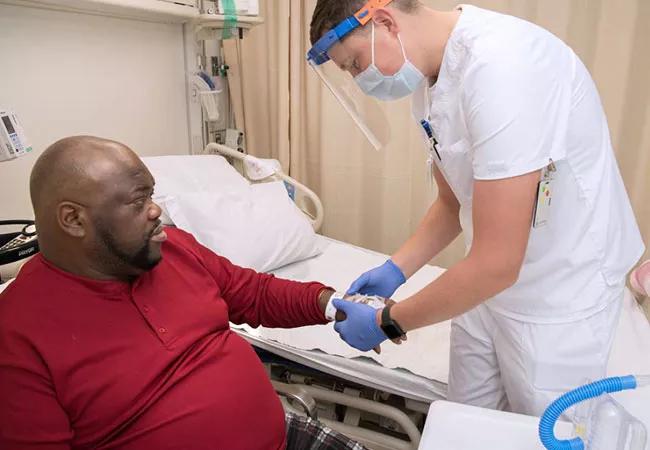
Image content: This image is available to view online.
View image online (https://assets.clevelandclinic.org/transform/00eccdfa-fcb2-4f40-b6ef-4a4a41b48c2d/20-NUR-2005297-YON-Spotlight-OrthoNurses-CQD-650x450-1_jpg)
20-NUR-2005297-YON-Spotlight-OrthoNurses-CQD-650×450
Cleveland Clinic’s Orthopaedic & Rheumatologic Institute performs more than 7,000 hip, knee, shoulder, ankle, elbow, wrist and finger joint replacements each year, which is one of the highest volumes in the United States. Surgeries performed range from severe osteoarthritis and rheumatoid arthritis to trauma. One Cleveland Clinic location specializing in orthopaedic patient care is Cleveland Clinic Euclid Hospital. The fifth floor of Euclid Hospital includes a 22-bed nursing unit that features 12 private rooms and stunning views of Lake Erie.
Advertisement
Cleveland Clinic is a non-profit academic medical center. Advertising on our site helps support our mission. We do not endorse non-Cleveland Clinic products or services. Policy
Tracy Ball, MSN, RN, NE-BC, is the Nurse Manager (NM) for the unit, which is staffed by 27 nursing caregivers – 17 registered nurses (RNs), eight patient care nursing assistants (PCNAs) and two health unit coordinators (HUCs). In addition to orthopaedic patients in need of total knee or hip replacements, shoulder, forearm, wrist or hand surgeries, knee reconstructions, Birmingham hip resurfacings or fractures, the unit also cares for patients who have had general surgery or urologic and gynecologic procedures.
Ball began working on the unit was she was still in nursing school. Through the guidance and mentoring of her manager, she was encouraged to pursue the leadership track. She went back to nursing school to earn her Master of Science in Nursing degree, was promoted to Assistant Nurse Manager (ANM) for the unit and has now had the pleasure of serving as the unit’s NM for the past 5 years.
“I always thought when I graduated nursing school I would work on a pediatric unit,” notes Ball. “Fourteen years later, I am still here, and I honestly can’t see myself anywhere else.”
She adds: “I truly love taking care of patients and watching them get better. Orthopaedic patients (for the most part) are committing to elective surgeries, so they are coming in on their own accord to become physically better than they were. They want to feel better, they want to do their therapy and they understand that the pain is only temporary.”
Ball says watching patients who have lived with chronic pain for years no longer feel that pain is a special experience for her. She recalls a patient she once cared for several years ago who noticed her outside in her front yard one day. She said the patient was riding a bike and stopped to show her that he could finally – after years of pain – ride a bike again.
Advertisement
“It’s experiences like these that solidified my decision to be an orthopaedic nurse,” Ball notes.
Ball arrives to Euclid Hospital’s orthopaedic nursing unit by 6 a.m. to interact with and receive patient updates from the team’s night shift nurses. By 7 a.m., the day shift has arrived and gathers for the daily team huddle, which is ran by the unit’s charge nurse.
After the report, the nursing staff is off and running. Since most orthopaedic patients leave the hospital the day following surgery, there is much to be accomplished in a short amount of time. Typically, this includes two daily therapy sessions per patient, which start the day of surgery. One of the primary responsibilities of orthopaedic nurses is to help patients safely move/maneuver to the restroom, a chair, or walk the unit halls. Additionally, orthopaedic nurses continuously educate patients and patients’ families on proper care during recovery. Ball says from the moment patients are admitted, nurses are educating them and their families in preparation for discharge. Nurses work closely with their physical therapy and case management colleagues to ensure patients have the tools and support needed to be discharged home safely.
“The nurses on my unit talk with patients and their families about the whole process they are going to go through, including pain and pain control, so they are prepared every step of the way,” Ball says. “One of our team’s top goals is to make sure the patient is active in their care as well as the decision-making process.”
Advertisement
Once patients reach their therapy goals and are medically cleared by their physician, nurses begin the discharge process. To avoid delays in discharge and to further ensure patients are well-prepared to continue their needed care at home, the team also conducts multidisciplinary rounding, which kicks off each day with a multidisciplinary team huddle at 8 a.m. and includes representation from nursing, case management, occupational and physical therapy, and orthopaedic program management. The collaborative group discusses plans of care and identifies potential issues or concerns.
In comparison to other medical-surgical nursing units, Ball notes that inpatient orthopaedic nursing units tend to offer more flexibility with regard to nurse staffing.
“Our staffing is a little more flexible and unique than other med-surg units. Although we go by our staffing grid, we can be creative with where we place nursing staff,” she says. “Our surgical volume increases as the week goes along and by the weekend, surgical patients have gone home so our staffing needs decrease.”
Ball, along with her ANM, continually evaluates the staffing/surgical volume of the unit, to move staff around in a way that will best meet patients’ needs. For example, she says she will often bring an RN in at 11 a.m. to offer extra support for a day’s admissions, which allows other nursing staff members working that day more opportunity to focus on their current assignments.
“We look at our surgery schedule ahead of time, which allows us to modify our staffing routinely,” Ball says. “Our staff members also help by keeping an eye on surgical volumes and offering to change their schedules accordingly.”
Advertisement
Because of the quick turnaround of orthopaedic patients, Ball says three key things that make a successful orthopaedic nurse are organizational skills, multi-tasking and teamwork. She also says orthopaedic nurses need to have tremendous patience and understanding.
“It can be a fast-paced environment, but orthopaedic nursing is very rewarding,” Ball comments. “Patients are extremely thankful for the care they receive and truly appreciate the time, patience, and thoughtfulness orthopedic nurses provide.”
Happy Year of the Nurse to all orthopaedic nurses!
Advertisement
Advertisement

Nurses play key role in comprehensive lifetime treatment program
Customized bots improve speed, efficiency by streamlining daily clinical, clerical tasks

Nurses play pivotal role in patients’ ability to recover in the comfort of their own homes
New protocol reduces costs, increases patient and caregiver satisfaction

Advocating for patient safety is imperative in fast-paced surgical settings

M-Power program improves the perinatal experience for people who have survived abuse

Advice for those pursuing a WOC nursing career

Veteran nurse shares his experience as a caregiver and community volunteer
 Search