Locations:





Research considers factors associated with occlusion
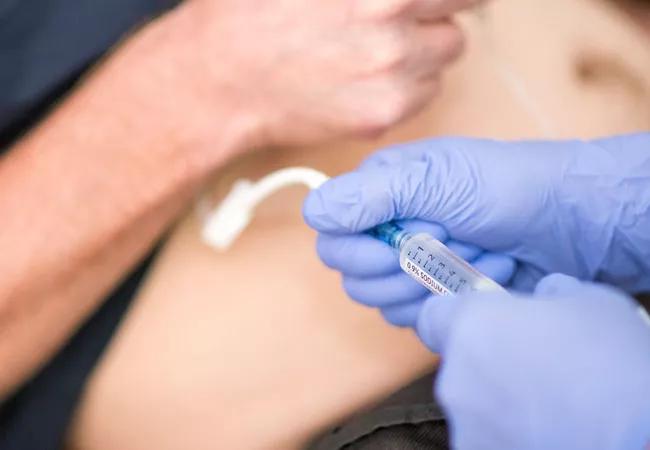
Image content: This image is available to view online.
View image online (https://assets.clevelandclinic.org/transform/f0dc268f-3d1a-4462-b2a6-71a14ed520b5/19-NUR-4198-flushingLine-650x450-002_jpg)
19-NUR-4198-flushingLine-650×450 (002)
As a member of Cleveland Clinic’s central line-associated bloodstream infections (CLABSI) Review Committee and a vascular access educator, Joyce Brodnik, MSN, RN, CCRN-K, VA-BC, is very interested in tackling the problem of CLABSI. She led a research project in 2018 on occlusions, since an occlusion is one complication of peripherally inserted central line catheters (PICCs) that can contribute to CLABSI.
Advertisement
Cleveland Clinic is a non-profit academic medical center. Advertising on our site helps support our mission. We do not endorse non-Cleveland Clinic products or services. Policy
“PICC lines require frequent flushing, dressing changes and continuous monitoring for signs of infection,” says Brodnik, a nursing professional development specialist at Cleveland Clinic. “Occlusions can be caused by a fibrin clot that blocks the lumen of the catheter. When that happens, the line can’t be used for medications or fluids; and worse, a fibrin clot can attract bacteria, making a clotted catheter a risk factor for a central line infection.”1
PICC occlusion delays medication and fluid administration and can be distressful for patients. Early recognition and treatment of line occlusion is an important preventive strategy, since PICC occlusion requires catheter replacement. Brodnik set out of understand what factors influence the occlusion of PICCs.
An observational research study, led by Brodnik and a team of nurses, involved adults admitted to the hospital with newly-inserted PICCs. The study explored the relative impact of several variables on occlusions, including the size of the syringe, routine use of anticoagulants, length of time the PICC was inserted, length of the catheter, access frequency and flushing frequency. Data were collected on variables from the day of insertion until the line was discontinued, the patient was discharged to a new level of care or the line occluded.
Between March and December 2018, Brodnik and her team of researchers obtained data on 377 PICCs. The PICC lines were assessed for a mean (SD) of 4.5 (SD = 1.2) days. During the study period, there were 18 occluded lines. “Of the multiple potential factors that are known to contribute to catheter occlusion, in this research, only one factor was important: flushing the line after using it for blood draws or medication administration,” says Brodnik. “Since PICC flushing represents a modifiable risk factor, our findings suggest that the primary cause of occlusion may be preventable. Nurses need to adhere to hospital-based PICC flushing procedures.”
Advertisement
Size or type of syringe, length of the catheter, use of anticoagulants and length of time the catheter was in place were not associated with occlusions in this study.
Brodnik is in the dissemination and translation phase, garnering support for revising local policy in PICC order sets by adding a requirement to flush the line after administering a medication or drawing serum labs. Content was added to the nursing orientation class curriculum to address the importance of careful adherence to flushing procedures. In addition, healthcare system leaders will launch a “Don’t Rush the Flush” campaign in early 2020 to educate nurses on flushing central lines. Posters will be placed on units throughout Cleveland Clinic, and vascular access resource nurses will educate nurses on their units.
“We plan to monitor both flushing documentation and occlusion rates as part of an ongoing quality improvement initiative,” says Brodnik.
1 Baskin, Jacquelyn L., et al. “Management of occlusion and thrombosis associated with long-term indwelling central venous catheters.” The Lancet 374.9684 (2009): 159-169.
Advertisement
Advertisement

Nurses play key role in comprehensive lifetime treatment program
Customized bots improve speed, efficiency by streamlining daily clinical, clerical tasks

Nurses play pivotal role in patients’ ability to recover in the comfort of their own homes

New protocol reduces costs, increases patient and caregiver satisfaction

Advocating for patient safety is imperative in fast-paced surgical settings

M-Power program improves the perinatal experience for people who have survived abuse

Advice for those pursuing a WOC nursing career

Veteran nurse shares his experience as a caregiver and community volunteer
 Search