Locations:





 Search
Data supports multifaceted approach to responsiveness
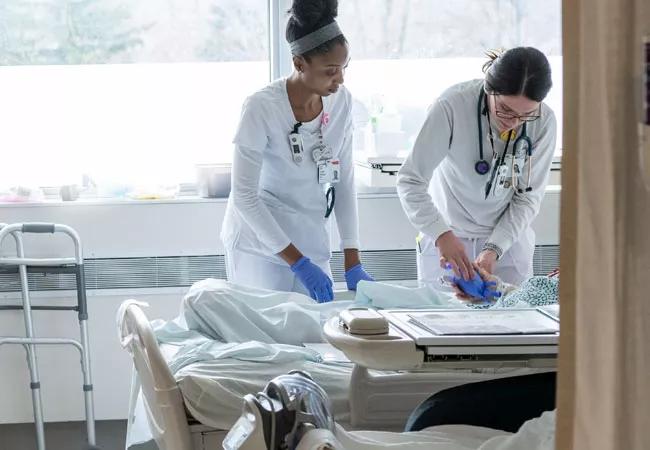
Image content: This image is available to view online.
View image online (https://assets.clevelandclinic.org/transform/b8d78a32-4c46-4801-a9c1-9fe7aa892ab7/19-NUR-5057-callLight-650x450-003_jpg)
19-NUR-5057-callLight-650×450 (003)
In 2018, nursing leaders on the bariatric surgery unit on Cleveland Clinic’s main campus realized that their HCAHPS responsiveness scores didn’t consistently meet the national benchmark of 81%, so they launched a continuous improvement project to examine call light responsiveness, decrease the total volume of patient calls and reduce the number of calls that extend beyond five minutes. The project was so successful that the two nurses who led the year-long process are now working on a manuscript to share their findings and intervention strategies.
Advertisement
Cleveland Clinic is a non-profit academic medical center. Advertising on our site helps support our mission. We do not endorse non-Cleveland Clinic products or services. Policy
Maya Shamailov, MSN, APRN, AGCNS, PCCN, a clinical nurse specialist, and Suzanne Neal, BSN, RN, CMSRN, a clinical nurse, spearheaded the continuous improvement project under the guidance of Kevin Gazley from Cleveland Clinic’s Continuous Improvement Office.
When nurses began the project in January 2018, the 10-bed bariatric surgery unit’s HCAHPS responsiveness scores were 67.5%. First, Shamailov and Neal tracked the total number of patient calls during a three-month period, as well as the number of calls greater than five minutes. They also sought to learn the reasons why patients pushed their call light buttons. Whenever a patient used the call light, the nursing caregiver or health unit coordinator who responded recorded the reason for the call in a chart kept at the nurses’ station. Neal compiled all data, placing it in a spreadsheet and summarizing the results.
“We found out that 80% of our calls were related to pain, positioning, needing to use the bathroom, IV beeping (alarms) and needing an item,” says Shamailov. “The most common reasons for using a call light were requests that could be addressed in hourly purposeful rounding.” Shamailov and Neal met with nursing caregivers on the unit to share results, discuss barriers to timely response to call lights and generate ideas to improve responsiveness.
The bariatric surgery unit implemented a multifaceted approach to enhance responsiveness, which included the following:
Advertisement
“It’s all about teamwork,” says Shamailov. “We want nursing caregivers to work together to address all patient calls proactively and, by doing so, reduce call light activations.”
Post-intervention data, collected three months after the intervention, and maintenance data, collected in the third quarter of 2018, shows the bundled intervention strategy is working: The number of calls/bariatric patient and calls/unit day significantly decreased over time.
Shamailov attributes the success of the call light responsiveness initiative to the bundling of several interventions. “Even though the individual interventions we deployed were not new, when combined, patient needs were more likely to be met,” she states. “The combination of interventions and the consistency in which nurse caregivers implemented them was the right balance in meeting patients’ responsiveness expectations.”
Advertisement
Advertisement

Nurses play key role in comprehensive lifetime treatment program
Customized bots improve speed, efficiency by streamlining daily clinical, clerical tasks
Nurses play pivotal role in patients’ ability to recover in the comfort of their own homes
New protocol reduces costs, increases patient and caregiver satisfaction

Advocating for patient safety is imperative in fast-paced surgical settings

M-Power program improves the perinatal experience for people who have survived abuse

Advice for those pursuing a WOC nursing career

Veteran nurse shares his experience as a caregiver and community volunteer