Locations:





Surgeon who did first U.S. post-approval implant shares his take
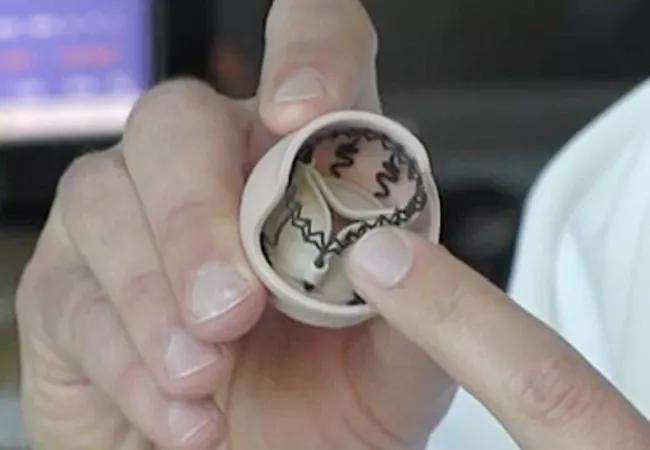
Image content: This image is available to view online.
View image online (https://assets.clevelandclinic.org/transform/bf84391c-0f9a-416c-a937-227aa9adda9f/16-HRT-412-PercevalValve-CQD-650x450_jpg)
Perceval Valve
On Feb. 29, 2016, Cleveland Clinic performed the first successful implantation of the Perceval valve in the United States following the device’s FDA approval in January. As the first commercially available sutureless aortic replacement valve, the Perceval valve shortens operative time — and thus the length of time that the heart is stopped — during aortic valve replacement procedures.
Advertisement
Cleveland Clinic is a non-profit academic medical center. Advertising on our site helps support our mission. We do not endorse non-Cleveland Clinic products or services. Policy
In this five-minute video, cardiothoracic surgeon Eric Roselli, MD — who performed the first post-approval Perceval implant — explains which types of patients stand to benefit most from the sutureless valve and how the forthcoming PERSIST trial should help refine understanding of its specific utility.
Video content: This video is available to watch online.
View video online (https://www.youtube.com/embed/7mACA_Tbkjc?feature=oembed)
New Heart Valve Technology
“A sutureless valve [allows us to] still address the native diseased valve through a surgical approach, and we cut it out like we do for a surgical operation, but instead of putting anywhere from 12 to 20 sutures inside the aorta to sew the regular stented valve in place, this Perceval self-expanding valve… is delivered inside the aorta. When it’s released, it’s this stent that seals and holds it in place with no sutures at all… that speeds up the operation, and we’ve seen so far that these devices have been very efficient in the initial trial and in commercial availability…
We’re the first center in the U.S. to use this commercially available valve, and we’ve continued to use this valve over the last several weeks and have continued to have a great experience with it.
We think that there are some very clear advantages to the use of this valve. Number one: we see that it shortens the amount of time that we have to have the heart stopped… we think that’s especially important in patients who are undergoing a multi-component operation… We also think that this can be very helpful in the patients who have calcified aorta… The third group… is the patients who are wishing to have a lesser invasive surgical approach.”
Advertisement
Advertisement

A sampling of outcome and volume data from our Heart & Vascular Institute
Concomitant AF ablation and LAA occlusion strongly endorsed during elective heart surgery
Large retrospective study supports its addition to BAV repair toolbox at expert centers
Young age, solid tumor, high uptake on PET and KRAS mutation signal risk, suggest need for lobectomy
Surprise findings argue for caution about testosterone use in men at risk for fracture
Residual AR related to severe preoperative AR increases risk of progression, need for reoperation

Findings support emphasis on markers of frailty related to, but not dependent on, age
Provides option for patients previously deemed anatomically unsuitable
 Search