Locations:





Cleveland Clinic Latino Epidemiology Cohort focuses on underrepresented communities in biomedical research
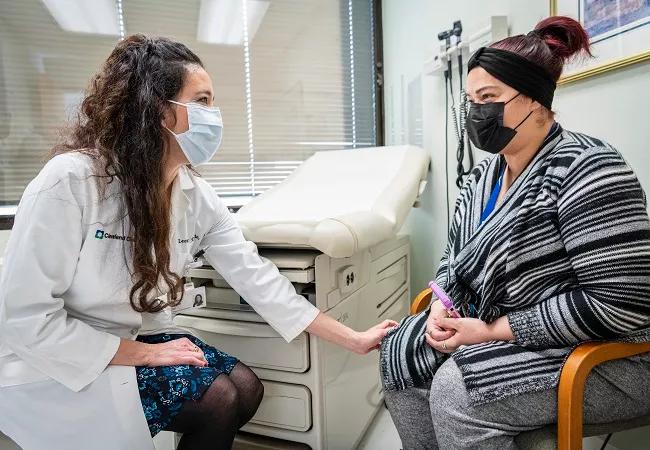
Image content: This image is available to view online.
View image online (https://assets.clevelandclinic.org/transform/a0301851-f21c-4b75-9606-67766cdb0ba4/22-CCC-2960668-Hero-4-650x450-1_jpg)
MED_Zoldsey_2677360
For decades, racial and ethnic minority populations have been largely underrepresented in health research studies. The result is missed opportunities to identify health disparities, investigate contributing factors of disease and evaluate strategies for improving health equity.
Advertisement
Cleveland Clinic is a non-profit academic medical center. Advertising on our site helps support our mission. We do not endorse non-Cleveland Clinic products or services. Policy
Cleveland Clinic researchers Stephanie Schmit, PhD, MPH, Associate Staff in the Genomic Medicine Institute (GMI), and Ignacio Mata, PhD, Assistant Staff in GMI, are changing that paradigm by establishing the Cleveland Clinic Latino Epidemiology (CCLE) Cohort.
In collaboration with colleagues from the Cleveland Clinic BioRepository, the Office of Diversity and Inclusion, the Global Center for Pathogen & Human Health Research, Cleveland Clinic Community Care (4C) and Cleveland Clinic Florida, Drs. Schmit and Mata will recruit Latino patients from Cleveland Clinic’s Ohio and Florida locations to build the initial CCLE Cohort. They will then utilize the CCLE Cohort to study biological causes for disease, risk and outcomes, initially focusing on Parkinson’s disease and colorectal cancer.
“This project closely aligns with Cleveland Clinic’s core value of inclusion and demonstrates a focused investment to engage a community that’s traditionally underrepresented in biomedical research,” says Dr. Schmit.
The team has received a one-year, $100,000 research co-laboratories award from Cleveland Clinic, which is renewable for one year pending progress. Ultimately, the CCLE Cohort will serve as a resource for additional Cleveland Clinic locations, and its leaders hope it can be harnessed to investigate other disorders in Latino populations.
The CCLE Cohort will leverage Cleveland Clinic’s large patient volumes and sophisticated electronic health record to build a research infrastructure that additional institutes and locations will be able to access when conducting research in the future.
Advertisement
“The CCLE Cohort will be the first of its kind at Cleveland Clinic,” says Dr. Mata. “Building the cohort will require a huge team effort, which is why we’re so grateful to be partnering on this important project with colleagues from across the organization.”
The study team also includes Monica Yepes-Rios, MD, Associate Staff in 4C; Lara Jehi, MD, Chief Research Information Officer and Director of the Cleveland Clinic BioRepository; Jesse Schold, PhD, Staff in the Department of Quantitative Health Sciences and the Global Center for Pathogen & Human Health Research; Hubert Fernandez, MD, Director of the Center for Neurological Restoration in the Neurological Institute; Alok Khorana, MD, Vice Chair for Clinical Services and Director of the Gastrointestinal Malignancies Program in the Taussig Cancer Institute; and Michelle Del Toro, MPH, MALS, Director of Diversity and Inclusion.
Advertisement
Advertisement


International collaboration is most genetically diverse study of the disease to date
Preclinical work promises large-scale data with minimal bias to inform development of clinical tests

Matching SNOMED Term with Curated Post. Please do not touch this post or any of its categories/snomed terms, thank you!

Matching Primary -> Secondary SNOMED Term with Curated Post. Please do not touch this post or any of its categories/snomed terms, thank you!

Cleveland Clinic researchers pursue answers on basic science and clinical fronts

Study suggests sex-specific pathways show potential for sex-specific therapeutic approaches
Cleveland Clinic launches Quantum Innovation Catalyzer Program to help start-up companies access advanced research technology
 Search