Locations:





 Search
One-stop shop elevates access to complete care
Image content: This image is available to view online.
View image online (https://assets.clevelandclinic.org/transform/a3548bd6-14bc-4b88-9377-f91e70ab67c3/Shoskes_jpg)
Shoskes
Advertisement
Cleveland Clinic is a non-profit academic medical center. Advertising on our site helps support our mission. We do not endorse non-Cleveland Clinic products or services. Policy
Central to the new Cleveland Clinic Center for Men’s Health is the recognition that systemic health conditions can have major impact on urologic conditions and their symptoms.
Benign prostatic hypertrophy (BPH); lower urinary tract symptoms (LUTS); erectile dysfunction (ED); adult-onset hypogonadism and pelvic pain, including chronic prostatitis/chronic pelvic pain syndrome (CPPS); and chronic orchialgia all can be affected by chronic disease. For instance, symptoms of LUTS, ED and CPPS are often exacerbated by cardiovascular disease and its treatment, and by low testosterone and diabetes. Furthermore, ED or LUTS could be the first manifestation of cardiovascular disease or poor diabetic control.
The Department of Urology at Cleveland Clinic created the Center for Men’s Health in August. Our goal is to improve the care of men with urologic conditions by bringing together urologists, cardiologists and endocrinologists. This allows patients to see multiple specialists at the same visit.
Other experts participating in the center treat exacerbating comorbidities. They include a psychologist/sex therapist, sleep medicine specialist (sleep apnea is associated with LUTS and ED) and pelvic floor physical therapists.
We have found that providing a “one-stop shop” speeds access and improves compliance.
Central to our approach is a new men’s health phenotype. This phenotype, with the acronym ACTIONS, classifies men according to presence and severity of seven conditions:
Advertisement
Our team has shown a correlation between total burden of systemic disease and severity of urologic symptoms. We hypothesize that the greater the systemic comorbidity burden, the less likely specific urologic interventions (medical or surgical) are likely to succeed. This is the subject of prospective research submitted for publication.
It is no secret that men could be better at tending to their health and seeking the medical care they need, and we continue to look for ways to improve access for our male patients. Expanding clinic hours into the evening and weekend is one approach. We are also sending staff to regional centers, including our Lakewood LGBT Clinic. We also are working with oncology colleagues to ensure rapid access to penile injection teaching for cancer patients with ED. We provide testosterone pellet implants (long-acting testosterone pellet inserted into hip or other fatty area) when endocrinologists do not perform the procedure.
Finally, we are looking to new technology to enhance our therapeutic options for these men. Under the leadership of urologist James Ulchaker, MD, we have been early adopters of new BPH technologies, including UroLift® System and Rezūm® System. For several years, we have offered spermatic cord denervation for chronic orchialgia. More recently, we have added low-intensity shockwave therapy . This technique can painlessly improve penile blood flow in men with ED, leading to successful erections in over 60 percent of patients. It can also be used to improve pain in CPPS, especially in men with pelvic floor spasm.
Advertisement
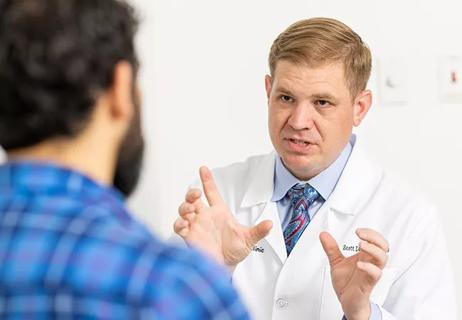
Dr. Shoskes, Glickman Urological & Kidney Institute urologist, is Director of the Cleveland Clinic Center for Men’s Health.
Advertisement
Advertisement

Clinicians should individualize dosing practices based on patient risk factors and preferences
Pioneering and refining the approach in pyeloplasty, nephrectomy and more
Fully-automated process uses preop CT, baseline GFR to estimate post-nephrectomy renal function
Could mean earlier treatment, but also could have negative effects

Unlike earlier pills, new drugs do not cause liver toxicity
Male factors play a role in about half of all infertility cases, yet men often are not evaluated
Surgeons choreograph nearly simultaneous procedures, sharing one robot between two patients

Identifying barriers in the renal genetic assessment of Black patients