Locations:





Dr. Gregory Nemunaitis looks to build on his history of integrating education, research and patient care
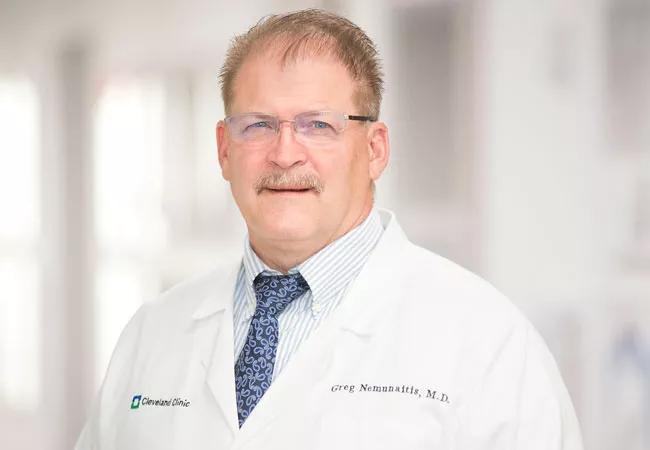
Image content: This image is available to view online.
View image online (https://assets.clevelandclinic.org/transform/35d44a4c-b034-4d69-b33c-1660b94aeef1/20-NEU-1959736-Dr_-Gregory-Nemunaitis_650x450_jpg)
20-NEU-1959736 Dr.-Gregory-Nemunaitis_650x450
This past summer, Gregory Nemunaitis, MD, headed to Middlefield, Ohio, about 45 miles east of Cleveland, to present a lecture to the Amish community about the risk of autonomic dysreflexia for people with spinal cord injuries. Dr. Nemunaitis, a board-certified physiatrist with subspecialty certification in acute spinal cord injury (SCI) medicine, has five patients in the Amish community with SCI.
Advertisement
Cleveland Clinic is a non-profit academic medical center. Advertising on our site helps support our mission. We do not endorse non-Cleveland Clinic products or services. Policy
Dr. Nemunaitis understands the importance of education. As the new Medical Director of Spinal Cord Injury Rehabilitation at Cleveland Clinic, he is committed to sharing his expertise not only with patients, but also with medical students, residents and fellows, despite the challenges of doing so in the age of coronavirus.
“With COVID-19, graduate medical education has undergone a big shift,” says Dr. Nemunaitis. To adapt, he has embraced teletraining.
When Dr. Nemunaitis joined Cleveland Clinic in February, he offered to give 42 short lectures over 14 days on the living anatomy to medical students at Case Western Reserve University (CWRU) School of Medicine. With the advent of COVID-19, that was pared down to 14 virtual lectures, created on PowerPoint with embedded audio and video of the physician examining patients. The lectures focus on the body’s major joints, including the shoulder, elbow, wrist, hand, hip, knee, ankle and cervical/lumbar spine.
Dr. Nemunaitis has also created a series of virtual lectures on the spinal cord and SCI that are presented on Wednesday mornings to residents, fellows and medical students at Cleveland Clinic Lerner College of Medicine and the CWRU School of Medicine. He often uses the lectures to educate physical therapists, allied health staff and physician colleagues, too. For instance, he presented a talk on the nuts and bolts of spinal cord medicine to Cleveland Clinic’s neurosurgery grand rounds in September.
“With the pandemic, it’s easy to just get caught up in caring for patients,” says Dr. Nemunaitis. “But we have to make time for students, even if it’s on our own time. They are the future of medicine, and the more we work with them during this difficult time, the better off we’ll be after it’s over.”
Advertisement
The insight that Dr. Nemunaitis shares with patients, students and colleagues builds on more than 30 years of experience in physical medicine and rehabilitation. Most recently, he served as Director of SCI Rehabilitation for MetroHealth Medical Center, greater Cleveland’s public health system.
Dr. Nemunaitis was the principal investigator for a Spinal Cord Injury Model Systems (SCIMS) grant from the National Institute on Disability, Independent Living, and Rehabilitation Research (NIDILRR). The SCIMS program is a national network of clinical centers that collaborate on multisite research projects and longitudinally track the experiences and outcomes of people with SCI. Under his leadership, MetroHealth was one of only 14 centers supported by the NIDILRR grant. His specific interest was to identify management options for restoration of function in individuals with cervical SCI, reduce unavoidable pressure injury from use of spine boards, and investigate functional outcomes from early data elements from the National Trauma Data Bank®.
In addition, Dr. Nemunaitis co-developed a new spine board for transporting patients with SCI that reduces board-to-skin interface pressures in an attempt to reduce the risk of pressure ulcers. “When I left MetroHealth, we had completed our final assessment of the spine board’s ability to drop pressures on the skin in contact with the board,” he says. “It was pretty remarkable.”
Among his other accomplishments, Dr. Nemunaitis helped found the Northeast Ohio Chapter of the United Spinal Association in 2002, and he currently serves on the board of directors of the American Spinal Injury Association.
Advertisement
In his new role as Medical Director of SCI Rehabilitation at Cleveland Clinic, Dr. Nemunaitis’ goal is to build an elite SCI program. “The program is being developed as a three-pronged approach to fostering the best care, education and research for this population of people with traumatic and nontraumatic SCI,” he says.
Care provided will include inpatient and outpatient services for patients, an acute care home program, respite care and consulting services. Research activities will stem from care of people with SCI, leading to collaborations with educational institutions, other healthcare providers and private enterprises to develop programs for acute and chronic SCI. “I have close working relationships with the major hospitals in the area, and I’m hopeful we can work together on this,” says Dr. Nemunaitis.
One such fruitful collaboration is the Spinal Cord Injury Medicine Fellowship, which Dr. Nemunaitis launched at MetroHealth in 2006. As a partner in the one-year fellowship, Cleveland Clinic hosts fellows for a three-month rotation. Since its inception, the program has trained 16 fellows, all of whom passed their board examinations on the first try.
Advertisement
Advertisement
New study advances understanding of patient-defined goals
Testing options and therapies are expanding for this poorly understood sleep disorder
Real-world claims data and tissue culture studies set the stage for randomized clinical testing
Digital subtraction angiography remains central to assessment of ‘benign’ PMSAH

Cleveland Clinic neuromuscular specialist shares insights on AI in his field and beyond
Findings challenge dogma that microglia are exclusively destructive regardless of location in brain
Neurology is especially well positioned for opportunities to enhance clinical care and medical training
New review distills insights from studies over the past decade
 Search