Locations:





Understanding resistance in PARP inhibitor therapy
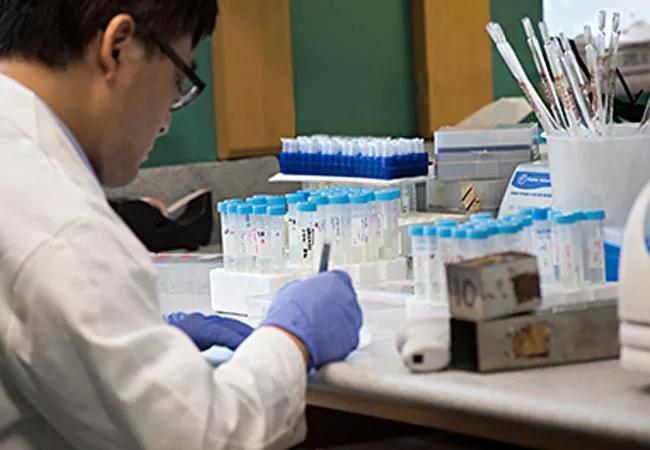
Image content: This image is available to view online.
View image online (https://assets.clevelandclinic.org/transform/2baacc3b-26bc-4e30-bf36-69e170fbbf82/18-LRI-5959-cancerGrants-650x450_jpg)
18-LRI-5959-cancerGrants-650×450
Zihua Gong, MD, PhD, was recently awarded a new grant from the National Cancer Institute, part of the National Institutes of Health, to continue his research related to BRCA1- and BRCA2-associated breast and ovarian cancer.
Advertisement
Cleveland Clinic is a non-profit academic medical center. Advertising on our site helps support our mission. We do not endorse non-Cleveland Clinic products or services. Policy
DNA repair is a normal part of cellular housekeeping but can become dysfunctional in cells that have mutations in BRCA1 or BRCA2 genes. Specifically, BRCA1 or BRCA2 mutations affect homologous recombination repair. Some cancer treatments exploit this characteristic to benefit the patient, the best example of which is PARP inhibitors (PARPi).
PARPi induce cell death in BRCA1 or BRCA2-deficient cancer cells through a phenomenon called synthetic lethality. Unfortunately, PARPi have only about a 40 percent response rate in BRCA-mutated breast and ovarian cancers. With his new, five-year, $1.8 million award, Dr. Gong hopes to improve PARPi therapy by better understanding the mechanisms of resistance.
In papers published in Nature Communications (2018) and Journal of Biological Chemistry (2017), Dr. Gong and his collaborators identified a previously unrecognized DNA repair pathway that confers PARPi resistance. They showed that the protein 53BP1 (P53-binding protein 1) together with another protein called TIRR (Tudor-interacting repair regulator) mediates cancer cells’ PARPi sensitivity. TIRR regulates the expression of and binds with a specific region of 53BP1 to form a protein complex. Both proteins are crucial for the stability of the complex. Without one or the other, therapeutic resistance in BRCA-mutated breast and ovarian cancer cells may result.
Dr. Gong and his team will further investigate the TIRR-53BP1 pathway, looking specifically at how these proteins are up- and downregulated. Proteins that inhibit or turn off TIRR and/or 53BP1 may be targets for future therapy.
Advertisement
Dr. Gong’s research is also funded by the Ovarian Cancer Research Alliance. He was recently awarded a renewal for his Liz Tilberis Early Career Award, which he originally received in 2016. The grant renewal will allow Dr. Gong to further define DNA mismatch repair deficiency, which is the most common cause of hereditary ovarian cancer after BRCA1 and BRCA2 mutations.
Dr. Gong is assistant staff in the Department of Cancer Biology, Lerner Research Institute. He is also a member of the molecular oncology program of the Case Comprehensive Cancer Center.
Advertisement
Advertisement


International collaboration is most genetically diverse study of the disease to date

Preclinical work promises large-scale data with minimal bias to inform development of clinical tests

Matching SNOMED Term with Curated Post. Please do not touch this post or any of its categories/snomed terms, thank you!

Matching Primary -> Secondary SNOMED Term with Curated Post. Please do not touch this post or any of its categories/snomed terms, thank you!
Cleveland Clinic researchers pursue answers on basic science and clinical fronts

Study suggests sex-specific pathways show potential for sex-specific therapeutic approaches
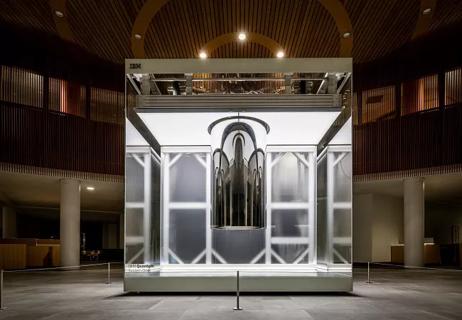
Cleveland Clinic launches Quantum Innovation Catalyzer Program to help start-up companies access advanced research technology
 Search