Locations:





Dr. Jeffrey Cohen on ACTRIMS Forum 2019 and trends in the subspecialty
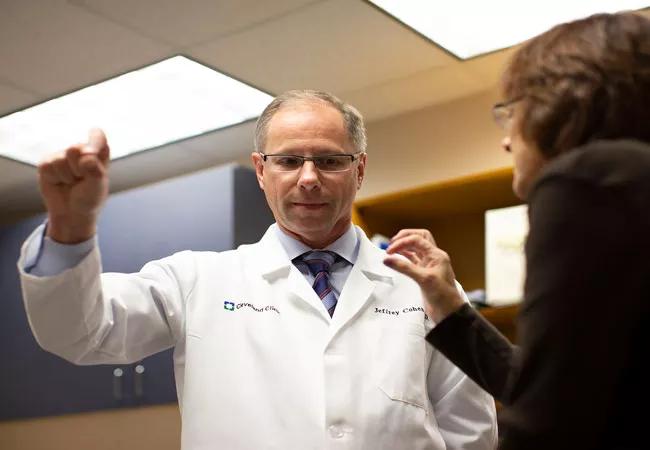
Image content: This image is available to view online.
View image online (https://assets.clevelandclinic.org/transform/624966ed-7e91-4bb8-a675-2cb817372750/19-NEU-156-Cohen-profile-as-ACTRIMS-Chair-CQD_Hero650x450_jpg)
19-NEU-156-Cohen-profile-as-ACTRIMS-Chair-CQD_Hero650x450
When the Americas Committee for Treatment and Research in Multiple Sclerosis (ACTRIMS) convenes this week in Dallas for its fourth annual forum, Cleveland Clinic neurologist Jeffrey Cohen, MD (shown with a patient above), will take the helm for the start of a three-year term as ACTRIMS Chair.
Advertisement
Cleveland Clinic is a non-profit academic medical center. Advertising on our site helps support our mission. We do not endorse non-Cleveland Clinic products or services. Policy
Consult QD caught up with Dr. Cohen, Director of the Experimental Therapeutics Program in Cleveland Clinic’s Mellen Center for Multiple Sclerosis Treatment and Research, to learn more about ACTRIMS and his vision for it — and to get a preview of this year’s forum, which runs from Feb. 28 to March 2.
Dr. Cohen: ACTRIMS is a voluntary community of leaders from the U.S. and Canada dedicated to the treatment and research of MS and related diseases. It was founded in 1995 and has really grown in recent years, mirroring the rapid changes in the field of MS itself. We anticipate that ACTRIMS will soon be regarded as hosting the preeminent MS scientific meeting in North America.
We put a strong emphasis on developing young clinicians and investigators, through education and mentoring, as well as on promoting their interactions with funding entities, institutions, industry and senior counterparts in the field. We also support young scientists with special course summits and provide travel and tuition grants for attendance at our meetings and events.
Our main activity is the annual ACTRIMS forum. The first independent forum was held in 2016 with about 600 participants. This year we expect to double that number. The meeting is unique in that it has a single track, with all participants going to the same activities. This format builds cohesion and gets everyone up to speed on cutting-edge developments.
Every three years, we hold a conference in conjunction with our European counterpart, ECTRIMS, which typically attracts more than 5,000 attendees. The next one will be in 2020 in Washington, D.C.
Advertisement
Dr. Cohen: I aim to further foster partnerships among MS research entities. A number of other societies have interests that overlap those of ACTRIMS — the North American Imaging in Multiple Sclerosis Cooperative, the International Multiple Sclerosis Visual System Consortium and the European Charcot Foundation, to name a few — and there are many advantages to working together. We aim to create a regular presence for these groups at our annual forums and to also participate in their meetings
Another example of such a partnership is with the National Multiple Sclerosis Society. They present their Barancik Prize for innovative research in MS at our annual forum, and the awardee gives a talk on the winning research.
Dr. Cohen: We have an exciting lineup of interactive sessions covering cutting-edge research and clinical topics, presented by young clinicians and investigators as well as by established leaders in the field. About 200 posters will be showcased in two poster sessions. A resident forum includes experts who have pursued different career paths — in clinical medicine and research — as well as representatives from the National Institutes of Health and other granting agencies.
This theme of this year’s forum, “Precision Medicine Approaches for MS: Scientific Principles to Clinical Application,” is particularly timely. Major advances have swept through the field in recent years, increasingly allowing us to treat patients as individuals rather than rely on general strategies for this diverse and complex condition.
Advertisement
Dr. Cohen: As part of the pre-meeting CME course, I am giving a talk on my special area of interest, cell-based therapies for neuroprotection and repair. Great strides have been made in this novel approach to MS therapy in recent years. Just this month, autologous hematopoietic stem cell transplantation was endorsed by the American Society for Blood and Marrow Transplantation (ASBMT) as a treatment for refractory relapsing MS, as outlined in a new ASBMT position statement for which I served as lead author (Biol Blood Marrow Transplant. 2019 Feb 19 [Epub ahead of print]).
Dr. Cohen: We now have a broad range of treatment options for MS, which is quite a change from just a decade ago. In addition to the new and upcoming stem cell therapies, there are now 16 drugs approved, with several additional promising ones in the pipeline.
Another interesting area, which will of course be a big part of the meeting, involves precision diagnostic tools, many of which have been developed for other diseases that could apply to MS. More-sophisticated imaging techniques and emerging pathological, genetic and immunological biomarkers can help distinguish MS from similarly presenting conditions, further refine diagnostic criteria and better monitor disease progression and therapy efficacy.
This is an exciting time in MS care and research. We are starting to make significant headway in understanding and treating even the progressive form, which is particularly challenging.
Advertisement
Advertisement

New study advances understanding of patient-defined goals

Testing options and therapies are expanding for this poorly understood sleep disorder
Real-world claims data and tissue culture studies set the stage for randomized clinical testing
Digital subtraction angiography remains central to assessment of ‘benign’ PMSAH

Cleveland Clinic neuromuscular specialist shares insights on AI in his field and beyond
Findings challenge dogma that microglia are exclusively destructive regardless of location in brain

Neurology is especially well positioned for opportunities to enhance clinical care and medical training
New review distills insights from studies over the past decade
 Search