Locations:





Aim is to find new insights among unifying principles
Image content: This image is available to view online.
View image online (https://assets.clevelandclinic.org/transform/a05ef937-94c0-4539-bca4-91b9d510e708/17-NEU-551-Cummings-589583890-650x450_jpg)
17-NEU-551-Cummings-589583890-650×450
When it comes to age-related neurodegenerative diseases, similarities matter. That’s the premise behind a distinctive new academic text edited by two Cleveland Clinic brain health experts.
Advertisement
Cleveland Clinic is a non-profit academic medical center. Advertising on our site helps support our mission. We do not endorse non-Cleveland Clinic products or services. Policy
Neurodegenerative Diseases: Unifying Principles was released in late 2016 by Oxford University Press. Co-editors Jeffrey Cummings, MD, ScD, and Jagan Pillai, MD, PhD, both of Cleveland Clinic Lou Ruvo Center for Brain Health, say they developed the book explicitly to explore the shared features and challenges linking conditions such as Alzheimer’s, Parkinson’s and Huntington’s diseases.
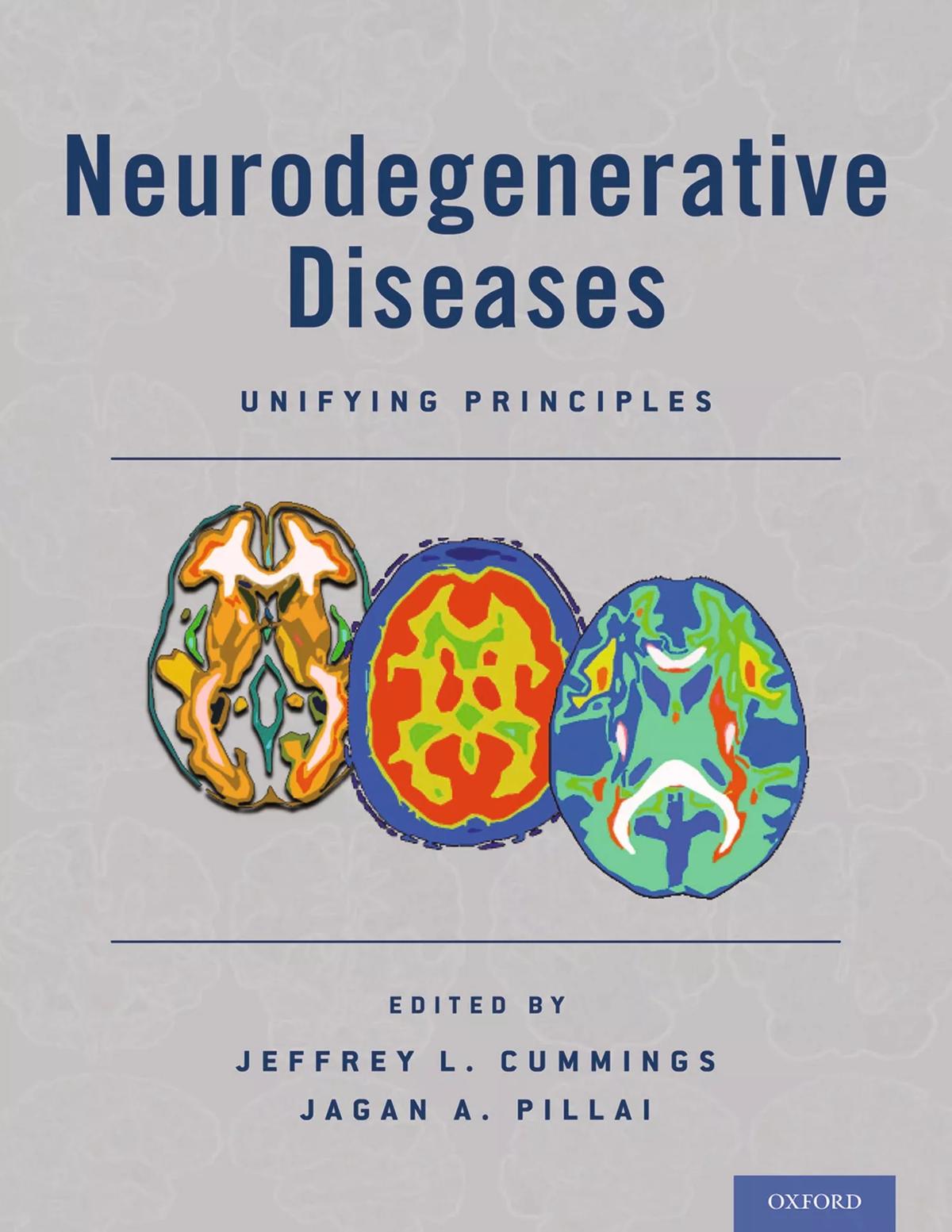
Image content: This image is available to view online.
View image online (https://assets.clevelandclinic.org/transform/7258619f-8b27-486a-9359-c9fd46087c75/17-NEU-551_Inset_jpg)
“Our field increasingly recognizes the common biological and pathological features across seemingly varied neurodegenerative disorders that involve protein misfolding dysfunction and its long-term consequences,” explains Dr. Pillai.
“Conventional approaches emphasize the differences among neurodegenerative diseases,” adds Dr. Cummings, Director of the Lou Ruvo Center for Brain Health. “This book is the result of a conceptual revolution over the past decade or so in our understanding of these diseases as sharing many unifying features. Providing an overview of this conceptual change is a key theme of the book.”
The co-editors set out to do so by assembling a roster of international expert authors to provide insights on their subspecialty areas across the 360-page book’s 19 interrelated chapters.
Most chapters aim to identify common threads among neurodegenerative disorders, be they in molecular biology, pathology, neuroinflammation, physiology, genetics and epigenetics, biomarkers, behavioral syndromes, treatment strategies and more.
“The specific aim is to present a thorough examination of unifying principles from the subcellular to the systems and clinical levels,” notes Dr. Pillai. “The broader goal is to enable better patient care and promote research collaboration across multiple subspecialties to help advance insights and facilitate novel therapies.”
Advertisement
Such cross-fertilization of ideas is a definite goal, Dr. Cummings emphasizes: “Given the compelling evidence that neurodegenerative diseases share many features, insights in one may be rapidly translated into advances in another.”
For more on the book, visit the Oxford University Press site.
Advertisement
Advertisement

New study advances understanding of patient-defined goals

Testing options and therapies are expanding for this poorly understood sleep disorder
Real-world claims data and tissue culture studies set the stage for randomized clinical testing
Digital subtraction angiography remains central to assessment of ‘benign’ PMSAH

Cleveland Clinic neuromuscular specialist shares insights on AI in his field and beyond
Findings challenge dogma that microglia are exclusively destructive regardless of location in brain
Neurology is especially well positioned for opportunities to enhance clinical care and medical training
New review distills insights from studies over the past decade
 Search