Locations:





Technology aims to revolutionize how MS-related mental decline is monitored and addressed

Image content: This image is available to view online.
View image online (https://assets.clevelandclinic.org/transform/5e0dcc4e-91f1-4c0b-a0ba-5efd2efb7e43/Rao-App-690x380_jpg)
Rao-App-690×380
By Stephen M. Rao, PhD, ABPP/CN
Advertisement
Cleveland Clinic is a non-profit academic medical center. Advertising on our site helps support our mission. We do not endorse non-Cleveland Clinic products or services. Policy
At the 2014 annual meeting of the American Academy of Neurology (AAN), Cleveland Clinic investigators presented results of a study demonstrating the reliability and validity of a self-administered, computerized tool to screen for cognitive dysfunction in the multiple sclerosis (MS) clinic. This novel assessment tool, called the Processing Speed Test (PST), takes advantage of Apple’s iPad technology.
The PST is one of a battery of iPad apps, called the Multiple Sclerosis Performance Test, designed to provide quantitative assessments of motor, vision and cognitive performance in MS.
Approximately 50 percent of MS patients experience mental symptoms — typically in the form of cognitive dysfunction — in addition to the disease’s hallmark physical symptoms. The two most common cognitive deficits involve the ability to process information quickly and to retrieve recently learned memories. These cognitive deficits can have a deleterious impact on employment, driving and the ability to perform routine daily activities.
Longitudinal studies suggest that approximately 15 to 25 percent of patients with MS experience cognitive dysfunction during the early relapsing phase of the illness; this figure rises to 65 percent when patients enter the more progressive stage of the disease. Approximately 5 to 6 percent of patients will experience new cognitive symptoms or a worsening of existing cognitive symptoms in any given year.
The optimal method for assessing cognitive dysfunction is through standardized neuropsychological tests, which typically take two to three hours to complete and must be administered by a board-certified clinical neuropsychologist. Administering such a lengthy battery to all patients with MS is unrealistic.
Advertisement
The alternative is to use cognitive screening tests that identify those patients who may have experienced a worsening of their cognitive abilities. Unfortunately, simply asking the patient or his or her family members about changes in cognitive functioning has proved unreliable, since their responses do not correlate with those obtained from objective neuropsychological testing.
One solution is to have patients perform a brief neuropsychological test during their visits to the MS clinic. One such test, the Symbol Digit Modalities Test (SDMT), takes 10 minutes to administer, score and enter into the medical record. For busy MS clinics, such as Cleveland Clinic’s Mellen Center for Multiple Sclerosis Treatment and Research, allocating even 10 minutes of personnel time to screen for cognitive dysfunction is impractical.
A multidisciplinary team of neurologists, bioengineers and neuropsychologists in Cleveland Clinic’s Neurological Institute addressed this problem by developing the PST app, which resembles the SDMT (see Figure).
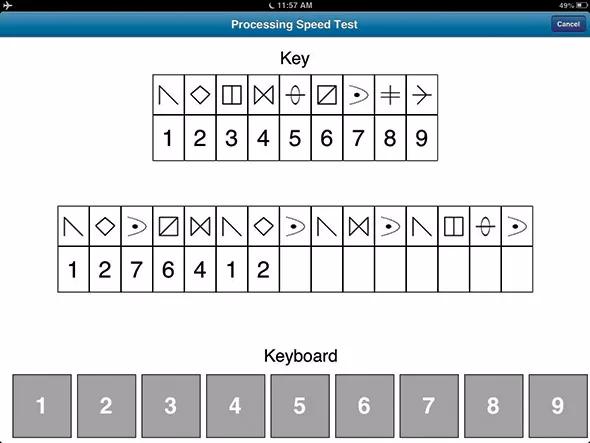
Image content: This image is available to view online.
View image online (https://assets.clevelandclinic.org/transform/6906b095-5135-4289-b29e-490d26ee56ed/Rao-Fig_jpg)
Figure. Screen shot of the Processing Speed Test (PST) app for assessment of information processing and episodic memory in multiple sclerosis.
Results reported at the AAN meeting indicated that the self-administered PST has exhibited equal, if not better, test-retest reliability and sensitivity for identifying cognitive dysfunction in patients with MS compared with the technician-administered SDMT. Moreover, the PST and SDMT are highly correlated, indicating that they measure similar cognitive abilities.
Advertisement
We are now generating a nationwide normative database, derived from the performance of healthy individuals, to be completed in 2015. We are also conducting a study to determine whether test performance declines when a technician is not present in the evaluation room — a critical validation step for self-administration.
We envision that the PST will be self-administered in the waiting area of the clinic before the patient sees his or her caregiver. Once the patient completes the test, the raw data will be transferred wirelessly to the cloud, scored and adjusted for demographic factors (age, education, sex, etc.) that might influence interpretation of the score.
Our plan is to then integrate the results into the patient’s electronic medical record. This transfer of information will be nearly instantaneous, allowing the clinician to view the results at the same patient visit. Depending on the evaluation results, the caregiver may refer the patient for a more comprehensive neuropsychological evaluation. The results may also suggest a “cognitive relapse” that might prompt changes to the patient’s medical care plan.
The PST offers several additional advantages over the SDMT:
Advertisement
Ultimately, our goal in developing this technology is to revolutionize the way cognitive problems are monitored and addressed in patients with MS.
The Processing Speed Test is one of five apps for the iPad that constitute the Multiple Sclerosis Performance Test, which is detailed in a new video publication by a team of Cleveland Clinic researchers in the Journal of Visualized Experiments:
Cleveland Clinic is exploring beta testing of the Multiple Sclerosis Performance Test app suite in clinical trials and MS centers beyond Cleveland Clinic, with potential plans for ultimate submission to the FDA for market clearance for broad clinical use.
The author acknowledges Richard Rudick, MD, former Director of the Mellen Center, and Jay Alberts, PhD, Director of the Concussion Center, for their teams’ leadership in the development of the PST app.
Dr. Rao is Director of the Schey Center for Cognitive Neuroimaging in Cleveland Clinic’s Neurological Institute. He also has appointments in the departments of Neurosciences, Neurology, and Psychiatry and Psychology as well as in Cleveland Clinic Lou Ruvo Center for Brain Health.
1. Rao S, Alberts J, Miller D, Bethoux F, Lee J-C, Stough D, Reece C, Mourany L, Schindler D, Hirsch J, Rudick R. Processing Speed Test (PST): a self-administered iPad®-based tool for assessing MS-related cognitive dysfunction. Abstract presented at: Annual meeting of the American Academy of Neurology; April 30, 2014; Philadelphia, Pa.
2. Rudick RA, Miller D, Bethoux F, Rao SM, Lee JC, Stough D, Reece C, Schindler D, Mamone B, Alberts J. The Multiple Sclerosis Performance Test (MSPT): an iPad-based disability assessment tool. J Vis Exp. 2014 Jun 30;(88):e51318.
Advertisement
Advertisement

New study advances understanding of patient-defined goals
Testing options and therapies are expanding for this poorly understood sleep disorder
Real-world claims data and tissue culture studies set the stage for randomized clinical testing
Digital subtraction angiography remains central to assessment of ‘benign’ PMSAH

Cleveland Clinic neuromuscular specialist shares insights on AI in his field and beyond

Findings challenge dogma that microglia are exclusively destructive regardless of location in brain
Neurology is especially well positioned for opportunities to enhance clinical care and medical training

New review distills insights from studies over the past decade
 Search