Locations:





Registry-based PASSION initiative aims to identify epileptogenesis biomarkers, compare therapies
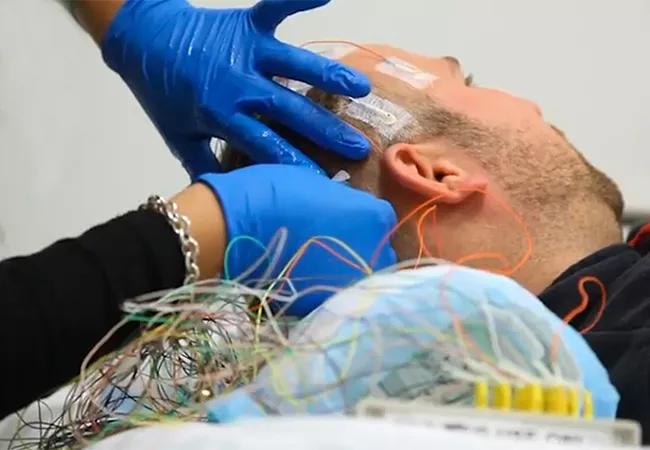
Image content: This image is available to view online.
View image online (https://assets.clevelandclinic.org/transform/4a705ed6-c251-4938-a0ec-19c8248e8c88/21-NEU-2391643_EEG-monitoring_650x450_jpg)
21-NEU-2391643_EEG-monitoring_650x450
With support from an American Epilepsy Society Infrastructure Grant, Cleveland Clinic’s Epilepsy Center is leading the launch of a multicenter network to investigate the optimal use of anti-seizure medication in patients who experience acute symptomatic seizures (ASyS) following acute brain injury.
Advertisement
Cleveland Clinic is a non-profit academic medical center. Advertising on our site helps support our mission. We do not endorse non-Cleveland Clinic products or services. Policy
The Post-Acute Symptomatic Seizure Investigation and Outcomes Network (PASSION) will generate data to:
PASSION will be managed by grant recipient Vineet Punia, MD, MS, of Cleveland Clinic’s Epilepsy Center, in cooperation with collaborators from Yale School of Medicine, University of North Carolina at Chapel Hill, Brown University and Massachusetts General Hospital.
Under current standards of care, patients who experience ASyS following an acute brain injury are discharged from the hospital with a prescription for anti-seizure medication. Patients are likely to continue this therapy for a year or more with no diagnosis of epilepsy.
The growing use of continuous EEG to monitor patients following acute brain injury has significantly increased the number of ASyS diagnoses in this patient population and, consequently, the use of continued anti-seizure medication. But, according to Dr. Punia, only 20% to 30% of patients with EEG-diagnosed ASyS develop epilepsy within one to two years.
“That means about 70% of patients diagnosed with ASyS may be taking anti-seizure medication unnecessarily — some of them for years,” says Dr. Punia. He notes that long-term anti-seizure therapy can impair quality of life, with adverse effects that include cognitive slowing, mood symptoms and gait instability. “There is little evidence that prolonged treatment reduces the long-term risk of developing epilepsy,” he adds.
Advertisement
“Our hypothesis is that a minor subset of ASyS patients develop late seizures that require long-term epilepsy care,” Dr. Punia says, “and the lack of systematic follow-up after ASyS results in overprescription of anti-seizure medication and worse outcomes.”
PASSION will include five academic centers staffed with primary investigators who have expertise in the study of ASyS and related outcomes. The centers will adhere to the post-acute symptomatic seizure (PASS) clinic model, which is dedicated to the post-discharge management of patients who suffer ASyS. The PASS clinic model, detailed by Dr. Punia and Cleveland Clinic colleagues in Epilepsia Open (2020;5:255-262), promotes assessment of the risk of epilepsy development and anti-seizure medication management in each patient.
“PASSION will feature a shared database to ensure uniform collection of longitudinal clinical, EEG and imaging data, which will make it easy to observe and measure outcomes and their predictors,” Dr. Punia explains. Standardized, periodic patient follow-up will enable clinicians to assess changes in functional and neurocognitive outcomes and review the rate of seizure recurrence by type and frequency.
All participating patients will:
Advertisement
Dr. Punia anticipates enrolling 50 patients per center during the first year.
The uniform collection of data will enable PASSION investigators to identify different pathways to the development of epilepsy in patients. The criteria for diagnosis will be consistent with the 2015 International League Against Epilepsy definition (at least two unprovoked seizures occurring more than 24 hours apart, or late seizure after acute brain injury). Based on the acute clinical, neuroimaging and electrophysiologic data collected, Dr. Punia and co-investigators will generate multivariable regression analysis-based models predicting risk of epilepsy development over one year of follow-up.
Prescription strategies will vary among the five clinical sites, and the investigators will leverage these variations for comparative information, including:
“Meeting these objectives — successful creation of the registry, identification of biomarkers and therapeutic comparisons — will lay the groundwork and infrastructure for future trials of anti-epileptogenesis therapy,” says Dr. Punia. “This will support our ultimate goal of more focused, data-driven management of anti-seizure therapy in the context of early identification of patients at high risk for epilepsy development.”
Advertisement
Advertisement

New study advances understanding of patient-defined goals

Testing options and therapies are expanding for this poorly understood sleep disorder
Real-world claims data and tissue culture studies set the stage for randomized clinical testing
Digital subtraction angiography remains central to assessment of ‘benign’ PMSAH

Cleveland Clinic neuromuscular specialist shares insights on AI in his field and beyond

Findings challenge dogma that microglia are exclusively destructive regardless of location in brain

Neurology is especially well positioned for opportunities to enhance clinical care and medical training
New review distills insights from studies over the past decade
 Search