Locations:





 Search
Identifying disease-disease relationships
When more than one disease occurs in a single individual (i.e., disease comorbidity), interactions between the diseases may worsen each other, resulting in poorer health outcomes and increased healthcare costs. In a recent study, a team of researchers led by Feixiong Cheng, PhD, of Cleveland Clinic’s Genomic Medicine Institute, developed a network-based methodology that may help predict relationships between multiple complex diseases as well as pinpoint potential therapeutic targets.
Advertisement
Cleveland Clinic is a non-profit academic medical center. Advertising on our site helps support our mission. We do not endorse non-Cleveland Clinic products or services. Policy
Disease comorbidities are common, but identification of their underlying causes remains elusive. In an effort to more accurately predict and treat disease comorbidities, researchers have sought genetic links between diseases, such as a single genetic mutation that could help explain why an individual developed both asthma and chronic obstructive pulmonary disease (COPD). However, these traditional approaches fail to account for the complexity of disease pathogenesis.
Previous studies have demonstrated that microRNAs (miRNAs), which are small, noncoding RNA molecules that regulate gene expression, are closely related to disease development, progression and prognosis. Furthermore, a single miRNA regulates multiple genes, meaning that an individual miRNA could be the link between comorbid diseases that do not have a genetic mutation in common. This suggests that shared patterns of miRNA-regulated gene expression could discern disease-disease relationships.
To investigate this hypothesis, Dr. Cheng’s team constructed a comprehensive biological network that incorporates diseases, genes and miRNAs. Known as meta-path-based Disease Network (mpDisNet) capturing algorithm, this network utilizes miRNA regulatory networks to identify connections between diseases and displays an improved performance in inferring both clinically reported and new disease-disease relationships compared to earlier methods.
mpDisNet correctly identified 220 known disease-disease pairs, while traditional approaches only identified 120. The network also uncovered miRNA-mediated pathways that may explain the common coexistence of certain pulmonary diseases, including asthma, COPD and lung cancer. In addition, mpDisNet revealed potential associations between Alzheimer’s disease and certain cardiovascular diseases, such as myocardial infarction, atherosclerosis and hypertension, which are supported by vascular dementia commonly observed in clinic. These results indicate that, if broadly applied, mpDisNet would serve as a powerful tool to more accurately anticipate the co-occurrence of diseases as well as aid in the development of personalized treatments for disease comorbidities.
Advertisement
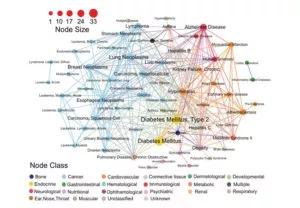
Image content: This image is available to view online.
View image online (https://assets.clevelandclinic.org/transform/971d141d-b822-4e0b-bb69-9290f327f908/20-LRI-049_CQD_650x450_Predict-disease-comorbidities-300x208_jpg)
An miRNA-mediated disease-disease network. Top 300 mpDisNet-predicted disease-disease pairs (edges) connecting 61 diseases (nodes) are illustrated. The node size denotes the degree. The color of nodes is encoded based on the pathobiological categories of diseases.
This study was supported by the National Heart, Lung, and Blood Institute of the National Institutes of Health. Serpil Erzurum, MD, Chair of Cleveland Clinic’s Lerner Research Institute, is co-author of the study.
Please note: This article originally appeared here.
Advertisement
Advertisement


International collaboration is most genetically diverse study of the disease to date

Preclinical work promises large-scale data with minimal bias to inform development of clinical tests

Matching SNOMED Term with Curated Post. Please do not touch this post or any of its categories/snomed terms, thank you!

Matching Primary -> Secondary SNOMED Term with Curated Post. Please do not touch this post or any of its categories/snomed terms, thank you!

Cleveland Clinic researchers pursue answers on basic science and clinical fronts

Study suggests sex-specific pathways show potential for sex-specific therapeutic approaches

Cleveland Clinic launches Quantum Innovation Catalyzer Program to help start-up companies access advanced research technology