Locations:





Newly proposed scheme could inform clinical decision making
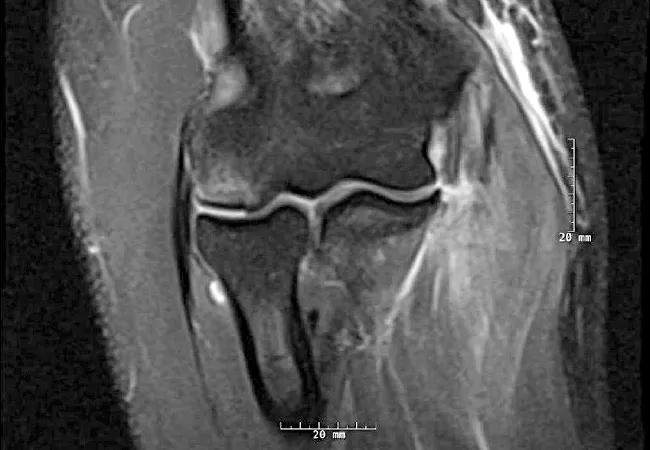
Image content: This image is available to view online.
View image online (https://assets.clevelandclinic.org/transform/48f1952c-e009-4526-8fcb-ad39dedb56ea/16-ORT-1509-Frangiamore-Hero-Image-650x450pxl_jpg)
19-ORT-1125
For the first time, a group of trained specialist surgeons from different institutions is able to identify complete versus partial tears and tear location in injuries to the ulnar collateral ligament (UCL).
Advertisement
Cleveland Clinic is a non-profit academic medical center. Advertising on our site helps support our mission. We do not endorse non-Cleveland Clinic products or services. Policy
A new study will be presented today at the 2019 Annual Meeting of the American Association of Orthopaedic Surgeons (AAOS) and Saturday, March 16, 2019 at American Shoulder and Elbow Society (ASES) Specialty Day in Las Vegas, which evaluates the reliability and reproducibility of a newly proposed 6-stage, MRI-based classification system for UCL injuries. The classification system takes into account tear grade (partial or complete) and location (proximal, midsubstance or distal) for broad generalizability and communication in future research.
“This is the first study, to our knowledge, to classify UCL tears based on location and tear degree,” notes Mark Schickendantz, MD, who specializes in arthroscopic shoulder and elbow surgery and serves as head team physician for the Cleveland Indians MLB team and Director of Cleveland Clinic Center for Sports Health. “Our scheme is simple, clinically valuable, reliable and reproducible across UCL specialists.”
To determine reliability, nine fellowship-trained observers across multiple institutions reviewed 60 cases, half of which required surgery. The cases were combined in a file containing 30 at a time. Observers reviewed the files twice, with variation in the order of case presentation and with three days between the first and second review.
Compared to intraoperative findings, observers had high accuracy rates for partial and complete grade tears (90%), proximal tears (100%) and distal tears (64%). Observers had much lower accuracy (40%) for midsubstance tears. This shortcoming may be of little clinical significance in light of the system’s overall utility in the accurate identification of proximal versus distal tears, as proximal tears may be more amenable to a nonoperative approach while distal tears tend to require surgical intervention. With near perfect intraobserver reliability and substantial agreement with interobserver reliability, these preliminary results pave the way for validation studies.
Advertisement
Additional axial views did not increase agreement within and among reviewers, indicating that the view of choice is coronal. In order to classify a tear, the axial or sagittal view may not be necessary.
Twenty-five percent of major league pitchers and 15 percent of minor league pitchers have a history of UCL reconstruction, according to previous research. Although these injuries are increasingly common, the treatment algorithm for UCL tears remains ill-defined.
Magnetic resonance arthrography (MRA) is gold standard evaluation; however, MRI is also considered a valuable, noninvasive method of evaluation for UCL injuries. A similar study, which assesses the reliability of this classification system using MRA imaging, is forthcoming.
“Many athletes who sprain their ulnar collateral ligament do not require surgery,” Dr. Schickendantz states. “In our experience, however, there is no significant difference in physical exam findings or performance between patients for whom nonoperative treatment succeeds or fails. A reliable classification system would inform clinical decision making, potentially avoiding unnecessary surgical delays. Our goal is to get these athletes back in the game, safely.”
Advertisement
Advertisement
Biologic approaches, growing implants and more
Study reports zero infections in nearly 300 patients
How to diagnose and treat crystalline arthropathy after knee replacement
Study finds that fracture and infection are rare
Center will coordinate, interpret and archive imaging data for all multicenter trials conducted by the foundation’s Osteoarthritis Clinical Trial Network

Reduced narcotic use is the latest on the list of robotic surgery advantages
Cleveland Clinic specialists offer annual refresher on upper extremity fundamentals
Cleveland Clinic orthopaedic surgeons share their best tips, most challenging cases and biggest misperceptions
 Search