Locations:





The multidisciplinary research team reported their findings in JAMA
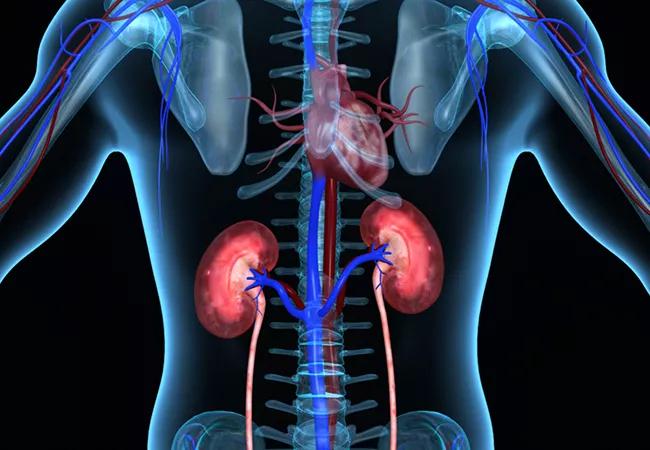
Image content: This image is available to view online.
View image online (https://assets.clevelandclinic.org/transform/a7d762df-298a-4eff-be8a-9eb7bf87d406/22-URL-2795653-CQD-650x450-1_jpg)
Heart and kidneys
Cleveland Clinic researchers have shown that predictive models using data derived from basic metabolic laboratory panels can accurately predict acute kidney injury (AKI) within 72 hours and 14 days of cardiac surgery. They reported their findings in JAMA.
Advertisement
Cleveland Clinic is a non-profit academic medical center. Advertising on our site helps support our mission. We do not endorse non-Cleveland Clinic products or services. Policy
It’s not uncommon for patients to experience kidney-related issues after major surgery. Following cardiac surgery, as many as 1 in 4 patients can experience mild kidney disease, while 1 in 20 has more serious kidney involvement, and nearly 2% require dialysis for some time, according to data from the study.
The standard of care for diagnosing and managing AKI is measuring serum creatinine and blood urea nitrogen in conjunction with urine output. This calculation, however, does not account for events in the perioperative setting that may trigger physiologic and metabolic pathways associated with AKI.
“A patient could have been identified as low-risk for developing cardiac surgery-related AKI before surgery, but unexpected perioperative events may enable progression to some form of AKI,” says Sevag Demirjian, MD, lead author of the study and a nephrologist in Cleveland Clinic’s Department of Kidney Medicine.
The multidisciplinary team created and validated models using basic metabolic laboratory panels in a perioperative and immediately postoperative setting in patients who underwent coronary artery bypass graft, valve and/or aorta surgery.
The team developed four risk models using data from 63,260 patients in the Cleveland Clinic health system, a derivation cohort (N = 58,526) and a validation cohort (N = 4,734). The models, as listed, were based on data derived from routine perioperative metabolic panels.
Advertisement
The derivation group, which comprises data from Cleveland Clinic main campus (2000-2019), showed that within 72 hours of surgery, 2,674 (4.6%) patients developed moderate to severe AKI and 868 (1.48%) patients developed AKI requiring dialysis. Within 14 days of surgery, 3,156 (5.4%) patients developed moderate to severe AKI and 1,018 (1.74%) patients developed AKI requiring dialysis.
The models performed with “excellent predictive discrimination” across all endpoints, the authors report in the paper. These models were then tested in a separate validation cohort of 4,734 patients at three Cleveland Clinic regional hospitals (2009-2019) with similar results.
“We were pleasantly surprised by how well the models performed,” says Dr. Demirjian.
Because the models are built from discrete, inexpensive and accessible laboratory data, they could be easily incorporated into patients’ electronic health records. These values are already monitored frequently throughout the perioperative period as part of routine care.
Flagging patients at risk for developing AKI early in the postoperative stage could allow for more targeted management, such as closer monitoring, hemodynamic and volume optimization, and avoidance of nephrotoxins that could be detrimental to kidney function, explains Dr. Demirjian.
“Some of the early changes in the multiple components of the blood profile are easy to overlook individually, but the models highlight patterns of changes in multiple variables better than us clinicians,” he says.
Advertisement
Although, he notes, at this point the models are not powered to determine risk at an individual level.
More research is needed to validate the tool and its clinical utility. “The next step is proving that interventions based on early recognition of kidney issues identified by the models will actually translate for better outcomes for our patients,” concludes Dr. Demirjian.
Advertisement
Advertisement

Clinicians should individualize dosing practices based on patient risk factors and preferences
Pioneering and refining the approach in pyeloplasty, nephrectomy and more
Fully-automated process uses preop CT, baseline GFR to estimate post-nephrectomy renal function
Could mean earlier treatment, but also could have negative effects

Unlike earlier pills, new drugs do not cause liver toxicity
Male factors play a role in about half of all infertility cases, yet men often are not evaluated
Surgeons choreograph nearly simultaneous procedures, sharing one robot between two patients

Identifying barriers in the renal genetic assessment of Black patients
 Search