Locations:





Positive outcomes may pave way for randomized trial
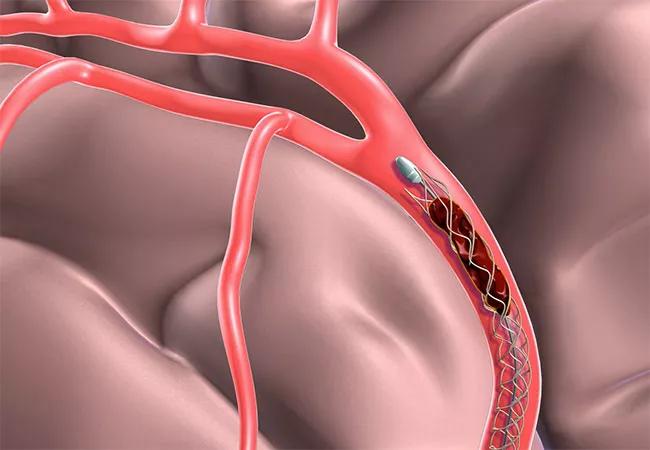
Image content: This image is available to view online.
View image online (https://assets.clevelandclinic.org/transform/699f0b43-0e61-4ecd-92df-7b014468ff05/19-NEU-078_Toth-MISTWAVE-650x450_jpg)
19-NEU-078_Toth-MISTWAVE-650×450
Support for endovascular therapy for emergent large vessel occlusion (ELVO) in the setting of mild acute ischemic stroke is mounting, according to results of the prospective MISTWAVE study being presented this week by Cleveland Clinic researchers.
Advertisement
Cleveland Clinic is a non-profit academic medical center. Advertising on our site helps support our mission. We do not endorse non-Cleveland Clinic products or services. Policy
“Endovascular therapy for ELVO is standard of care in patients with disabling strokes, but prospective data assessing it in patients with mild stroke symptoms are scarce,” says Cleveland Clinic vascular and interventional neurologist Gabor Toth, MD, who is presenting the findings at the 2019 International Stroke Conference (ISC 2019) in Honolulu. “Yet retrospective data suggest that mild ischemic stroke with ELVO leads to unfavorable outcomes in many patients in the absence of treatment. That’s why we’ve undertaken this study as one of the first prospective investigations of mechanical thrombectomy in this setting.”
Dr. Toth detailed the rationale for the MISTWAVE trial in a July 2018 Consult QD post when he presented findings from its first three patients at the annual meeting of the Society of Neurointerventional Surgery. Since that time, the Cleveland Clinic-led investigation has added a second study site — the University of Iowa — and accrued outcomes on 20 patients for presentation at ISC 2019.
MISTWAVE (Mild Acute Ischemic STroke With LArge VEssel Occlusion) is a single-arm prospective study of patients with anterior circulation or basilar artery ELVO within 24 hours of onset and an initial National Institutes of Health Stroke Scale (NIHSS) score < 6. Exclusion criteria were prior intracranial hemorrhage, current anticoagulant use or an Alberta Stroke Program Early CT Score ≤ 6.
Patients received best medical therapy combined with endovascular mechanical thrombectomy using FDA-approved devices. Enrollees may or may not have received tissue plasminogen activator (t-PA) therapy.
Advertisement
The primary safety end points were symptomatic cerebral hemorrhage (ECASS III definition) within 24 hours of the procedure and worsening of NIHSS score by 4 or more points within 72 hours of intervention or during hospitalization. The researchers also recorded clinical and radiographic outcomes.
The 20 enrollees (11 men, 9 women) had a mean age of 65.6 years. Twelve had M1 occlusions; eight had M2 occlusions.
TICI grade 2B or 3 recanalization was achieved in 19 of 20 patients (95 percent). No patients suffered symptomatic cerebral hemorrhage.
One patient experienced neurological worsening within 24 hours in spite of TICI 3 recanalization; this was due to an underlying intracranial stenosis. No other periprocedural complications were observed.
Median NIHSS score declined from 3 at presentation to 0 at last follow-up. Eighty-five percent of patients (17/20) were discharged home with minimal or no residual deficits. Excellent clinical outcome, defined as a modified Rankin Scale score of 0 or 1, was achieved in 19 of 20 patients (95 percent).
“This is one of the first prospective trials demonstrating the safety and feasibility of endovascular therapy in patients with low NIHSS scores and ELVO,” observes Dr. Toth. “While a randomized controlled investigation is needed to confirm these preliminary results, these are heartening findings.”
Advertisement
Advertisement

New study advances understanding of patient-defined goals

Testing options and therapies are expanding for this poorly understood sleep disorder
Real-world claims data and tissue culture studies set the stage for randomized clinical testing
Digital subtraction angiography remains central to assessment of ‘benign’ PMSAH

Cleveland Clinic neuromuscular specialist shares insights on AI in his field and beyond
Findings challenge dogma that microglia are exclusively destructive regardless of location in brain

Neurology is especially well positioned for opportunities to enhance clinical care and medical training
New review distills insights from studies over the past decade
 Search