Locations:





More evidence needed on pharmacologic therapy alone and combined with gait training
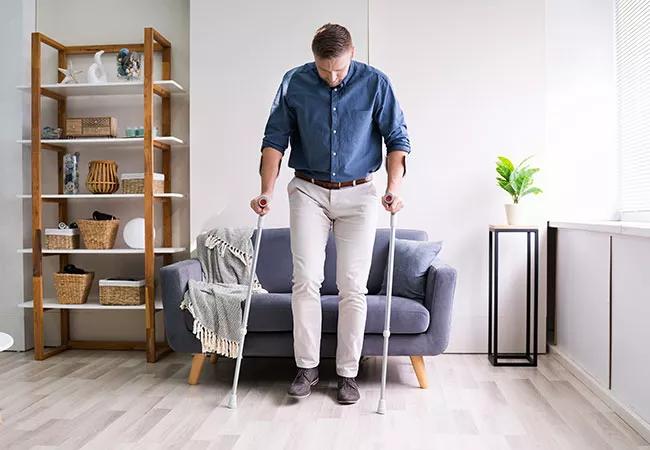
Image content: This image is available to view online.
View image online (https://assets.clevelandclinic.org/transform/d44dfc18-e55f-4a0f-8e70-0cae7a57ef57/22-NEU-2678473-CQD-Hero-650x450-1_jpg)
22-NEU-2678473-CQD-Hero-650×450
Enhanced synergy between neurology and rehabilitation research would benefit patients with multiple sclerosis (MS) who have gait or balance impairment, according to Francois Bethoux, MD.
Advertisement
Cleveland Clinic is a non-profit academic medical center. Advertising on our site helps support our mission. We do not endorse non-Cleveland Clinic products or services. Policy
Impaired balance and gait in MS are significant concerns for Dr. Bethoux, Chair of Cleveland Clinic’s Department of Physical Medicine and Rehabilitation and Director of Rehabilitation in Cleveland Clinic’s Mellen Center for Multiple Sclerosis. He recently shared his observations at the International Symposium on Gait and Balance in Multiple Sclerosis.
He notes that while evidence supports medical interventions for walking, gait and balance impairment in MS, more research is needed — especially on medical management in combination with rehabilitation therapies, assistive devices and home exercise.
“Whether these modalities are complementary is a great unanswered question,” Dr. Bethoux says. He proposes that, along with disease-modifying therapies, symptomatic therapies that impact gait and balance in MS be considered when appropriate, based on available evidence.
In his recent symposium talk, Dr. Bethoux reviewed the evidence to date on the one FDA-approved therapy to improve walking in MS as well as the effects of several antispasticity therapies on gait and balance in MS. Consult QD followed up with him on several of the therapies that have been most widely studied in this context — the “walking therapy” dalfampridine and the antispasticity agents intrathecal baclofen and nabiximols.
Dalfampridine is indicated to improve walking in patients with MS. As a symptomatic therapy, dalfampridine was shown to positively affect walking speed, but not the development or progression of MS. Studies of its efficacy have generated research on the clinical significance of walking speed and the definition of meaningful change.
Advertisement
An evidence review in the International Journal of MS Care (2016;18[3]:105-115) assessed the impact of symptomatic medication therapy or gait training on gait and walking impairment. “The review compared average improvement of walking speed with each modality and found that the results were in the same ballpark,” Dr. Bethoux observes.
Although the review was not a direct comparison, it raised the question of benefits that might be achieved by adding gait training to medical intervention. Dr. Bethoux adds that preliminary evidence has suggested further improvement when gait training is added to dalfampridine treatment, supporting the concept of combination therapy.
Intrathecal baclofen (ITB) is primarily used for diffuse, severe spasticity that has not responded to oral baclofen, but it also has been studied for its effect on walking and gait. The treatment is invasive, requiring surgical placement of a device to infuse medication into the spinal fluid.
Case series and prospective studies looking at ITB’s effects on walking have had inconsistent results. A prospective pre- and post-treatment series showed no difference in timed 10-meter walk test results before and after treatment, but another prospective study found that nearly two-thirds of patients reported improvement in walking. However, several case series have shown no significant change in short-distance walking speed after one year.
Interpreting these findings is tricky, Dr. Bethoux says, because walking limitations with MS are not due solely to spasticity. “Disability due to the disease process accumulates over time,” he explains. “Another way to look at these results is to consider that adequate control of spasticity can be achieved without compromising the ability to walk.” He adds that measurements of gait other than walking speed may also provide useful information.
Advertisement
Other limitations to making clinical decisions about the use of ITB in individuals with MS who are able to walk include small sample sizes and the absence of control groups. Emerging data suggest that some baseline characteristics are associated with a higher risk of becoming nonambulatory. “Patients who become nonambulatory while on ITB therapy tend to have more walking impairment to begin with,” Dr. Bethoux notes.
Another antispasticity therapy evaluated for effect on gait and walking is the cannabis extract nabiximols. Administered as an oromucosal spray, nabiximols has been extensively studied and is approved for use in several countries, although it remains an investigational product in the U.S.
At least one randomized controlled trial of nabiximols (Neurol Res. 2010;32[5]:451-459) showed significant improvement on the timed 10-meter walk test compared with placebo. A small randomized trial (Mult Scler Relat Disord. 2021;51:102805) showed significant improvement based on balance and gait parameters 45 minutes after the first nabiximols dose, and this was maintained through follow-up at four weeks.
In a study that combined nabiximols with robot-assisted gait training (Mult Scler Relat Disord. 2020;43:102177), walking test results improved more with the combination than with robot-assisted gait training alone. On the other hand, patients in a case series who remained on nabiximols actually showed significantly worse balance after 12 months (Mult Scler. 2019;25[1]:113-117).
Advertisement
Dr. Bethoux notes that despite methodological limitations in some studies and many gaps in evidence, investigators and clinicians are increasingly using medical management in an attempt to improve walking, gait and balance in people with MS.
“I would like to see more investigations of pharmacotherapies combined with walking and gait therapies,” Dr. Bethoux concludes, noting that the work done so far on combination treatment has been inconclusive and predictors of therapeutic response remain to be determined. “Additionally, studies should direct more attention to effects on other aspects of gait and walking, as walking speed has been the dominant walking outcome measured in MS to date.”
Advertisement
Advertisement

New study advances understanding of patient-defined goals
Testing options and therapies are expanding for this poorly understood sleep disorder
Real-world claims data and tissue culture studies set the stage for randomized clinical testing
Digital subtraction angiography remains central to assessment of ‘benign’ PMSAH

Cleveland Clinic neuromuscular specialist shares insights on AI in his field and beyond
Findings challenge dogma that microglia are exclusively destructive regardless of location in brain

Neurology is especially well positioned for opportunities to enhance clinical care and medical training
New review distills insights from studies over the past decade
 Search