Locations:





Nov. 30-Dec. 1 course takes a highly case-based approach
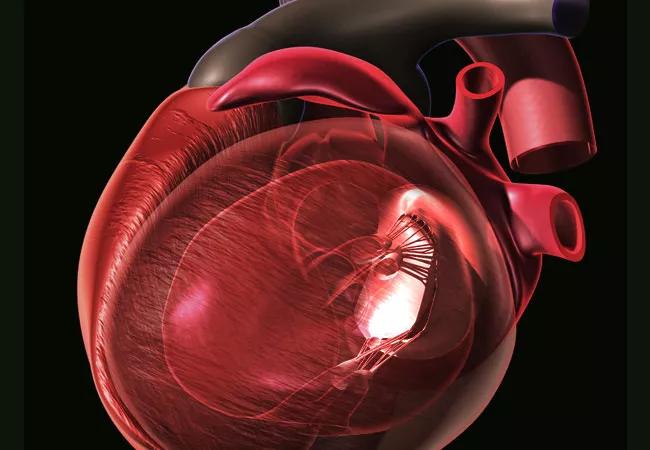
Image content: This image is available to view online.
View image online (https://assets.clevelandclinic.org/transform/d95ca36b-a3d2-476e-a155-265547c8153a/18-HRT-4696-Mitral-Valve-CME-003_jpg)
18-HRT-4696-Mitral-Valve-CME (003)
For many complex and challenging areas of practice, nothing teaches as well as a good case. That’s the philosophy behind Mastering the Mitral Valve: A Case-Based Approach, a Cleveland Clinic-sponsored live CME event to be held in New York City from Friday, Nov. 30, to midday Saturday, Dec. 1, 2018.
Advertisement
Cleveland Clinic is a non-profit academic medical center. Advertising on our site helps support our mission. We do not endorse non-Cleveland Clinic products or services. Policy
Cases will serve as the window into mitral valve management, with two of the six sessions in the day-and-a-half course devoted solely to challenging cases and with case studies figuring prominently in each of the four other sessions. All sessions consist of highly focused presentations or Q&As no longer than 15 or 20 minutes.
The case-based emphasis is a new wrinkle in this second annual offering of the course, which will again be held at JW Marriott Essex House New York, adjacent to Central Park.
“We’re building on last year’s popular inaugural ‘Mastering the Mitral Valve’ course with this increased focus on case-based learning, which will enhance its relevance to cardiologists and engage participants in discussions and debates around clinical decision-making,” explains course co-director Brian Griffin, MD, Section Head of Cardiovascular Imaging at Cleveland Clinic.
“Management of mitral valve disease can be challenging and complex,” adds co-director A. Marc Gillinov, MD, Cleveland Clinic’s Chair of Thoracic and Cardiovascular Surgery. “Questions abound: Which imaging modality — MRI or stress echo? When to refer a patient to surgery? What type of surgery — repair or replacement? This course will address each of these issues and provide answers to help attendees optimize patient care.”
The program starts with a stage-setting session that provides a contemporary framework for approaching mitral valve disease by reviewing current guidelines and controversies, key recent papers and the role of the valve center in patient management.
Advertisement
Next comes a session devoted to imaging the mitral valve, from basic echo to advanced techniques, followed by a session on mitral valve surgery and surgical decision-making. Each uses abundant case studies to bring real-world applications to bear or to discuss strategies for managing important issues often related to degenerative mitral valves, such as tricuspid repair or atrial fibrillation ablation.
Then come the two sessions on challenging cases. Here’s a sampling of the 14 scenarios to be explored:
The course concludes with a session devoted to emerging transcatheter mitral and tricuspid valve technologies, again illustrated with case studies.
A particular highlight is a Friday discussion session, “The History of the Mitral Valve,” with American Association for Thoracic Surgery (AATS) President David Adams, MD, Chair of the Department of Cardiovascular Surgery at the Icahn School of Medicine at Mount Sinai. Dr. Adam’s discussion of the topic will be moderated by Cleveland Clinic Heart & Vascular Institute Chair Lars Svensson, MD, PhD.
Dr. Adams will be one of four renowned specialists from leading U.S. institutions joining 14 Cleveland Clinic experts in cardiology, cardiothoracic surgery, interventional cardiology and cardiothoracic anesthesiology to make up the course’s faculty. The program is designed for cardiothoracic surgeons, cardiologists, interventional cardiologists, internists, physician assistants and nurses.
Advertisement
“Optimal treatment of mitral valve disease requires a multidisciplinary, team-based approach,” says Cleveland Clinic Cardiovascular Medicine Chair Steven Nissen, MD. “This course focuses on the Cleveland Clinic approach, which involves close collaboration between imaging specialists and surgeons to select the right patients, the optimal timing and the best surgical option.”
“At Cleveland Clinic we’ve devoted much effort to achieving the highest quality in mitral valve surgery, including with the aid of robotic surgery,” adds Dr. Svensson, another co-director of the course. “Those efforts have yielded unequaled outcomes. In the latest Adult Cardiac Surgery Database analysis from the Society of Thoracic Surgeons, for the period January 2015-December 2017, Cleveland Clinic achieved the maximum three-star rating in all five categories, including the two newly reported categories of mitral valve repair and replacement surgery with or without coronary artery bypass surgery. Only two out of 1,012 database participants achieved these results. We believe it’s important for Cleveland Clinic to share with the wider cardiovascular community the lessons we’ve learned for enhancing the care of patients with mitral valve disease.”
For more course information, including agenda and registration details, visit ccfcme.org/mitralmasters. Early-bird registration rates end Oct. 1.
This activity has been approved for AMA PRA Category 1 credit™.
Advertisement
Advertisement
A sampling of outcome and volume data from our Heart & Vascular Institute
Concomitant AF ablation and LAA occlusion strongly endorsed during elective heart surgery

Large retrospective study supports its addition to BAV repair toolbox at expert centers

Young age, solid tumor, high uptake on PET and KRAS mutation signal risk, suggest need for lobectomy
Surprise findings argue for caution about testosterone use in men at risk for fracture
Residual AR related to severe preoperative AR increases risk of progression, need for reoperation

Findings support emphasis on markers of frailty related to, but not dependent on, age
Provides option for patients previously deemed anatomically unsuitable
 Search