Locations:





 Search
Don’t let your bulldog crush a stented renal artery
By Juan D. Garisto, MD, and Jihad Kaouk, MD
Advertisement
Cleveland Clinic is a non-profit academic medical center. Advertising on our site helps support our mission. We do not endorse non-Cleveland Clinic products or services. Policy
When partial nephrectomy is necessary in patients with previously placed endostents for narrowing of renal arteries, it is time to “call of the dogs.” These renal stents are simply not strong enough to withstand bulldog clamps. Placing bulldogs on the artery can crush and occlude the renal artery, shutting it down permanently and damaging the kidney.
Instead, we dissect the artery more distally, at each segmental branch and use multiple bulldog clamps, successfully preserving the renal artery and kidney function.
This video demonstrates our surgical technique for robotic partial nephrectomy (RPN) with particular focus on vascular clamping in a patient with a complex renal mass and endovascular stent (ES) in the renal artery.
A 73-year-old man with a 10 cm left renal and associated fenestrated endograft due to endovascular aorta repair presented to our practice. After reviewing preoperative imaging, we elected to use a robot-assisted partial nephrectomy.
Major steps included hilar control, intracorporeal renal hypothermia using ice slush, distal clamping of the renal artery, excision of renal mass, and intraoperative ultrasound post-excision to confirm blood flow.
We reviewed records of three patients who underwent RPN at our institution with selective clamping of renal arteries due to previous placement of ES to better understand outcomes. Median age was 69.6 years, BMI was 31.3, and mean eGFR was 36.6 mL/min. No cases were converted to open procedures. Perioperative outcomes of patients who underwent nephron-sparing surgery (NSS) are described in Table 1.
Advertisement
Based on our review and experience, we found the following steps to be key drivers in optimizing outcomes during NSS in patients with stented renal arteries:
Partial nephrectomy in patients with renal artery stents requires distal dissection of the renal artery beyond the stent. Our technique provides valuable and reproducible surgical hints and tips that will help optimize outcomes in NSS in patients with endovascular graft stents.
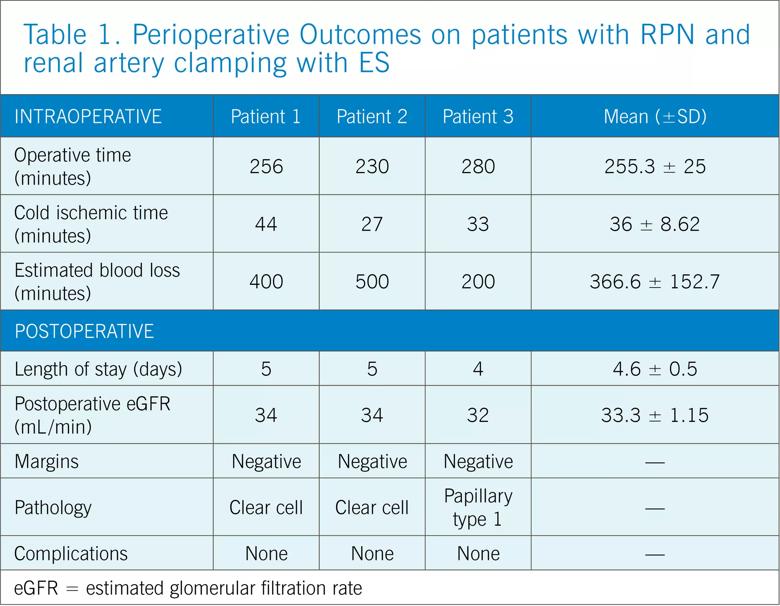
Image content: This image is available to view online.
View image online (https://assets.clevelandclinic.org/transform/66a0265b-b850-4e86-bfef-8aaffc8ac07d/805x-Inset-Managing-Stented-Renal-Arteries-Chart_jpg)
Video content: This video is available to watch online.
View video online (https://www.youtube.com/embed/HDov7qxfezc?feature=oembed)
Advertisement
Advertisement

Clinicians should individualize dosing practices based on patient risk factors and preferences
Pioneering and refining the approach in pyeloplasty, nephrectomy and more
Fully-automated process uses preop CT, baseline GFR to estimate post-nephrectomy renal function

Could mean earlier treatment, but also could have negative effects

Unlike earlier pills, new drugs do not cause liver toxicity

Male factors play a role in about half of all infertility cases, yet men often are not evaluated
Surgeons choreograph nearly simultaneous procedures, sharing one robot between two patients

Identifying barriers in the renal genetic assessment of Black patients